Discover: The Big Dipper
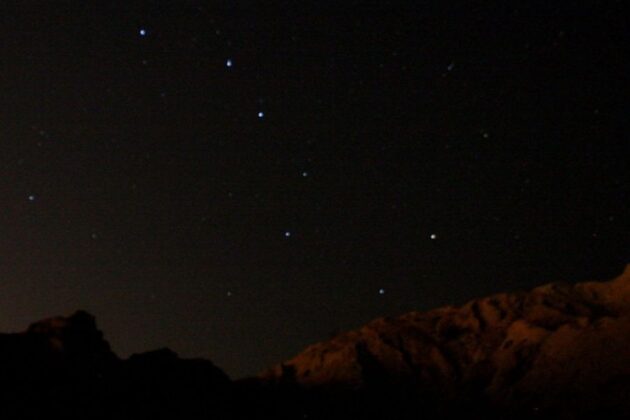
It’s night and you’re looking up into the night sky. What’s the first constellation you see? If you thought to yourself “the Big Dipper,” you’re not alone! In Western culture, it’s often one of the first things we learn to recognize in the night sky as children.
For many people in the United States, this recognizable grouping of stars represents a large spoon. Three stars make up the “handle” and four stars make up the “bowl.” But did you know that two of the stars in the bowl, known as Merak and Dubhe, can actually help you find Polaris, or the North Star?

But that’s not all! Get ready to impress your friends at parties because the Big Dipper can also help you find the star Arcturus during the spring and summer months. And if you’re lucky enough to spot Arcturus, congratulations! That means you’ve also spotted Boötes the Herdsman, as Arcturus is the brightest star in that constellation.

The Big Dipper itself is actually a part of Ursa Major, a constellation in the northern sky that borrows its name from antiquity. In Latin, Ursa Major means “the greater bear.” It is one of the 48 constellations cataloged by the Greco-Roman astronomer Ptolemy in the second century and one of the 88 modern constellations recognized by the International Astronomical Union (IAU).

Card from Urania’s mirror: or, A view of the heavens (1825), Adler Library
The Big Dipper can be found in myths, folklore, and depictions all over the globe
In Roman mythology, the Big Dipper is associated with the beautiful nymph Callisto who gave birth to the son of Jupiter (Zeus in Greek mythology). Juno (Greek Hera), the wife of Jupiter, turned Callisto into a bear out of jealousy as to punish Callisto and take away her beauty. In one version of the story, Callisto would come across her child all grown up many years later. Just as her son was about to slay his own mother, Jupiter would appear and avert the situation by placing them both amongst the stars.
In Arabian lore, the Big Dipper is associated with funerals. The bowl represents a coffin and the three stars in the handle are mourners following behind it.
Stories in some Native American groups saw the stars in the bowl of the Big Dipper as a bear, while the stars in the handle are hunters chasing it. Alternatively, the handle is interpreted as the tail of the bear and the bowl is part of the hindquarters.

The pattern of stars that forms the Great Bear is depicted as St. Peter’s Boat in this map from Julius Schiller’s Coelum stellatum Christianum (1627), where he tried to Christianize the constellations that Europeans inherited from Mesopotamia and Ancient Greece, and which had also been adopted by Islamic astronomers.
If you look carefully, you will be able to see the Big Dipper on the upper right side of the boat, with the Pointers just next to the mast (also in this case, the positions of the stars are reversed, as if seen on the surface of a celestial globe). Schiller’s constellations failed to gain any footing, but besides their impressive artistry, they are also a reminder that the night sky is open to everyone’s imagination!
Searching for the Big Dipper
So, how do you see the Big Dipper in a place like Chicago? Easy! First, refer to this phrase: spring up and fall down. Similar to the way “spring forward, fall back” helps us remember which way to turn our clocks during daylight savings time, “spring up and fall down” tells us where to find the Big Dipper in the sky each night. As you might guess, during the spring months, you’ll catch it high in the sky. And during the fall, you’ll find it low, close to the horizon. (Note that even when the Big Dipper is close to the horizon it will never fully go beyond, so you’ll be able to find it at any time of night!)
Next time you step outside to #LookUp at the Big Dipper, think about its fascinating and culturally rich significance in our night sky. Then remember that people all over the world are also looking up at this same grouping of stars and telling their own stories about what it means to them.
Header Image Credit: slworking2 on VisualHunt.com / CC BY-NC-SA
- Subjects:
- Skywatching
- Space History
Read more from our blog
Understanding Chicagohenge
The Chicagohenge is a bi-annual event where the cosmos and architecture harmoniously align. Learn about the science behind it all!

Meet Apollo 11 Spacesuit Designer Bob Davidson
Bob Davidson, a fresh-faced college graduate, ready for a challenge, made history joining the team at NASA designing the Apollo 11 astronaut spacesuit.