Meet Apollo 11 Spacesuit Designer Bob Davidson
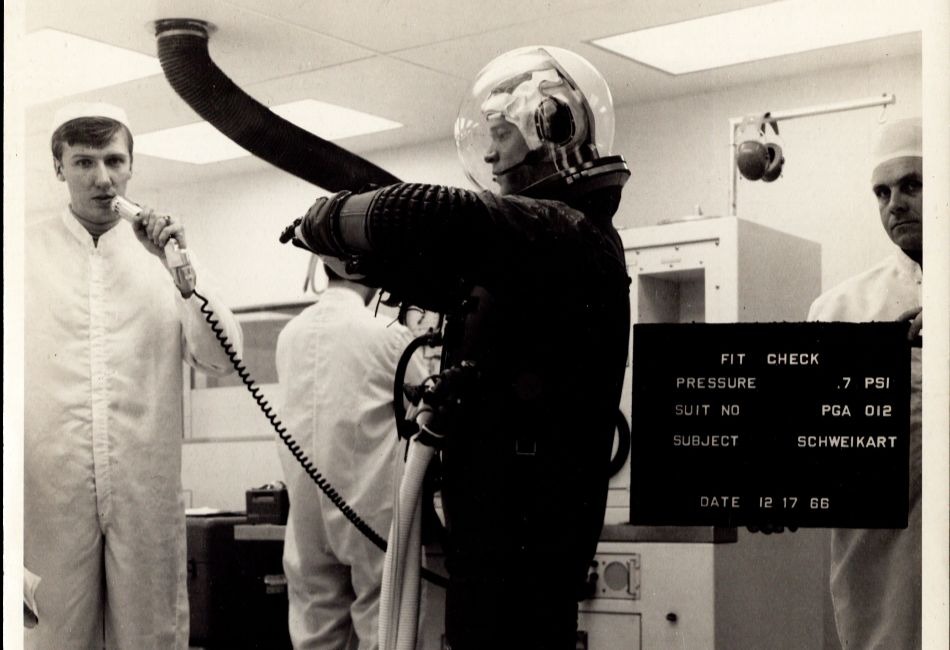
Image Caption: Bob Davidson, shown on the left of the image holding a microphone, is seen conducting a spacesuit fit check with Astronaut Rusty Schweikart on December 17, 1966.
Editor’s Note: This blog was originally published in 2019, and has been updated.
Imagine you are called into a meeting about a job. The job is completely different from any job you’ve ever had. It’s not an anxiety dream—this is really happening!—so you do what any responsible person would do: You tell the other people in the meeting you have no idea how to do this job.
To your surprise, they don’t seem concerned.
That’s okay, they say. Neither do we.
That’s more or less exactly what happened to Bob Davidson in 1962, not long after President John F. Kennedy, Jr., had announced that the United States would send people to the Moon before the end of that decade. Well, “announced” is a strong word. President Kennedy had said, “We choose to go to the Moon” into a microphone, but he couldn’t have been certain it would happen—let alone by the end of the decade—because it might have been impossible.
Nobody had ever done it before.
Who is Bob Davidson?
Bob Davidson was a fresh-faced college graduate, a newly minted electrical engineer. He had been working on a satellite project for NASA, but the project got cancelled and Bob got a new offer: Join a team of contractors from Playtex (The bra company? Yes, the bra company) to design and build a wearable device that could keep a person alive, comfortable, and mobile in the vacuum of space. A spacesuit. Or, as Bob prefers to think of it, a personal spacecraft.
Designing the Apollo 11 Astronaut Spacesuit
“We started with nothing,” he said, “and we had eight years.”
When Bob said “nothing,” he really meant it. At the beginning of the project, the team had no technical specifications to work with. They had only the most basic information about the environment on the Moon (less gravity, more extreme temperatures), and no real sense of direction. All they knew was that their work had to be done—and done perfectly—in time for the Apollo 11 launch. They were under an incredible amount of pressure to succeed, but Bob said the team didn’t really feel it.
”It was not pressure,” he said. “It was motivation. We’re gonna do it. We’re a team.”
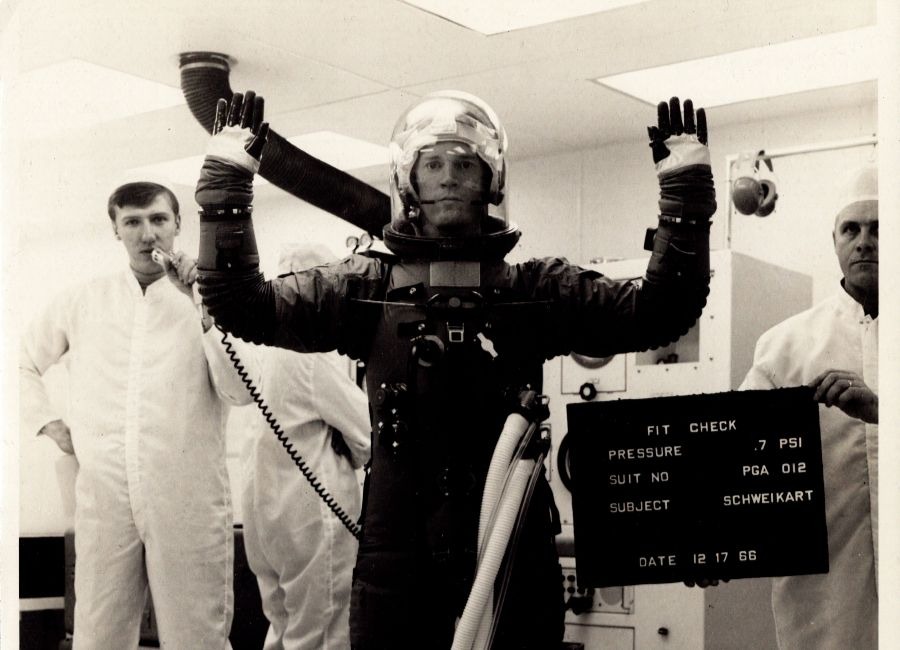
A few colleagues and I had the privilege of talking with Bob about his work on the Apollo 11 spacesuit design team. Even now, he has an encyclopedic knowledge of every inch of the suit.
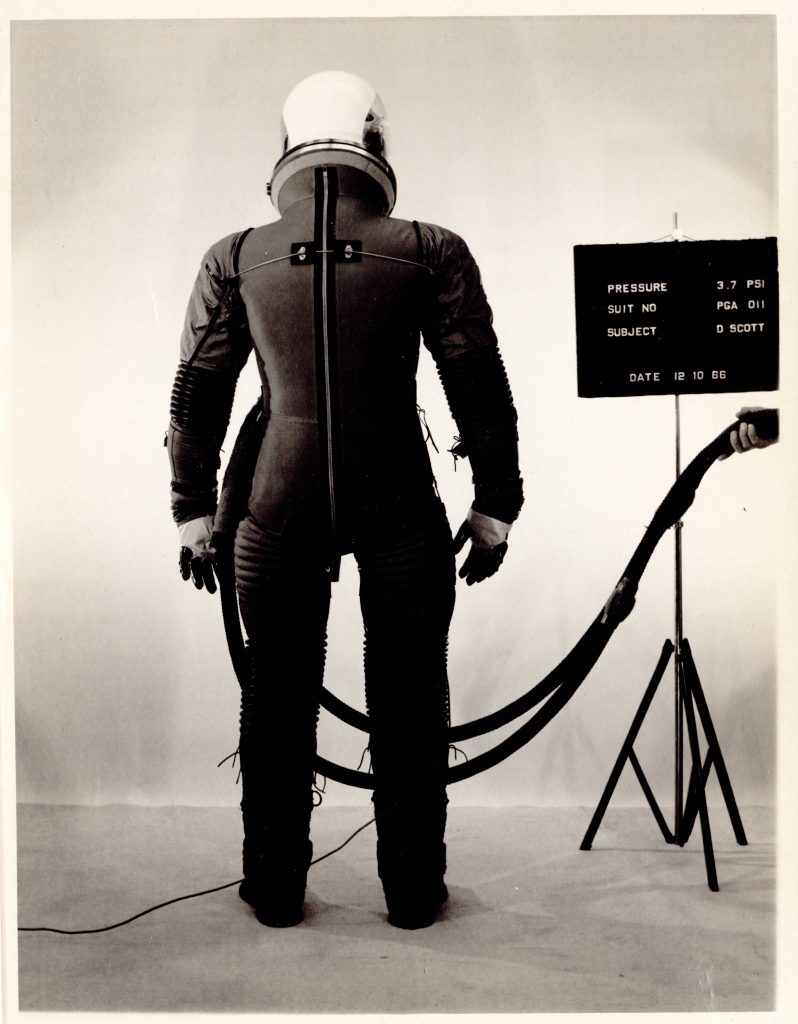
The ventilation system that kept astronauts from breathing in their own hair and skin cells. The way the zipper had to be designed to seal under pressure—two zippers, actually. The first one took the stress off the second. The connector tubes to the backpack, the urine port on the right knee, the urine bag, the buffer tubes, the draining bag. (“We had to test this stuff, by the way,” he said.) There was even a cargo pocket in case the astronauts only had time to grab a handful of rocks and run.
Lessons From Designing a Spacesuit
As Bob shared his story with us, there were many striking things about him. But aside from his deep knowledge, sharp memory, and memorable mustache, the thing that stuck with me was his optimistic (but also pragmatic) outlook on the human capacity to solve big, difficult problems—when we work together.
“If we as a nation have an issue, we have a problem, just look how John Kennedy did it. Use him as an example,” he said. “Get everybody to buy in.”
As a nation and as a species, we have different problems now than we had in the 1960s, like all the looming disasters that climate change may bring. But Bob is convinced that if everyone buys in, we can succeed in ways that will surprise us.
“The benefits that come out of it will be tenfold than just improving the environment. The benefits that spill out of it and come back to the commercial sectors—things we never thought we could develop, industries that become major industries,” he said.
“Everybody is gonna benefit from this.”
Speaking as a person who has a LOT of anxiety dreams, this is the part of Bob’s story that inspired me most: the way the team didn’t fritter away its time worrying about the immensity of the project, what might go wrong, all the ways they might have failed. It gave me a new appreciation for what people could accomplish together if our starting assumption was less “It’s impossible. We’re doomed” and more “We’re gonna do it. We’re a team.”
Learn More About Apollo 11
Inspired by Bob Davidson? Explore Apollo 11’s mission to the Moon by taking a look at “A Giant Leap for Mankind,” a digital collection made in partnership with NASA, the U.S. National Archives, Smithsonian’s Air and Space Museum, and more.