What Are Gravitational Waves: A New Window Into The Universe
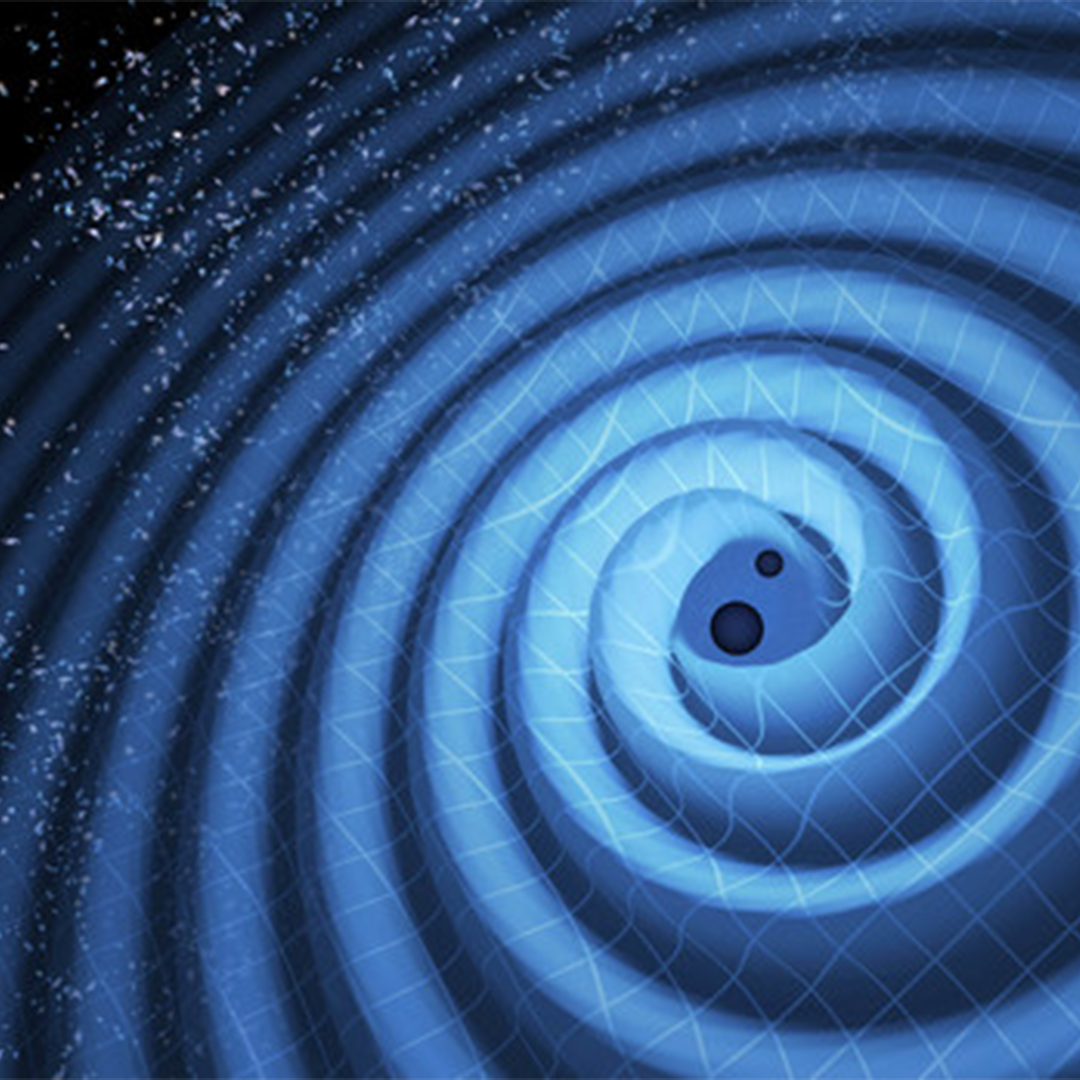
Header image: Illustration of gravitational waves after a merger of two black holes. Gravitational waves ripple outward as the black holes spiral toward each other. Image credit: LIGO/T. Pyle
Written by The Adler Planetarium’s Astronomer, Dr. Michael Zevin.
Humanity’s understanding of the universe has evolved in parallel with new methods of observing the cosmos. Our ancient ancestors tracked and cataloged the motion of heavenly bodies, and by the early 17th century, the invention of the telescope allowed us to observe dimmer, more distant objects. In the 19th century, we began relying on astronomical photography—which allows us to expose images of the universe for longer periods of time—and astronomical spectroscopy—which breaks apart light into its constituent colors.
By the 20th century, we could observe the universe in energies and colors of light that the human eye cannot see and we finally bypassed Earth’s atmosphere by sending telescopes into space. All of these advancements have improved our understanding of the cosmos, unveiling new mysteries in the process.
What you may not realize is that there is a commonality between all of these astronomical advances. They all rely on collecting a single form of information—electromagnetic radiation, which you may know better as “light.” For almost the entire history of astronomy, light has been the sole cosmic messenger we’ve used to glean information from the vast universe beyond our solar system.
However, it is still only one form of information, one sense that we can collect information with. What could we learn if we were able to collect information using other senses? Rather than just seeing the universe, what else would we discover if we could hear or feel it?
What Are Gravitational Waves?
There are other messengers from the universe beyond just light. One of these messengers is called gravitational radiation or gravitational waves. This phenomenon was predicted by Albert Einstein over a century ago as a byproduct of his theory of general relativity.
General Relativity
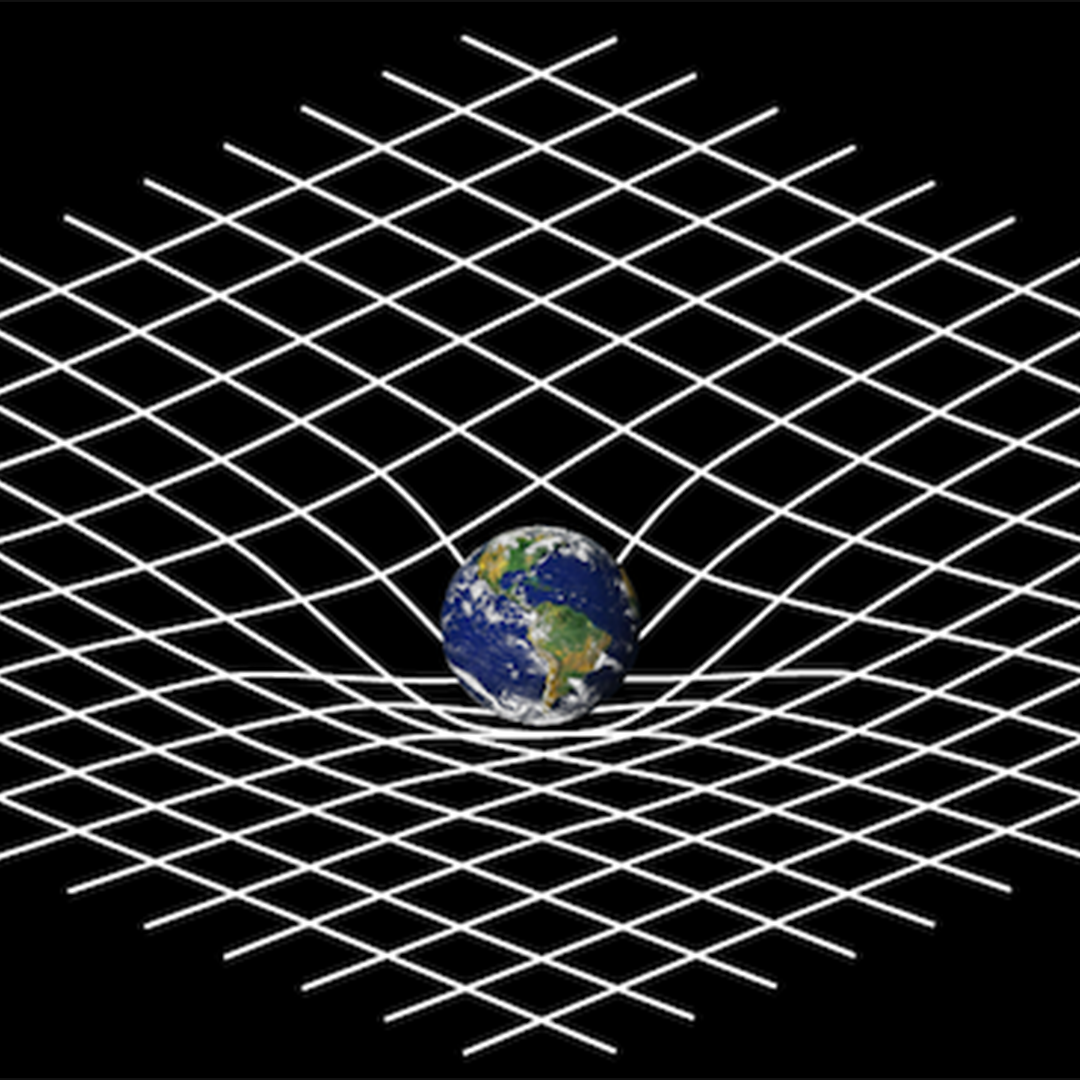
The theory of general relativity is our modern understanding of how gravity, space, and time operate in the universe. In a nutshell, it tells us that matter and energy curve the fabric of space. This curved space tells things like planets, stars, and galaxies how to move. If objects are accelerating through the malleable fabric of space, they create ripples in the fabric of space itself. These ripples are known as gravitational waves.
Gravitational waves travel at the speed of light and are completely invisible to a telescope, but provide a form of information from the universe that is completely independent from light! The direct detection of gravitational waves is analogous to hearing the sounds of the universe for the first time and can unveil unprecedented information about astrophysical objects that are notoriously difficult to study with light, such as black holes.
Observing Gravitational Waves
If gravitational waves are invisible, how can we detect them? As gravitational waves pass through space, they cause space itself—and everything within it—to expand and contract. For example, when a gravitational wave passes through our planet, it causes the equator to stretch, and the distance between the poles to squeeze, ever so slightly—and vice versa.
However, spacetime is exceptionally “stiff” and even the strongest gravitational waves have an unbelievably miniscule effect. For example, a passing gravitational wave from the collision of two black holes might stretch and squeeze the Earth by about the width of a proton, which is about a thousand trillionth of a meter. In fact, these signals are so elusive that even Einstein himself thought that we would never be able to detect them and use them to study the cosmos.
The Best Rulers Ever Built
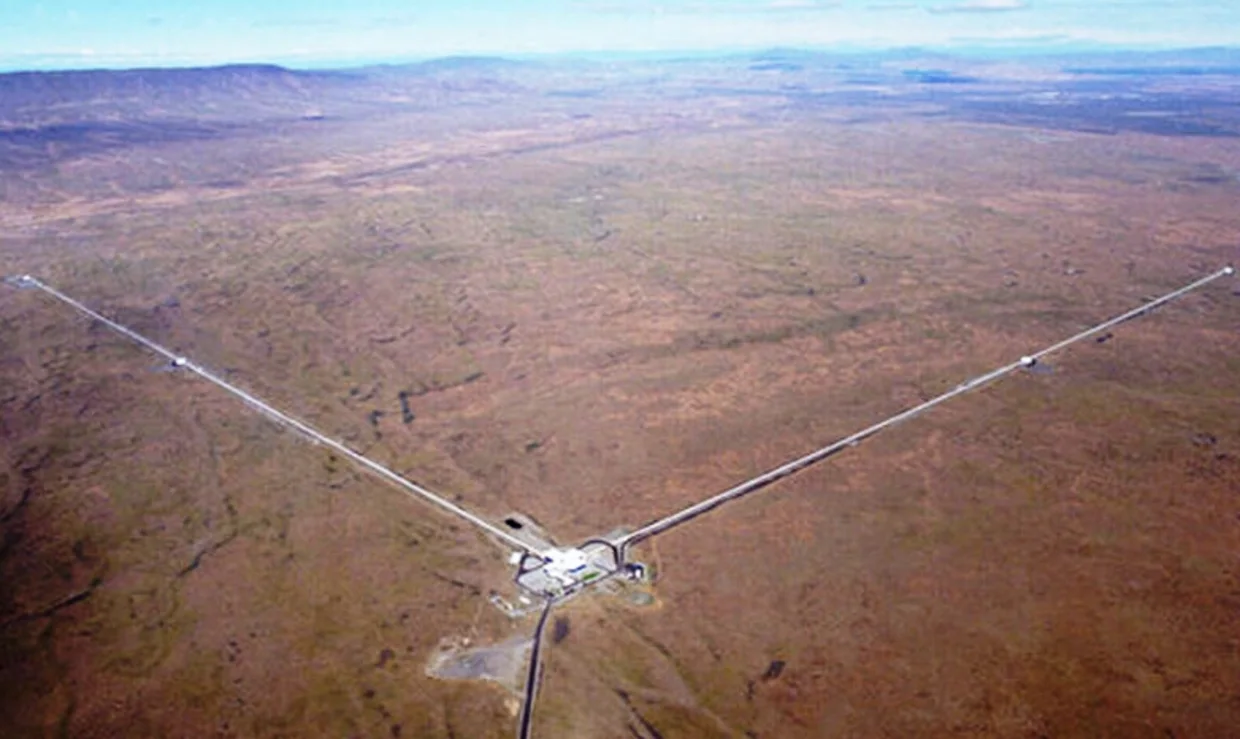
To observe gravitational waves, we use high-powered lasers that act as an incredibly precise ruler. The LIGO–Virgo–KAGRA gravitational-wave network does this with four separate detectors around the world: the twin LIGO detectors in Washington and Louisiana, the Virgo detector in Italy, and the KAGRA detector in Japan.
These detectors are giant L-shaped devices with two vacuum chamber arms that are each 2.5 miles long. The laser is sent down the two arms, bounces off mirrors at the ends of the arms, and comes back to interact with the light that went down the other arm. Because of the wave-like nature of the light in the lasers, we can detect interference when the two light beams recombine if the arms have a slight difference in length from a passing gravitational wave.
Gravitational Wave Research
The First Gravitational Wave Detected
On September 14, 2015, almost exactly a century after Einstein predicted the existence of gravitational waves, a screaming loud signal was observed in the LIGO detectors. Based on how the arms of the LIGO detectors wiggled, we could tell a lot about the system that created the gravitational-wave signal: two black holes about a billion lightyears away, each about 30 times the mass of the Sun, spiraling towards one another and merging.
This signal was one of the most monumental discoveries in modern physics, and was awarded the Nobel Prize in Physics in 2017. For the first time, we were able to hear the sounds of spacetime and use gravitational waves as a new sense to collect information from the universe!
Gravitational Wave Research Today
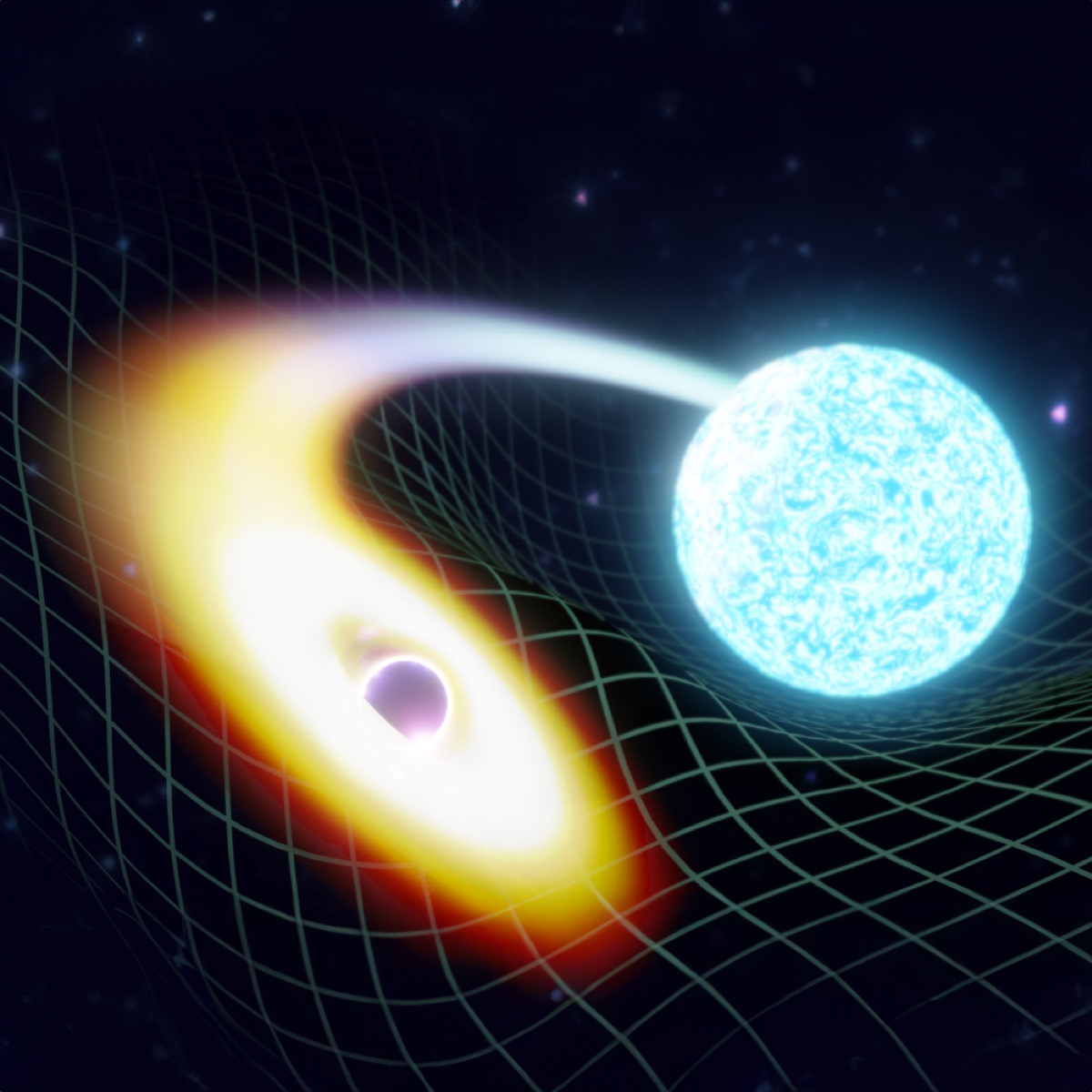
Since this discovery, the field of gravitational-wave astronomy has exploded. The last full observing run of gravitational-wave detectors completed in 2020, and at that time nearly 100 confident gravitational-wave events were observed. These didn’t just come from merging black holes; the dense remnant cores of massive stars called neutron stars were also observed in gravitational waves.
In fact, one infamous system of two merging neutron stars was observed in both electromagnetic and gravitational radiation—a “multi-messenger” event! When two neutron stars merge, they not only emit gravitational waves, but also a burst of high-energy radiation called a gamma-ray burst and an explosion powered by radioactive decay called a kilonova.
Kilonovas create a beautiful light show and are responsible for synthesizing most of the heavy elements on the periodic table (so you can thank them for generating the gold, silver, and platinum we have here on Earth).
Despite the groundbreaking gravitational-wave discoveries during the first half-decade of observations, the field of gravitational-wave astronomy is still in its nascent stages.
The network of gravitational-wave detectors turned back on for another observing run in May 2023, with hundreds more systems expected to be detected over the next few years. Expect quite a fanfare, with black holes, and neutron stars galore!
Learn More From Our Astronomers
Get more space with Adler Planetarium astronomers on our YouTube Channel! Ever wondered what dark matter actually is, or if we’re living in a simulation? Hear directly from our experts on some of the most commonly asked—and not so commonly asked—astronomy questions.