Gravitational Waves And The Search For Hierarchical Black Hole Mergers
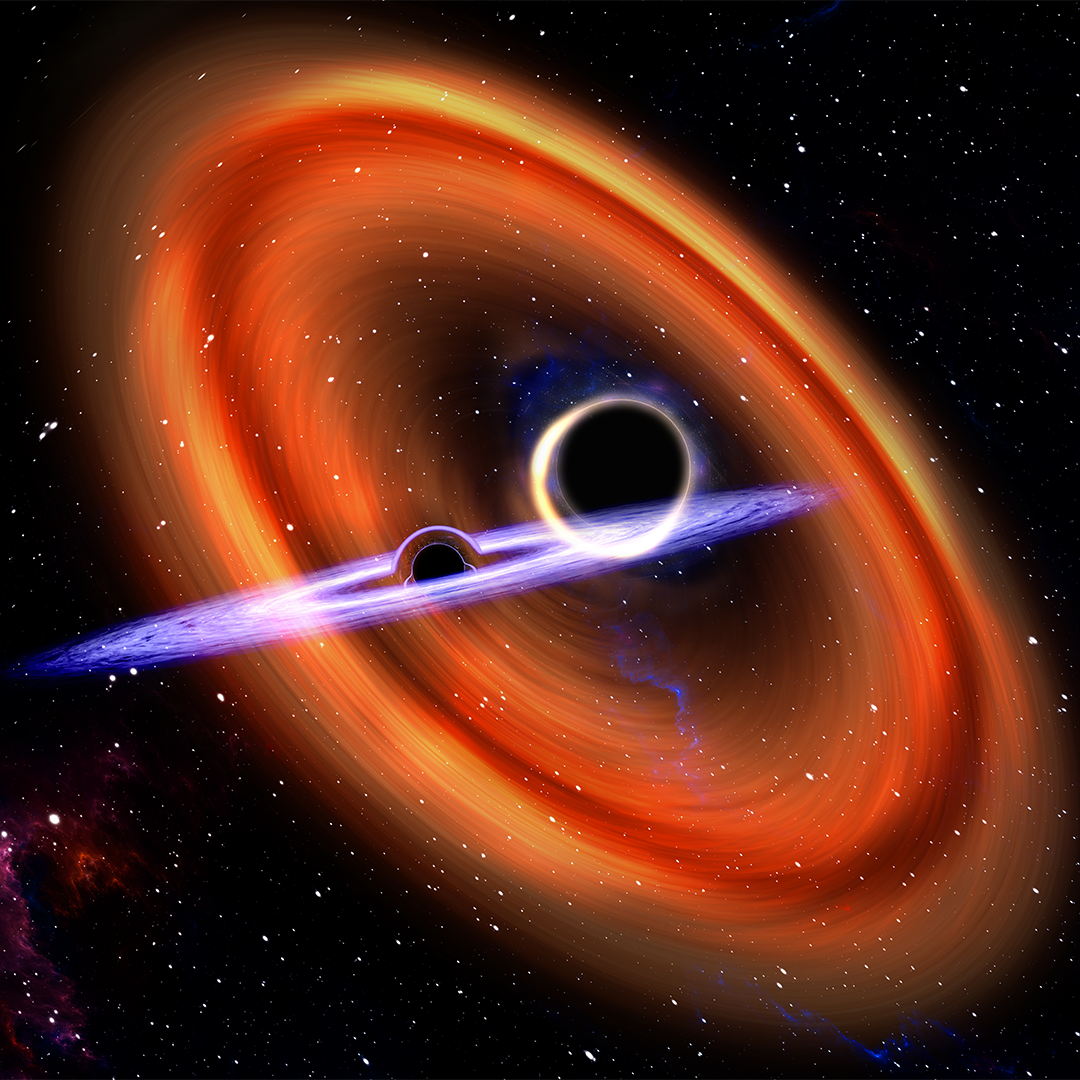
Header image: Illustration of two black holes surrounded by disks of gas and dust, spiraling toward each other as they merge. Image Credit: Carl Knox / OzGrav / Swinburne University of Technology
Written by Adler Planetarium Astronomer, Dr. Shanika Galaudage
Gravitational waves are ripples in spacetime created by accelerating objects such as black holes and neutron stars spiraling together and merging. These waves move at the speed of light, stretching and squeezing space as they pass, bringing us information about some of the universe’s most powerful events. Since scientists first detected gravitational waves in 2015, we have gained a whole new way to explore the universe. These ripples in spacetime let us ‘hear’ the universe in a way Einstein could only dream of.
In fact, we just celebrated the 10th anniversary of the first gravitational wave detection, which earned a Nobel Prize for scientists Rainer Weiss, Kip Thorne, and Barry Barish. Their contributions to LIGO (Laser Interferometer Gravitational-Wave Observatory) changed the way we understand the universe. Sadly, we also lost Rainer Weiss in the lead-up to this historic milestone, just shy of the 10th anniversary. Weiss was a visionary, and his passing marked a somber moment for the community, but his legacy continues to shape the future of gravitational wave astronomy.
The Role Of LIGO And The NSF In Gravitational Wave Research
Discovering Gravitational Waves
The discovery of gravitational waves would not have been possible without decades of research, collaboration, and funding. The National Science Foundation (NSF) played an instrumental role in supporting the LIGO project—one of the most ambitious scientific endeavors ever undertaken. In an era where scientific funding can be uncertain, the NSF’s continued investment in this area has paid off, yielding groundbreaking results that have reshaped our understanding of the cosmos.
When gravitational-wave detectors were first being developed, many were skeptical about whether such faint, almost imperceptible signals could ever be picked up by human-made instruments. Even with really massive objects like black holes, the gravitational waves we detect would be incredibly tiny, roughly 1/10,000th the size of a proton’s diameter! But against all odds, the LIGO detectors in Hanford, Washington and Livingston, Louisiana managed to detect the first-ever gravitational wave signal, originating from the merger of two black holes!
Gravitational Wave Research Today
Since then, LIGO along with detectors around the world (Italy’s Virgo and Japan’s KAGRA) have detected hundreds of gravitational wave events! These detections have provided critical insights into the mass and spin of black holes, phenomena that were previously beyond the reach of traditional telescopes. These gravitational waves signals were produced by binary systems, where two compact objects, like black holes, orbit one another in a cosmic dance before spiraling together and merging.
Want to take a deeper dive into gravitational waves and how they’ve changed astronomy? Learn more from our astronomer and gravitational wave expert, Dr. Michael Zevin.
Meet The New Gravitational Waves: GW241011 and GW241110
The LIGO-Virgo-KAGRA collaboration recently announced the discovery of two new gravitational-wave events: GW241011 and GW241110 (GW stands for “gravitational wave” and the numbers are its discovery date). These events are strikingly similar, and not just in their names! Both of these signals were created by the merger of an unequal mass pair of black holes. And in both systems, the heavier black hole spins very rapidly. By looking at the properties of the systems, we can begin to understand how and where the systems form and evolve.
GW241011
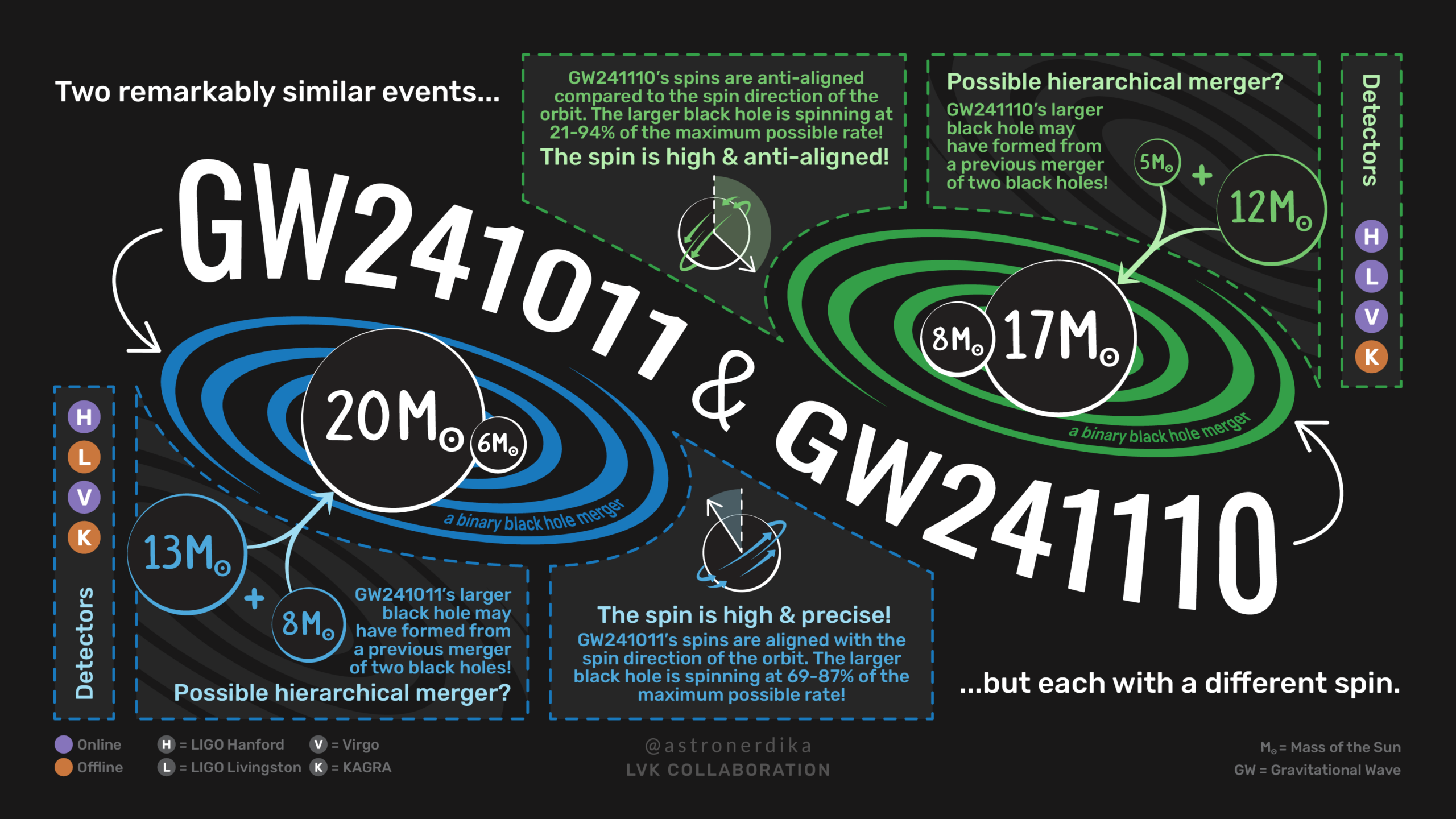
Let’s start with GW241011. Detected on October 11, 2024, this was a merger between two black holes with masses of 20 and 6 times the mass of our Sun. The spin direction of the heavier black hole was in the same direction as the pair’s orbit and spinning incredibly fast, around 69–87 percent of the maximum possible spin rate.
GW241110
GW241110, detected about a month later on November 10, 2024, showed us a slightly different scenario. The masses were in a similar range, with the black holes being 17 and 8 times the mass of the Sun. However, the spin of the more massive black hole was rotating in the opposite direction (or anti-aligned) to the orbit of the binary. The larger black hole was spinning at a similarly impressive rate of 21–94 percent of the maximum possible spin rate!
What We Learned From GW241011 and GW241110
The unequal masses, combined with high spins and anti-alignment, suggest that the larger black holes may be what we called a second-generation black hole—meaning it formed from a previous black hole merger! This process where black holes merge, and merge again is called hierarchical formation.
Check out the infographic below for a highlight of the results created by yours truly!
Hierarchical Formation: Black Holes That Merge, Then Merge Again
One intriguing detail about these events is that both GW241011 and GW241110 may have involved hierarchical mergers. But what does this mean? Essentially the larger black holes in both events could have come from the merger of smaller black holes in a previous generation rather than collapsing from stars.
Evidence Of Hierarchical Formation
But why do we suspect hierarchical formation? In both events, the more massive black holes have very fast spins, the systems have unequal masses, and in one of the cases, we have a black hole that is anti-aligned. These are features that are hard to explain if the black hole were born together from a pair of massive stars in isolation.
When black holes merge, the resulting black hole has both the spin of the previous black holes as well as the spin from the orbital notion as well. Therefore black holes that have formed from black hole mergers are larger but also have higher spins. If you have black holes that are randomly meeting each other in a dense star cluster, their spin tilts don’t necessarily have to be aligned with respect to the binary orbit. In contrast, black holes that form in isolated binary star systems—also known as the galactic field—tend to have similar masses and aligned spins tilts.
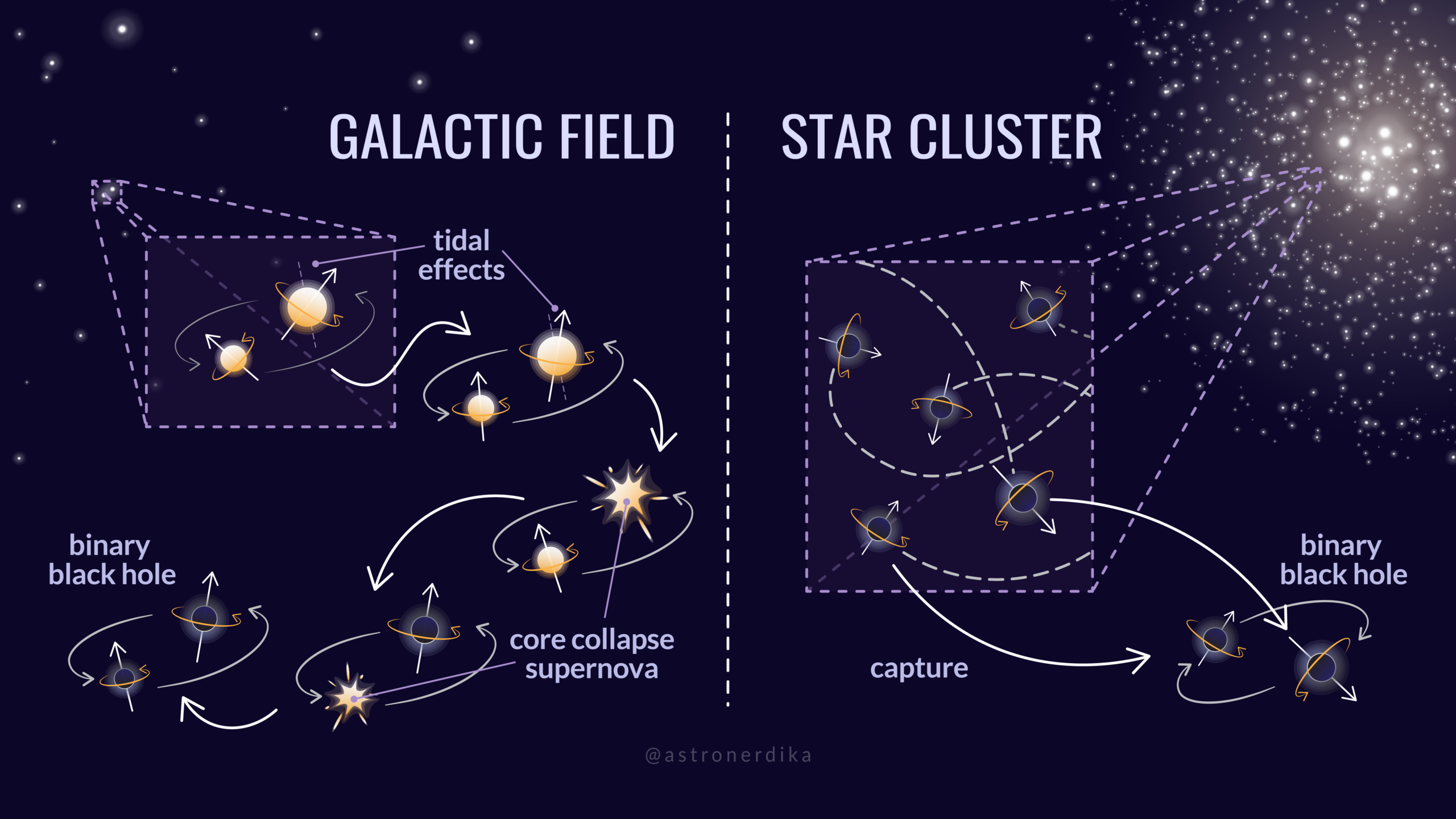
This is why scientists think that hierarchical mergers happen in dense stellar environments like globular clusters or nuclear star clusters, because this is where black holes can frequently interact, pair up, merge, and merge again sometimes. In the galactic field, stars and black holes are so spaced far apart that repeated encounters are pretty much impossible.
While the hierarchical formation scenario seems like the best explanation for these events, we cannot rule out other formation scenarios, and this is a big area of research in the field. Researchers at the Adler, such as myself and Dr. Michael Zevin, are interested in investigating and understanding just how these black hole systems form and evolve.
A New Era For Gravitational Wave Research
The field of gravitational wave astronomy has come a long way in just 10 years! The ability to detect these signals has opened up an entirely new window into the universe. As our detectors improve, and we refine our technology, the field will become even more exciting and improve our understanding of these colliding giants across the cosmos.
There are also plans for more gravitational wave detectors such as Cosmic Explorer and LISA (Laser Interferometer Space Antenna). Cosmic Explorer is set to be the next generation of ground-based detectors, with arms 40 km long, much longer than the current ground-based observatories, which have arms just a few kilometers long. LISA will be a space-based detector with an arm-length of 2.5 million kilometers! It will also have a different configuration, a triangle shaped configuration instead of an L-shaped one.
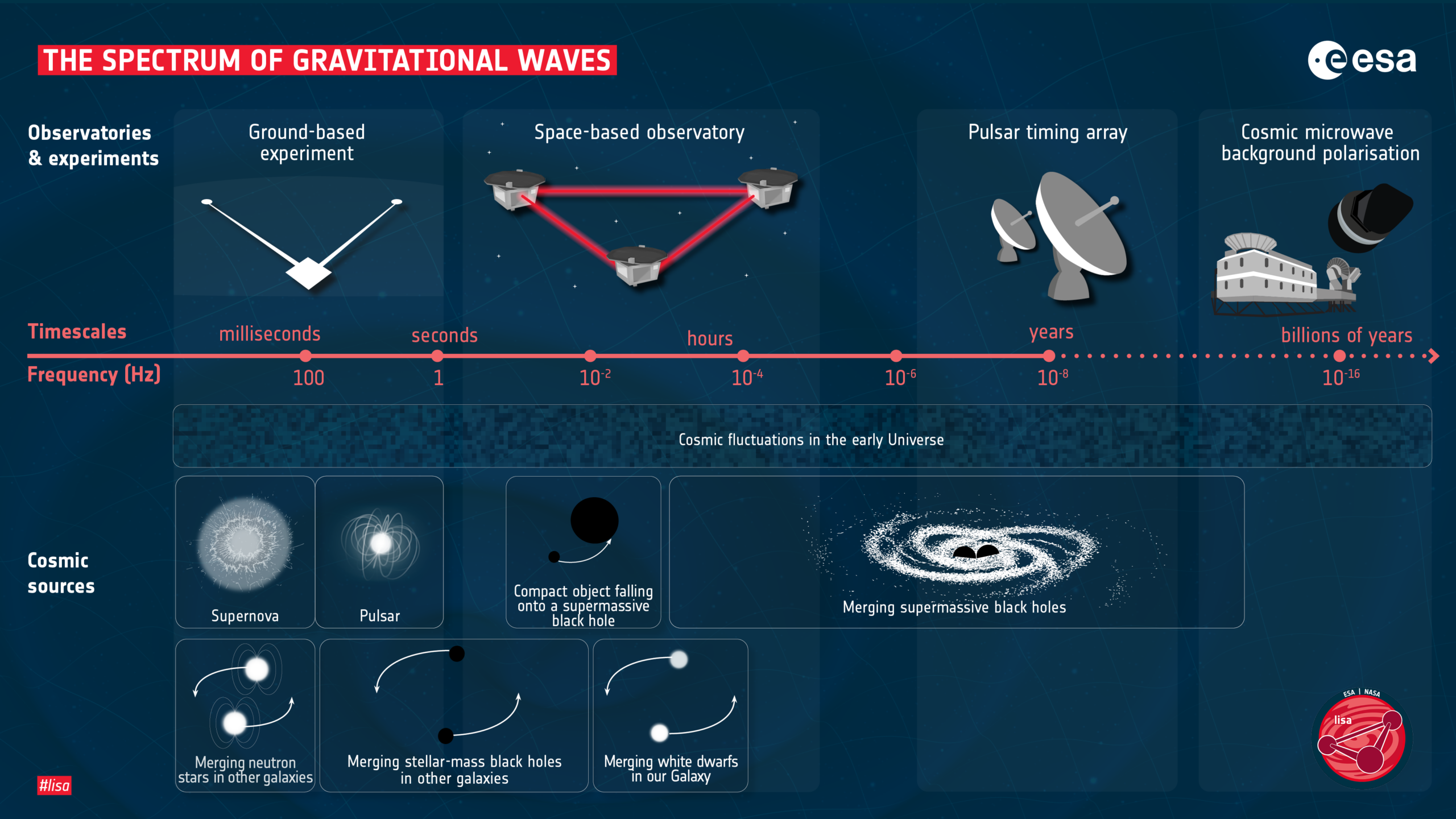
With these future detectors, we will push the boundaries even further to span a wider range of signal frequencies! We’ll be able to see larger black holes collide, and even smaller black holes plunging into supermassive black holes. We will also be able to listen to signals from deeper in the universe—maybe even from the earliest moments after the Big Bang!
As we celebrate these achievements, it’s also important to remember that continued funding will be crucial for sustaining the progress in gravitational wave research. With ongoing shifts in priorities funding astronomy, the future of gravitational wave research will face some challenges, but as long as scientists and the public alike are keen for these discoveries to continue, the future will remain bright AND loud in astronomy.
Learn More From Our Astronomers
Get more space with Adler Planetarium astronomers on our YouTube Channel! Ever wondered what dark matter actually is, or if we’re living in a simulation? Hear directly from our experts on some of the most commonly asked—and not so commonly asked—astronomy questions.