A Total Lunar Eclipse
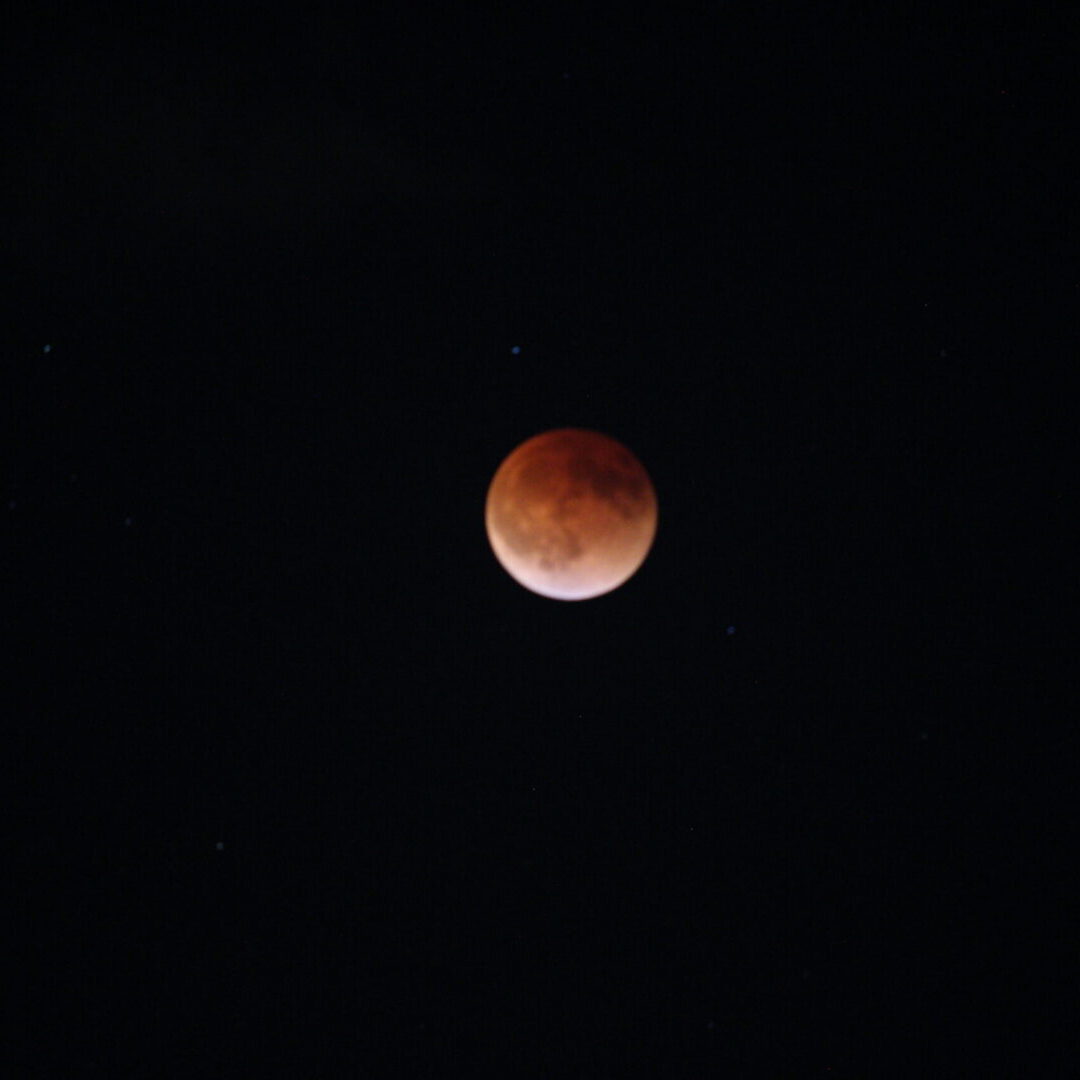
Image Caption: The March 15, 2022, lunar eclipse at totality. The full Moon appears to be brick red in color as the Earth’s shadow covers it. Image credit: Adler Planetarium
Editor’s Note: This blog was originally published in 2018 and has been updated to include relevant information about the next upcoming total lunar eclipse in 2026.
Are you getting ready for the next total lunar eclipse? If the weather is clear, lunar eclipses can be a magnificent show in the sky from start to finish. And the best part: you don’t need any special equipment to see one – just your eyes and a clear sky!
Here’s everything you need to know about lunar eclipses, and tips to see the next one.
Lunar Eclipses Explained
When the Sun’s light falls on our planet, the Earth blocks this light and casts a shadow into space. This is just like when you’re standing in the Sun—a shadow is cast behind you because YOU are blocking some of the Sun’s light! When the Moon’s orbit intersects with the Earth’s shadow, the Moon passes through the shadow, and the Moon appears to darken for a short while. We call this phenomenon a lunar eclipse.
When Do Lunar Eclipses Happen?
A lunar eclipse can only happen when the Moon is at the full Moon lunar phase. Why don’t we get a lunar eclipse at every full Moon? The Moon’s orbit doesn’t always intersect Earth’s shadow. The Moon’s orbit is tilted a bit with respect to the Earth, so as the Moon orbits Earth, usually the Moon misses the shadow, passing a bit above or below it in space. When everything lines up just right, we get a lunar eclipse.
On average, lunar eclipses only happen once or twice a year, so they are somewhat rare. Additionally, depending on your location, you may not see a lunar eclipse occur. If your spot on the Earth is not facing the Moon while the eclipse is happening, you will not see the eclipse at all. This makes spotting a lunar eclipse even more special!
Fun fact: If you were standing on the surface of the Moon during a lunar eclipse, you would see the Earth eclipse the Sun as a solar eclipse. Firefly Aerospace’s Blue Ghost Mission 1 robotic lander photographed this amazing phenomenon during the March 13-14, 2025 lunar eclipse! The Moon’s surface appeared reddish around the lander, and the craft photographed a beautiful solar eclipse.
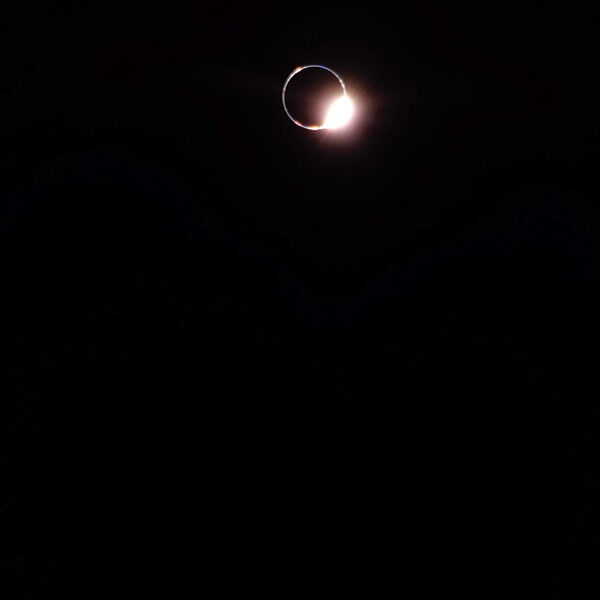
Image Caption: Captured at our landing site in the Moon’s Mare Crisium around 3:30 am CDT, the photo shows the sun about to emerge from totality behind Earth. Image credits/copyright: Firefly Aerospace
Different Types Of Lunar Eclipses
A penumbral lunar eclipse occurs when the Moon passes through the lighter, outer part of Earth’s shadow, called the penumbra. When the Moon is in this part of the shadow, it may appear a bit more tan in color, but the color change can sometimes be hard to notice at all.
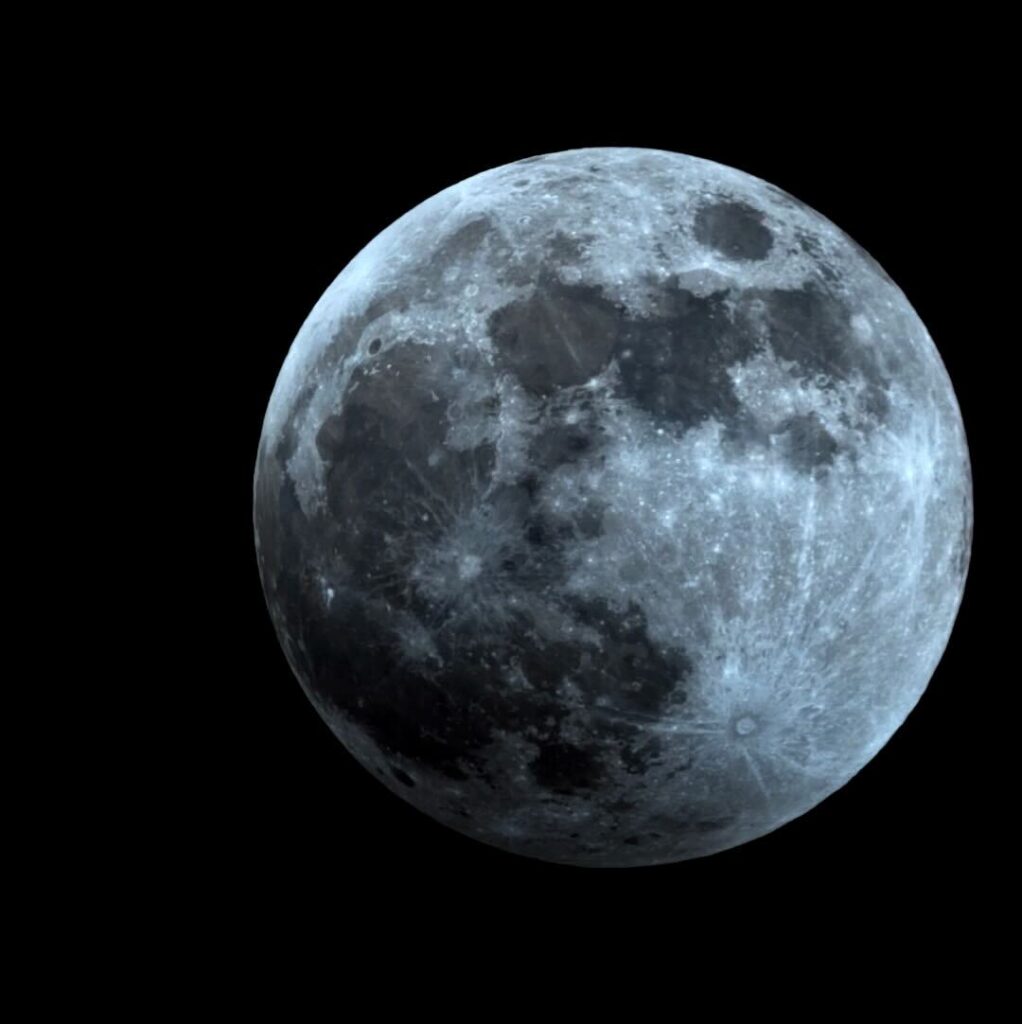
Image caption: The Moon in the Earth’s penumbral shadow during the March 13-14, 2025 lunar eclipse. The Moon shows a slight darkening on its lower-left side. Image credit: Adler Planetarium
A partial lunar eclipse occurs when some of the Moon passes into the darker, inner area of Earth’s shadow, called the umbra. At this point, the Moon looks like it has a bite taken out of it, and that bite grows progressively larger as the Moon passes further and further into the dark shadow.
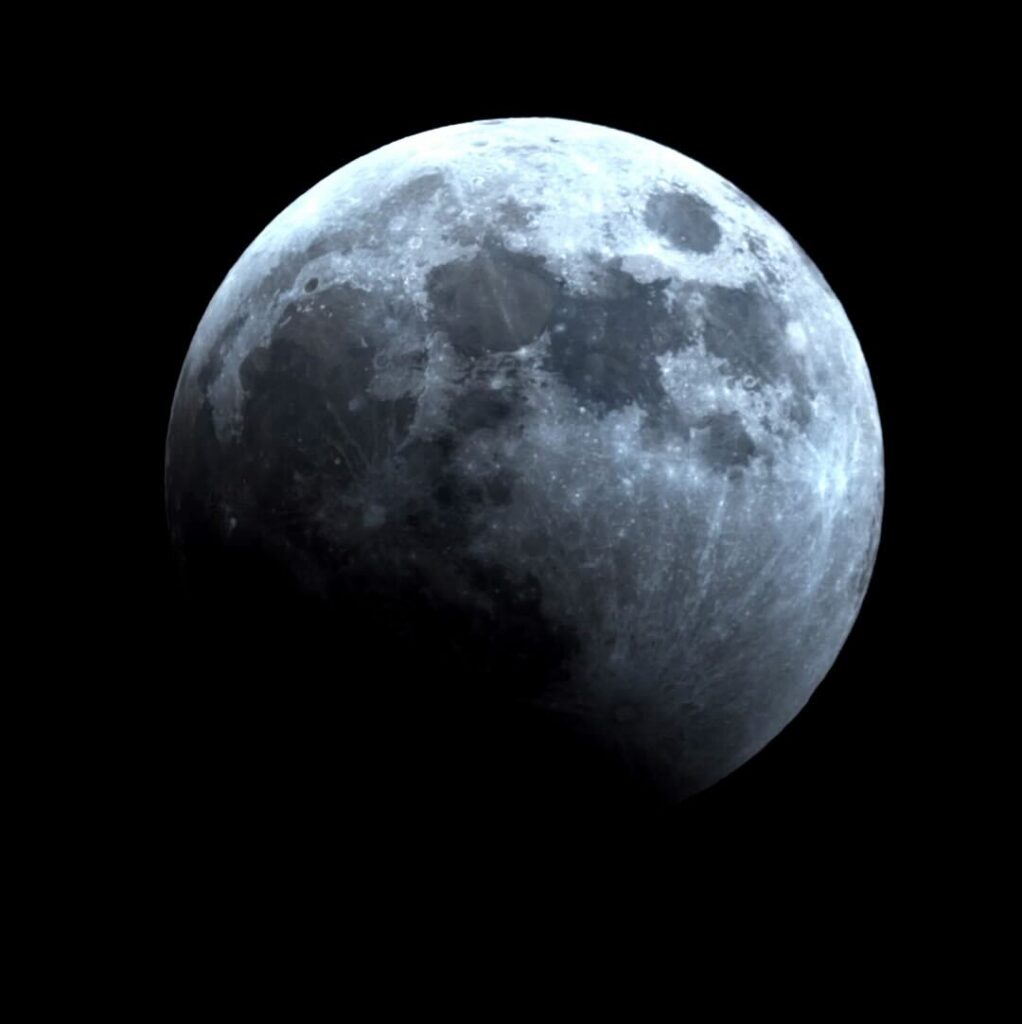
Image Caption: The partially eclipsed Moon during the March 13-14, 2025 lunar eclipse. A dark shadow covers the lower-left section of the Moon. Image credit: Adler Planetarium
A total lunar eclipse occurs when the Moon fully passes into the Earth’s umbra, the darkest central part of its shadow. Once totality begins, the Moon can appear reddish, gray, or even orange.
Not all lunar eclipses are total eclipses. The Moon’s orbit may only take it through part of the Earth’s shadow, never passing completely into the Earth’s umbra shadow. Some lunar eclipses are just penumbral eclipses, and some are just partial lunar eclipses.
Why Does The Moon Change Color During A Total Lunar Eclipse?
The color of the Moon during totality is due to sunlight passing through the atmosphere all around the edge of the Earth. Our atmosphere scatters away the bluer rays of the Sun’s light, and the redder wavelengths of light pass through and into the Earth’s shadow. You can also see this effect right before sunset: at that moment, sunlight is passing through a lot of air near the horizon, scattering the blue wavelengths and leaving the Sun’s redder wavelengths which makes the Sun appear orange or red.
Think of a lunar eclipse as showing you the color of the collective sunrises and sunsets happening around the entire edge of the Earth at that exact moment. Pretty cool, right?
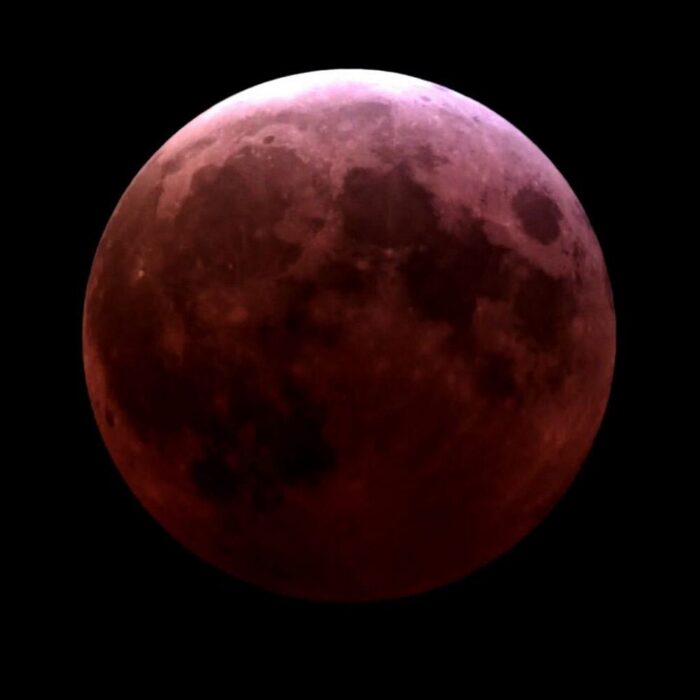
Image Caption: The March 13-14, 2025 lunar eclipse at totality. The full Moon appears to be a dark brick red as the Earth’s shadow covers it. Image credit: Adler Planetarium
The color of the Moon during totality is often different from one lunar eclipse to the next. This depends on whether the air the sunlight is passing through at that moment is dusty, clear, or cloudy, if there has been a sandstorm, or if there has been a recent volcanic eruption. The quality and clarity of Earth’s atmosphere affects the color of a total lunar eclipse. Sometimes during a total lunar eclipse, the Moon might appear light or dark red, orange, or even light or dark gray. That’s part of the fun of total lunar eclipses—we don’t know what the color of the Moon will be until the eclipse happens! The lunar eclipses in November 2021 and November 2022 were both dark brick-red in color. One Adler Planetarium staff member described the color of the March 13-14, 2025 total lunar eclipse as “a cinnamon-dusted cranberry.”
What Is A Blood Moon?
Blood Moon is an informal term used to refer to a total lunar eclipse, but it is not technically an astronomical or scientific term.
The phrase’s usage has grown in popularity, and these days, blood Moon and lunar eclipse are often used interchangeably. People use the phrase blood Moon because the Moon might appear the color of blood during the totality phase of a lunar eclipse.
Blood Moons aren’t your thing? Learn about Supermoons.
Solar And Lunar Eclipses Come In Pairs
Solar eclipses and lunar eclipses are extremely intertwined. If the Moon’s orbit is lined up with Earth to cause a lunar eclipse, it is also lined up with Earth for a partial or total solar eclipse, either about two weeks before or two weeks after the lunar eclipse.
The type of lunar eclipse will depend on which part of the Earth’s shadow the Moon encounters, and the type of solar eclipse will depend on how much of the Sun is covered as seen from the Earth. However, both eclipses may not be visible to the same parts of Earth, and both eclipses may not be total. For example, the lunar eclipse in early March 2026 has a corresponding solar eclipse in late February 2026, but that solar eclipse is only visible to viewers in Antarctica, the far southern tip of South America, and far southeast Africa and Madagascar.
To dive more into the explanation of both solar and lunar eclipses, check out our blog Solar Eclipses And Lunar Eclipses Explained.
When Is The Next Lunar Eclipse?
The next lunar eclipse visible from the Chicago area is early in the morning on March 3, 2026.
The Moon will be in the southwestern sky when the eclipse starts at 2:44 a.m. CST. As it appears lower and lower in our sky, the Moon begins to pass into the lighter outer part of the Earth’s shadow. The color of the Moon will start to change from bright light gray to a progressively deeper tan.
At 3:50 a.m. CST, the Moon will start to darken considerably as it begins to enter the Earth’s inner darker shadow. More and more of the Earth’s shadow will darken the Moon, making it look like an ever-increasing bite is taken out of it.
Totality, when the Moon is fully within the Earth’s umbra shadow, lasts from 5:04 a.m. CST until 6:02 a.m. CST. The Moon will be very low in the western sky at this point, so make sure you have a clear view to the western horizon. After totality is over, the Moon sets for viewers in the Chicagoland area just before 6:30 a.m. CST, so we’ll miss most of the end of the eclipse.
Can I See The Total Lunar Eclipse From My Location?
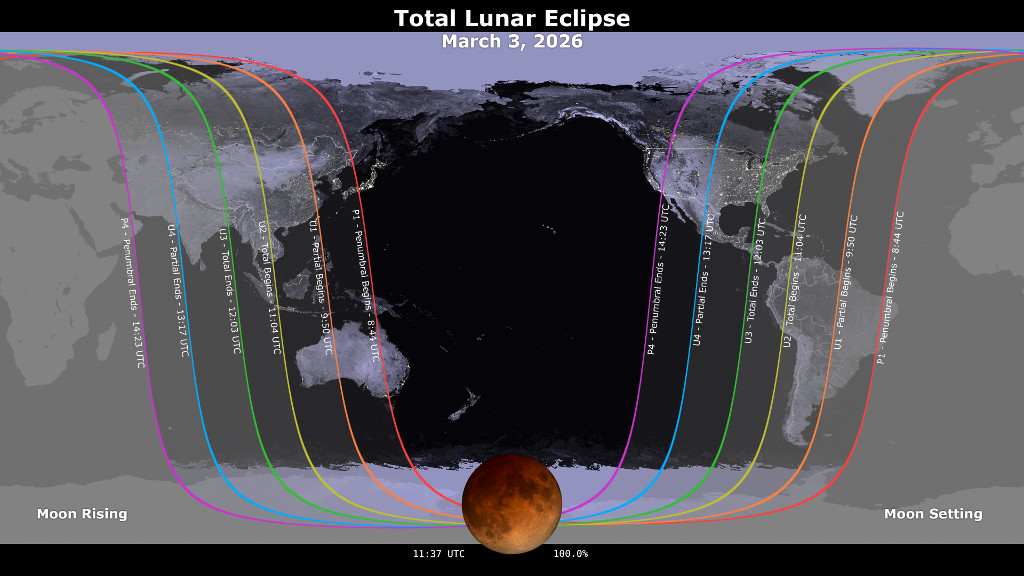
Each eclipse has different visibility and timing depending on your location. To see the lunar eclipse visibility map and the eclipse timing for the March 2026 lunar eclipse, check out Time and Date’s total lunar eclipse interactive map.
Please note that for some areas, the eclipse starts when it is still the late evening on March 2, so be sure to check your exact local timing for your location.
Tips For Viewing A Lunar Eclipse
If it is clear out and you are away from tall buildings and trees, you should have no trouble spotting the eclipse, at least at the beginning of it, for viewers in the Chicago area. As the Moon moves lower toward the western horizon, it will be harder to see due to local obstructions. Near the end of totality, the Moon will be extremely low in the sky and more difficult to see.
Here are a few more tips to make your viewing spectacular:
- Check the weather beforehand and dress appropriately. Lunar eclipses usually take several hours from start to finish.
- Double-check the time of each lunar eclipse phase in your time zone leading up to totality. The timing to view a lunar eclipse depends on your time zone at the moment when the Moon passes through the Earth’s shadow.
- Don’t stress about needing a telescope or binoculars—you don’t need any special equipment to see a lunar eclipse. If you can see the Moon with just your eyes at any other time, you can see a darker version of the Moon with just your eyes.
If it isn’t clear out in your location, you can watch a live broadcast of the lunar eclipse on the Time and Date website.
Our Astronomy Educators Explain Lunar Eclipses
Learn about what happens during a lunar eclipse and watch as the Moon passes through the Earth’s shadow during a previous total lunar eclipse in a prior episode of Sky Observers Hangout.
This episode was streamed live from the campus of Southern Illinois University Carbondale on March 14, 2025.