
Don't miss your chance to return to the Moon. Please purchase tickets online and in advance of your visit.
What Is Artemis II? Launch Date, Crew, And NASA’s Next Moon Mission Explained
Header Image: The full Moon rises behind NASA’s Artemis II Space Launch System (SLS) rocket and Orion spacecraft, Sunday, Feb. 1, 2026, at NASA’s Kennedy Space Center in Florida. Image credit: NASA/John Kraus
This blog was originally published on February 13, 2026, and was updated on February 23 and April 1, 2026 with the most up-to-date information on the launch of NASA’s Artemis II mission.
We’ll continue updating this blog with the latest news on the Artemis II mission, so check back soon or subscribe to our newsletter to get the latest space updates straight to your inbox.
Earth’s Moon has captivated humanity ever since our distant ancestors first looked up at it. We saw its phases with the naked eye and our earliest telescopes showed us its plains, mountains, and craters. We wondered what it was like to go there. In 1969, humanity achieved the impossible and sent humans to the Moon in the Apollo program. Over 50 years later, we’re working to go back to the Moon with the Artemis program.
A Brief History of Lunar Exploration
When the Space Age began in 1957, it did not take long before the Moon became the primary exploration target. After learning how to live in space and operate our spacecraft during the Mercury and Gemini programs, NASA’s successes in the Apollo program drew us ahead of the Soviet Union and put the United States’ science, engineering, technology, and industrial might on worldwide display.
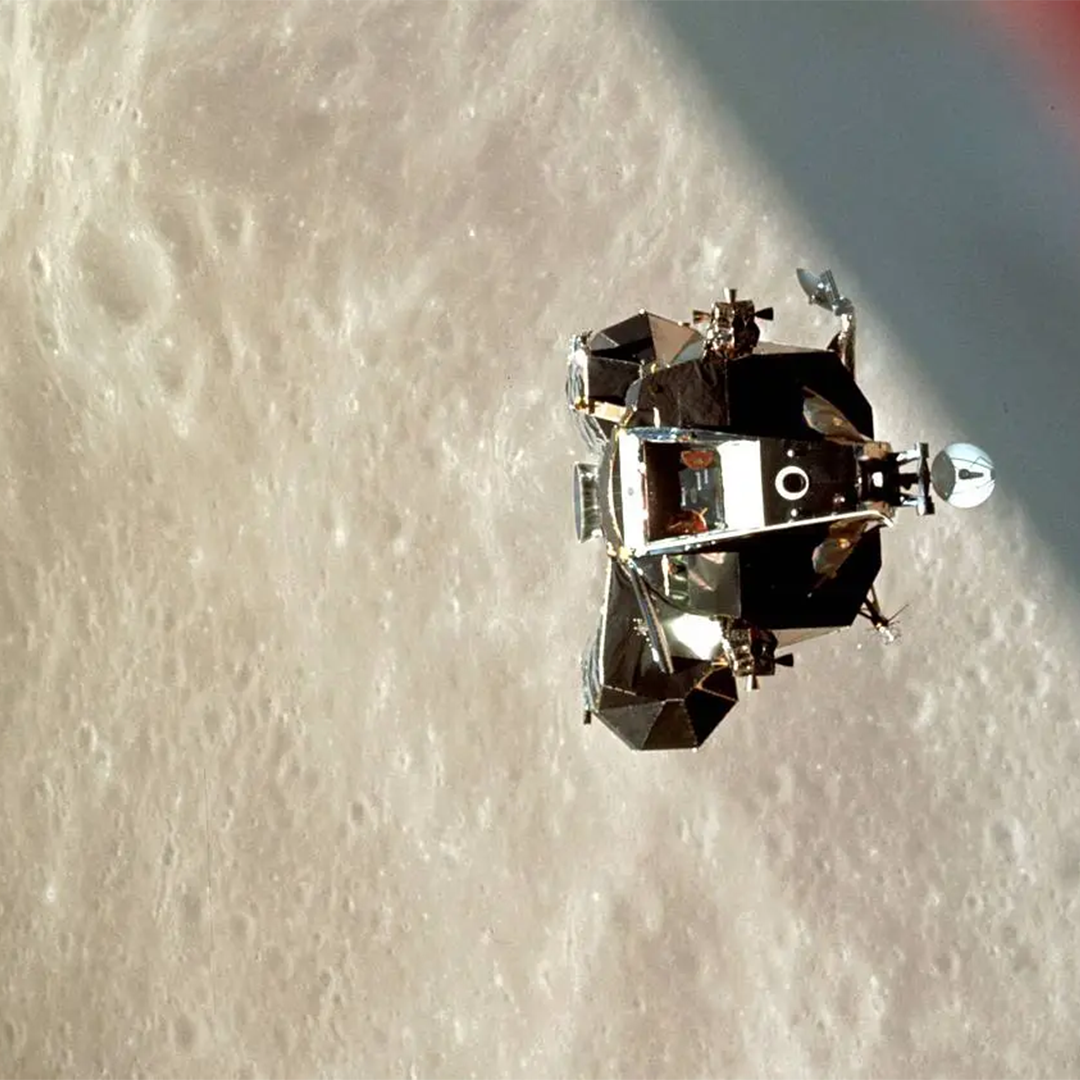
After the Apollo 7, 8, 9, and 10 test flights in Earth orbit and Moon orbit in 1968 and 1969, NASA accomplished Apollo 11’s successful Moon landing in July 1969. From 1969 to 1972, twelve astronauts walked and worked on the Moon during the Apollo 11, 12, 14, 15, 16, and 17 missions. To date, the United States is the only country to have landed astronauts on the Moon.
Why Did We Go To The Moon?
Putting people on the Moon was the main reason for going there, but it was not the only reason: scientific discovery was an important part of the effort, too. Thanks to the data from dozens of science instruments placed on the Moon and from studying hundreds of pounds of rocks brought back from the lunar surface, we learned how old the Moon is and started to constrain the scientific models to explain how the Moon originally formed.
What Happened After The Apollo Missions?
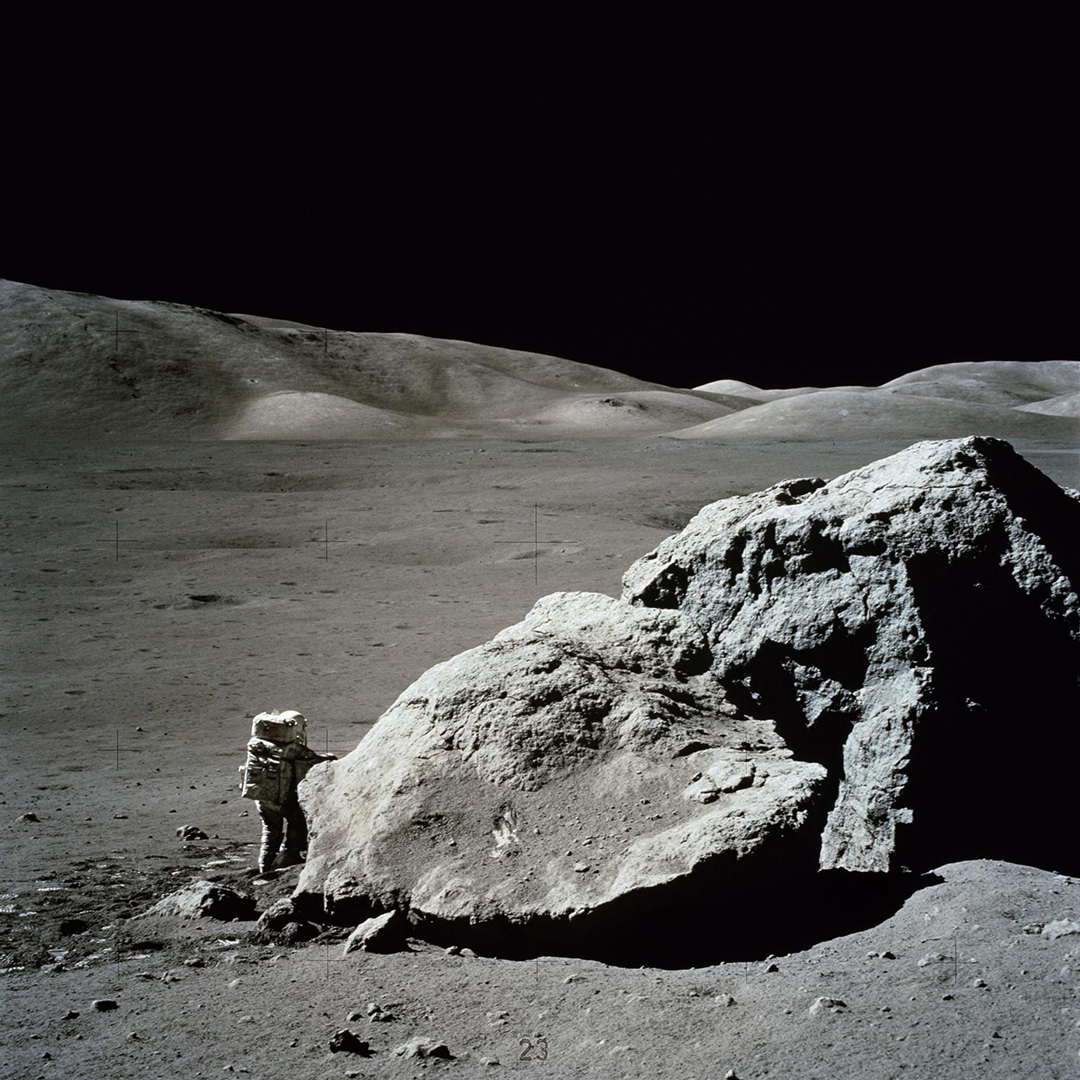
Apollo 17’s astronauts left the surface of the Moon on December 14, 1972, and since then, humans have not returned. NASA’s attention in the 1980s, 1990s, and 2000s was mainly focused on the space shuttle program, constructing and completing the International Space Station (ISS), and building and operating hundreds of spacecraft and telescopes to explore our Earth, Sun, Solar System, and the rest of the universe.
Slowly, scientists have been turning our attention back to the Moon. There is so much more we still want to know about Earth’s closest neighbor in space! Uncrewed orbiters, landers, impactors, and rovers from space agencies and private companies in the United States, the Soviet Union, Russia, China, Japan, the European Space Agency, India, Pakistan, and South Korea have all explored our Moon.
NASA’s Artemis Program
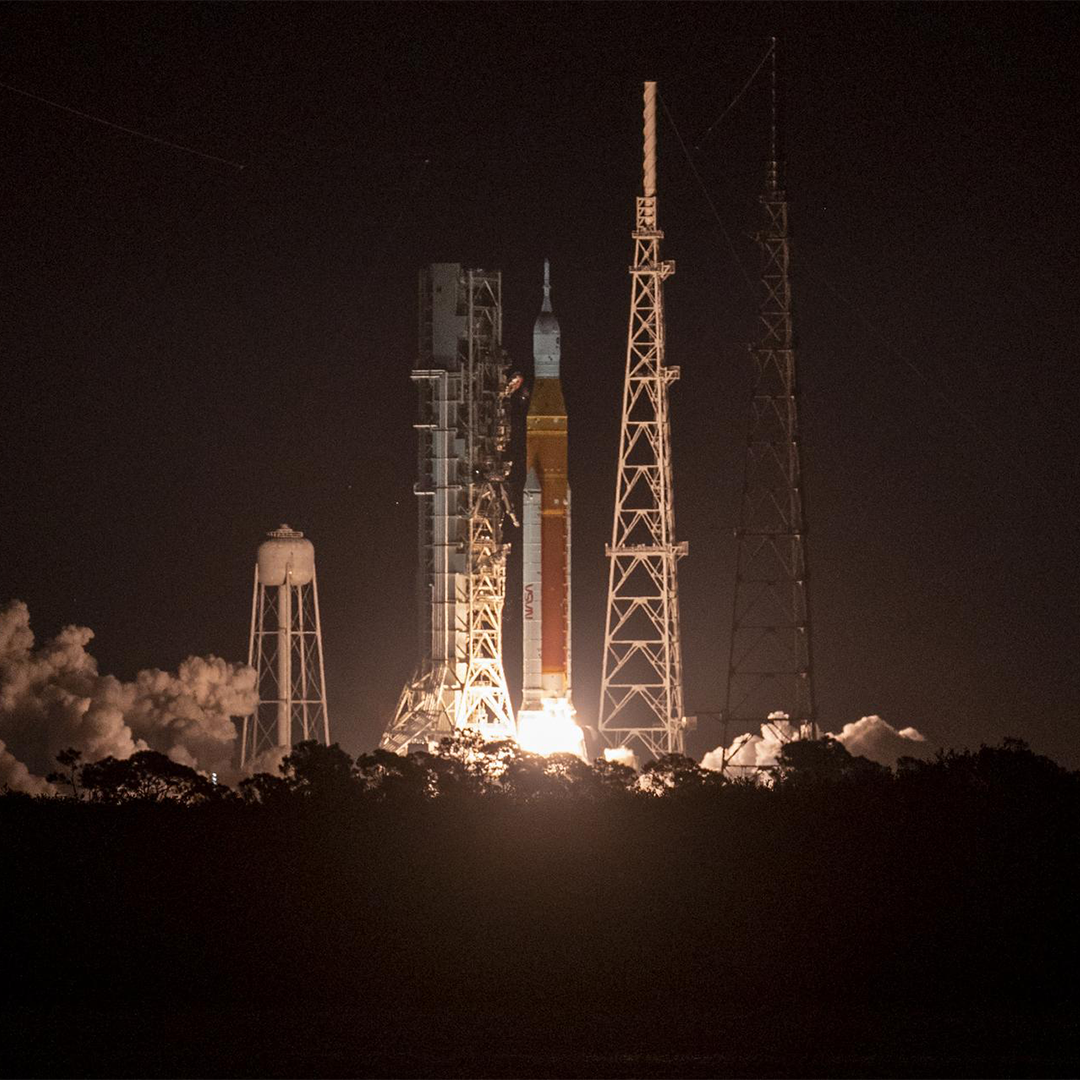
NASA began making plans to return people to the Moon starting in the mid-2000s, including work on new rocket designs and spacecraft to get us there. In 2017, the Artemis program was established, building on the former Constellation program efforts of the prior decade.
Why Are We Going Back To The Moon?
The goals of Artemis are to return humans to the surface of the Moon and to lay the groundwork for future long-term human presence there. Artemis is working towards landing people near craters at the Moon’s largely unexplored south pole. The program is also working to establish a long-term presence in lunar orbit aboard a new space station called Gateway. The first mission in the program, Artemis I, was an uncrewed test mission that successfully flew SLS and Orion in November–December 2022.
Artemis is a complex program featuring:
- A heavy-lift rocket called Space Launch System (SLS)
- A crew-carrying spacecraft named Orion
- Partnerships with Canada, the European Space Agency, Japan, and other countries to provide hardware, expertise, and astronauts
- Dozens of contracted private companies such as Blue Origin, Intuitive Machines, Firefly Aerospace, SpaceX, and many others. Private companies will first bring science instruments to the Moon and, later, their hardware will bring astronauts to the lunar surface from lunar orbit.
Artemis II: The Next Crewed Mission To The Moon
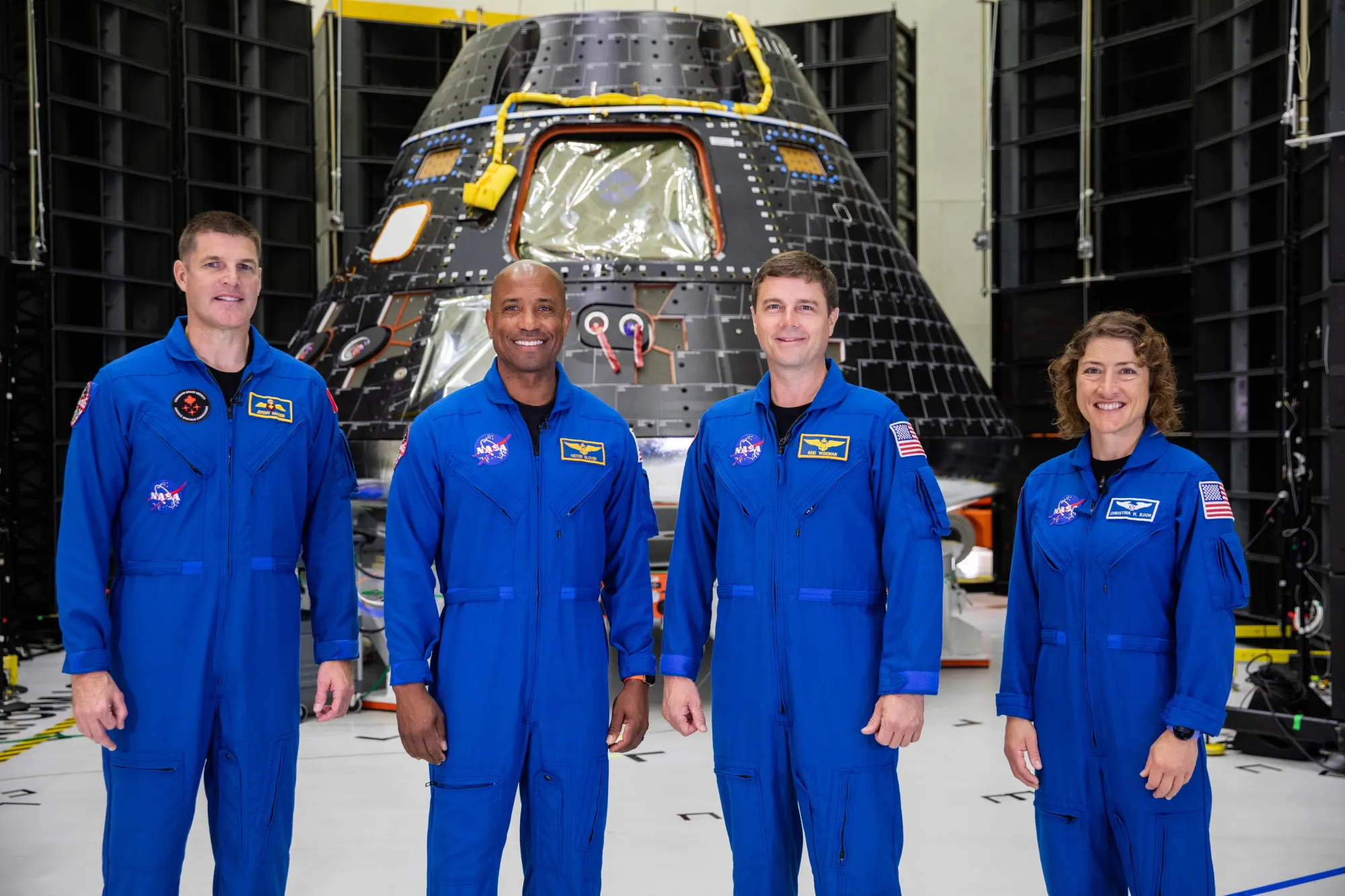
Artemis II is the next mission in the series, and it is the first one that will include a crew. For the first time since Apollo 17, humans will venture toward the Moon! Four astronauts will make the journey aboard their Orion spacecraft named Integrity. The outbound trip from Earth will last about four days, looping around the far side of the Moon. They’ll be about 4,600 miles beyond the Moon’s surface—around 230,000 miles from Earth—which will be the farthest humans have ever traveled.
The Integrity spacecraft will not go into lunar orbit or land astronauts on the Moon. Rather, the crew will focus on performing critical tests of various systems that will be used in future lunar missions, such as Artemis III. During the four-day return trip, the astronauts will continue to evaluate the spacecraft’s systems, before landing in the Pacific Ocean.
Who Is On The Crew Of Artemis II?
Artemis II will carry four astronauts representing the United States and Canada. The crew includes the first woman, the first person of color, and the first Canadian to travel beyond low Earth orbit. Artemis II crew members include:
- Commander: Reid Wiseman
- American. Prior experience: 165 consecutive days in space, flew aboard the ISS
- Pilot: Victor Glover
- American. Prior experience: 168 consecutive days in space, flew aboard the ISS
- Mission Specialist: Christina Hammock Koch
- American. Prior experience: 6 spacewalks, 328 consecutive days in space (longest single duration for any woman!), flew aboard the ISS
- Mission Specialist: Jeremy Hansen
- Canadian. Prior experience: Served as capcom (the voice between mission control and astronauts in space), Artemis II is his first spaceflight.
Artemis II Launch Updates
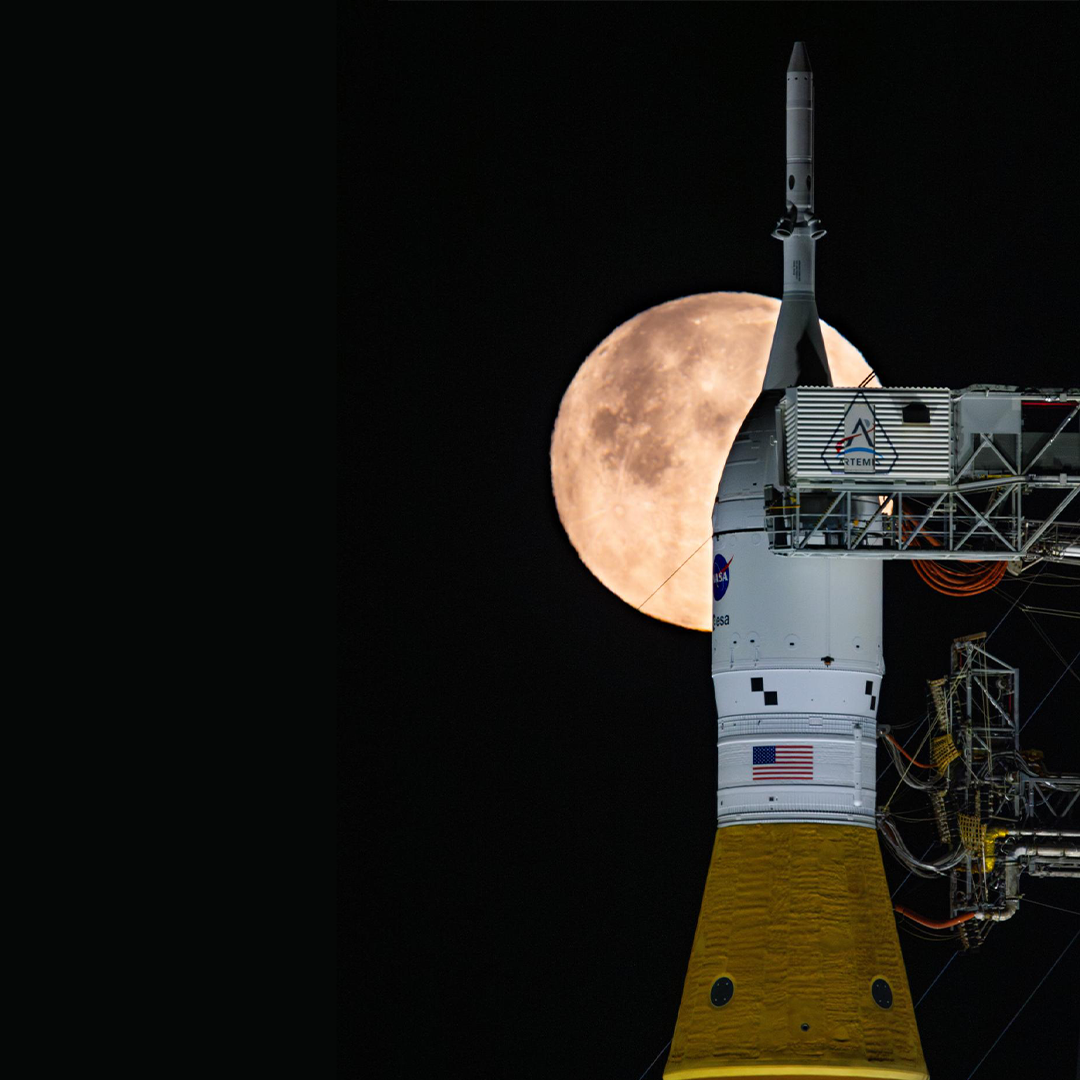
Artemis II Launch Update: April 1, 2026
NASA’s Artemis II mission is set to launch on April 1, 2026. The launch is scheduled for 5:24 pm CT, and the window is 5:24–7:24 pm CT. 80% chance of good weather at least at some point during that window. The mechanical issues have been fixed/resolved to NASA’s satisfaction.
If the mission cannot launch on April 1, the next available launch window dates and times are:
- April 2: 6:22 pm CDT
- April 3: 7:00 pm CDT
- April 4: 7:53 pm CDT
- April 5: 8:40 pm CDT
- April 6: 9:36 pm CDT
- April 30: 5:06 pm CDT
Artemis II Launch Postponement: February 23, 2026 Update
As of February 23, 2026, the launch of Artemis II has been delayed until April 2026 at the earliest.
NASA identified a problem with the flow of helium to the SLS rocket’s upper stage that has delayed the launch. This will require rolling the SLS from the launch pad back to the Vehicle Assembly Building (VAB). Helium is used to pressurize the upper stage’s fuel tanks and to purge the upper stage engine of any remaining oxygen and hydrogen. Helium is an inert chemical, meaning it won’t react with anything—so it’s a good material to use for these purposes.
The system worked during the dress rehearsal on February 19, 2026, but the problem was found while they were returning the rocket to normal operation post-rehearsal. NASA is currently looking at possible causes of the helium flow problem.
The March Artemis II launch dates are no longer an option and the crew has been released from quarantine. The SLS rollback to the VAB could be as early as February 24, but the exact date and timing will depend on the wind forecast.
When Is Artemis II’s Launch Date?
Artemis II could launch no earlier than:
- April 1: 5:24 pm CDT
- April 3: 7:00 pm CDT
- April 4: 7:53 pm CDT
- April 5: 8:40 pm CDT
- April 6: 9:36 pm CDT
If launch is not possible during these dates, the next available date is April 30. Whether these dates are actually available will depend on how long it will take to identify and fix the problem.
Artemis II Launch Dates As Of February 13, 2026
On February 2 and 3, 2026, NASA conducted a “wet dress rehearsal” to go through an entire simulated countdown, loading, and unloading of 700,000 gallons of liquid hydrogen and liquid oxygen aboard Artemis II’s SLS rocket for the first time.
Several problems occurred throughout the rehearsal event. There were periodic liquid hydrogen leaks due to issues with a few seals, and it took longer than planned for the ground crew to finish all of their countdown tasks. Additionally, there were periodic dropouts in audio communications, and cold weather affected some cameras and equipment.
NASA will first work on fixing the various problems that occurred before conducting a second wet dress rehearsal.
Artemis II is currently scheduled for “no earlier than” March 2026. Specific launch windows depend on mission readiness and final testing of the Space Launch System (SLS) rocket. Available launch dates and times are:
- March 6 at 7:29 pm CST, launch window is 120 minutes
- March 7 at 7:57 pm CST, launch window is 120 minutes
- March 8 at 9:56 pm CST, launch window is 120 minutes
- March 9 at 10:52 pm CST, launch window is 120 minutes
- March 10 at 11:48 pm CST, launch window is 115 minutes
If the mission cannot launch by March 10, the next available launch dates are April 1, 3, 4, 5, 6, and 30, 2026.
These particular dates and times ensure that Earth and the Moon are in the right places in space for Integrity to get to where it needs to go. “No earlier than” means the launch won’t be before those dates, but it could either be during these dates or during a later set of dates, depending on the testing and required fixes.
As of the posting of the blog February 13, 2026, there is no confirmed launch date, only a set of available dates. NASA will choose a launch date pending their review of all of the results of repairs, testing, and the second wet dress rehearsal.
We’ll be updating this blog with the latest information on the Artemis II mission, so check back soon or subscribe to our newsletter to get the latest space updates straight in your inbox.
Adler Skywatch: April 2026
Header image: Adler Planetarium infographic of April’s full Moon on April 1, 2026—nicknamed Pink Moon.
The smallest planet in the solar system gets to show off for a short time this month, April 2026.
What Planets Are Visible In April 2026?
How To See Mercury In The Night Sky
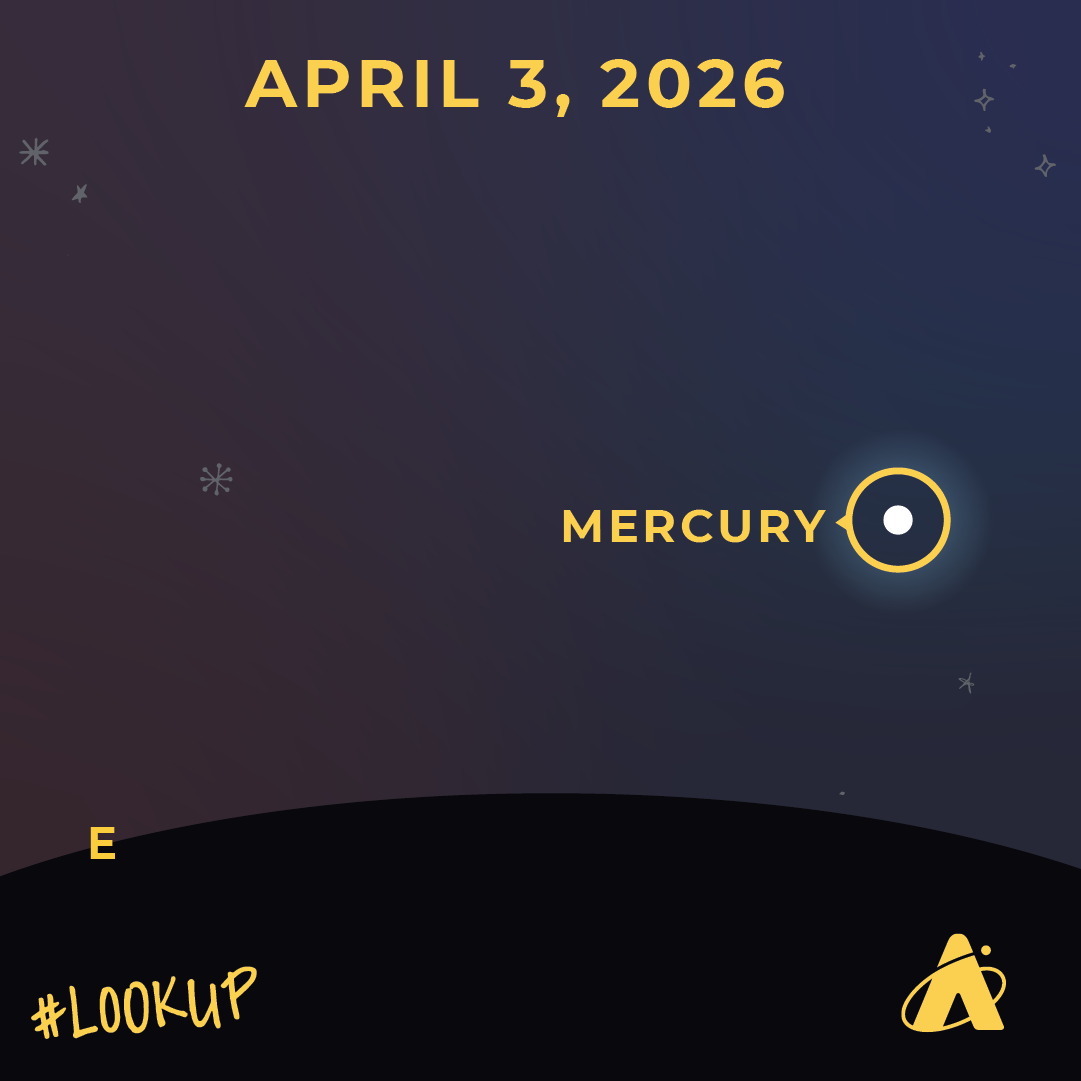
The usually hard-to-spot planet Mercury rises shortly before sunrise this month, a little south of due east. It starts the month at 0.4 magnitude and it gets a little brighter each day, reaching negative-numbered magnitudes by April 16 (the lower the magnitude number, the brighter the celestial object appears).
At the start of the month, Mercury rises nearly an hour before the Sun. However, the Sun rises earlier each day, and its glare makes it increasingly difficult to spot the planet. Try looking on or before April 19, when Mercury rises barely 40 minutes before the Sun. Once the Sun gets above the horizon, stop looking toward it or you risk permanent eye damage.
How To See Mars And Saturn
Mercury isn’t the only planet that’s near the Sun in the sky this month. On April 1, the planets Mars and Saturn appear, respectively, roughly ten and 20 degrees away from Mercury this month. By April 19, the three planets are within two degrees of each other, forming a tiny right triangle extremely low in the east.
Unfortunately, you’re likely to see only Mercury. Neither Mars nor Saturn are as bright as Mercury this month, and both appear closer to the Sun and to the horizon than Mercury does, so dawn’s glare will likely make them difficult if not impossible to see. Again, do not look toward the Sun once it’s up.
How To See Venus In The Night Sky
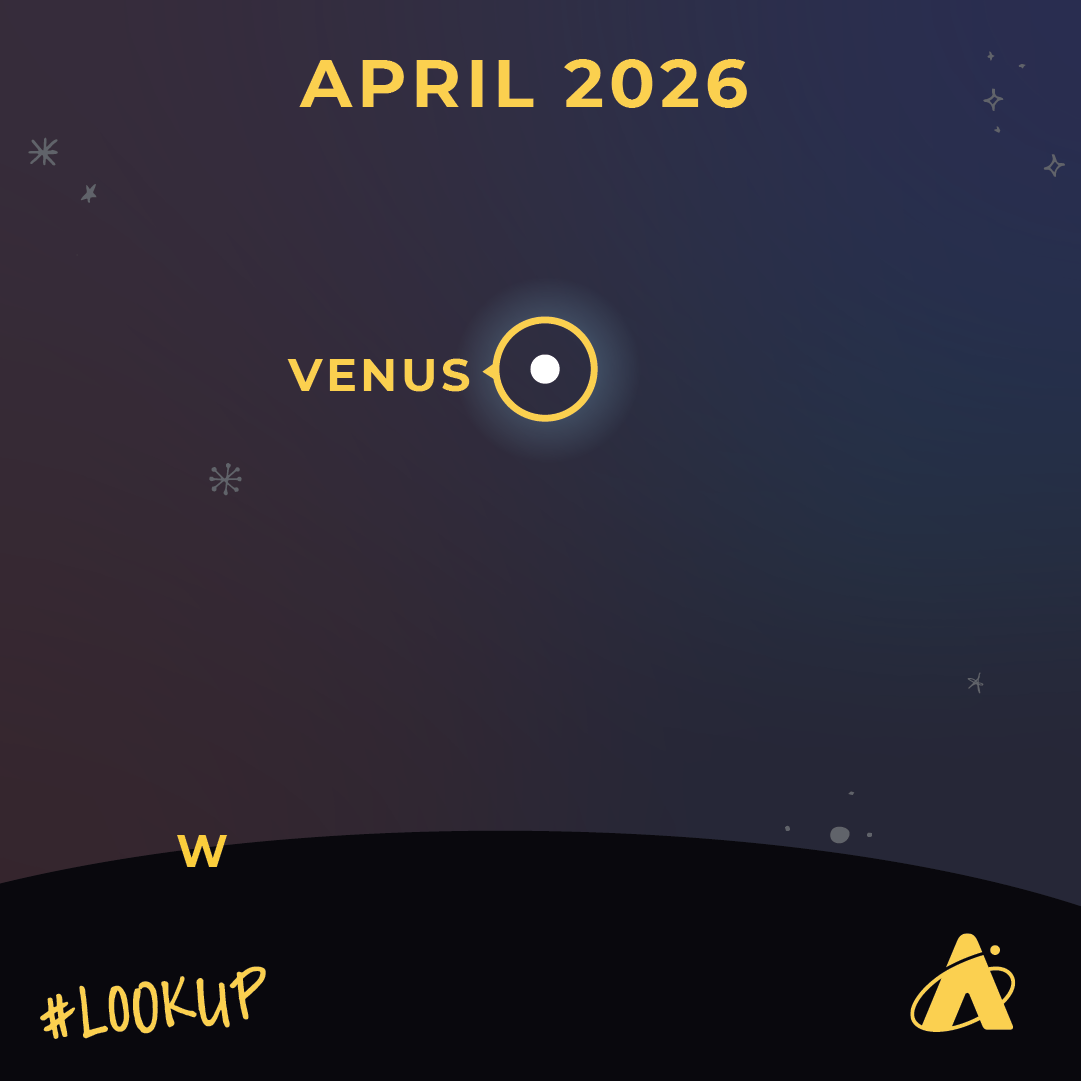
You won’t need to get up so early for the other naked-eye visible planets. The brightest planet, Venus, is just under –4 magnitude and appears very low in the west in evening twilight. Start looking for it about a half-hour after the Sun sets, slightly north of due west. Even though the Sun sets a little later each day this month, Venus moves slightly further away from the Sun’s position in the sky each evening. The evening of April 18, you may be able to spot an extremely slim crescent Moon, less than two days old, slightly to the right of Venus.
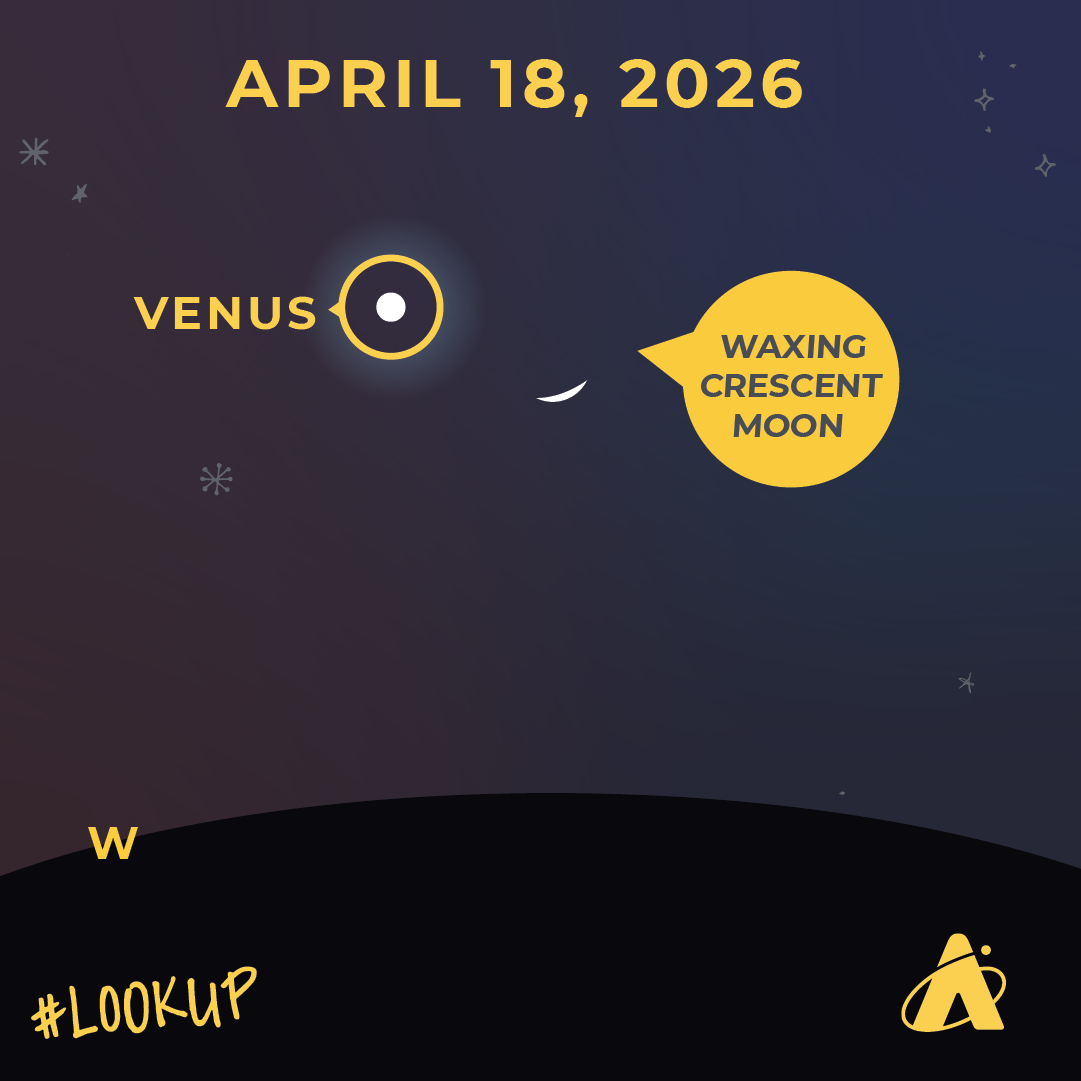
The next evening, April 19, the crescent Moon is a little larger and is just above the sparkly Pleiades star cluster, with Venus a few degrees below both. The evening of April 25, Venus is a few degrees to the left of the Pleiades. Venus sets at about 9:00 pm at the start of the month, and about 10:00 pm by month’s end.
Is Jupiter Visible This Month?
Once Venus sets, try spotting the planet Jupiter in evening twilight. It’s brighter than –2 magnitude—not quite as bright as Venus, but still brighter than any star in the sky. Jupiter is high in the southern sky early in the month and a little lower—but still high in the southwest sky—later in the month. Look for it about ten degrees below the stars Pollux and Castor in the constellation Gemini. The evening of April 22, a waxing crescent Moon appears just above Jupiter. The planet sets after 2:00 am at the start of the month, and around 1:00 am by month’s end.
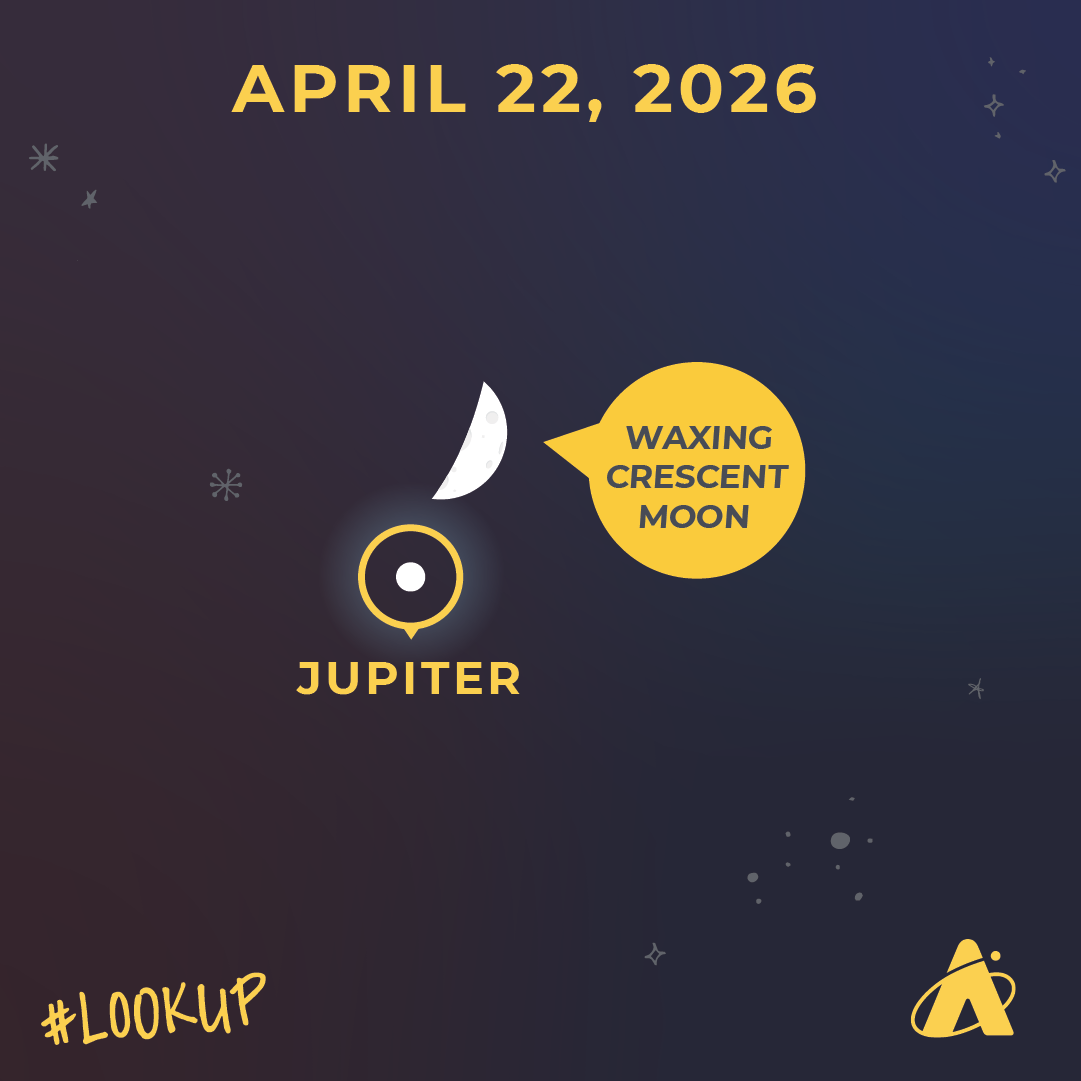
Around mid-month, you may notice that Jupiter and Venus appear to be moving closer together in the southwestern sky. By the end of the month, the two brightest planets appear about 40 degrees apart in the sky. They will get even closer over the next two months, with a picturesque close encounter on June 9.
April 2026 Moon Phases
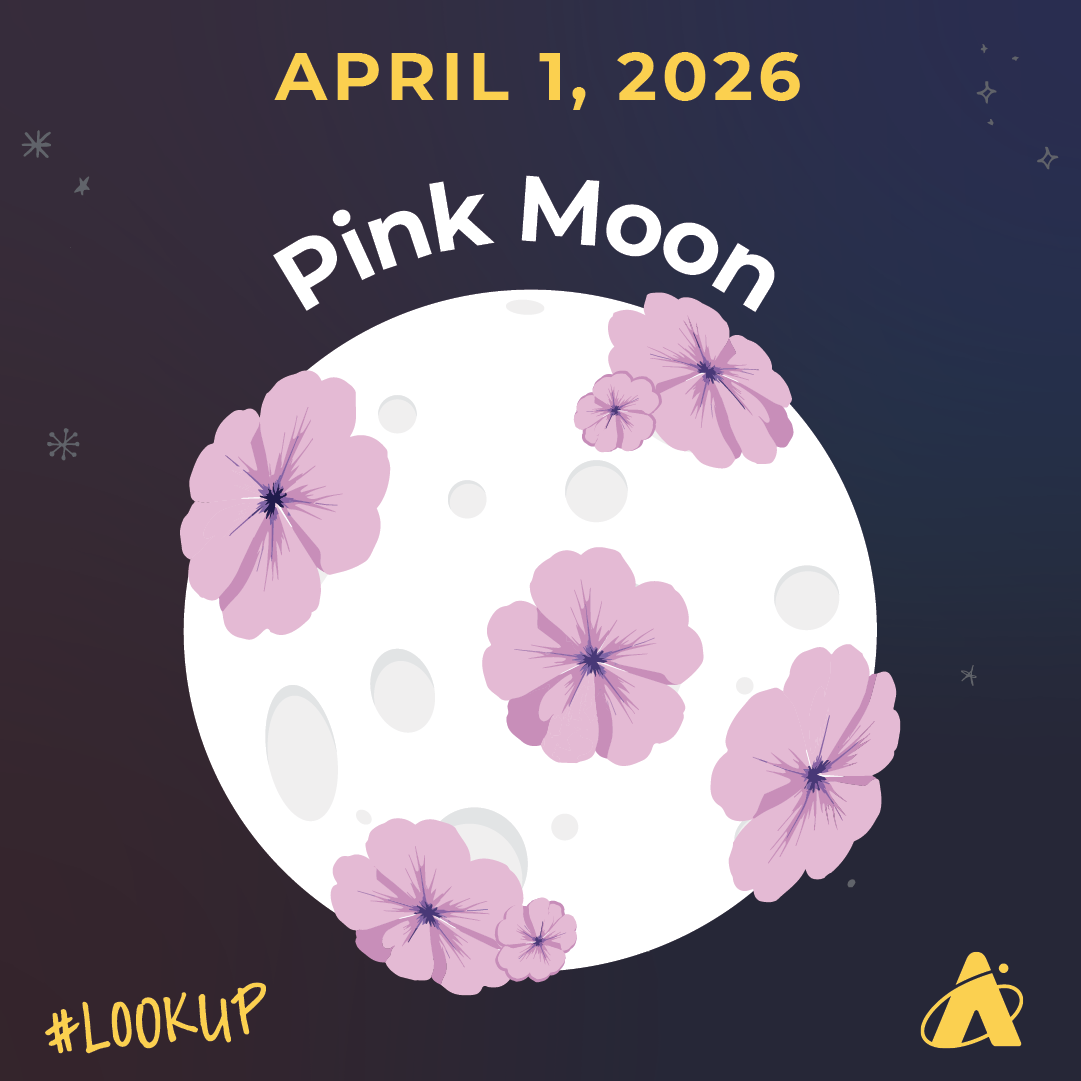
Full Moon: April 1
Last Quarter Moon: April 9
New Moon: April 17
First Quarter Moon: April 23
Please note: these descriptions are for the Chicago area, using Central time.
Explore What You Can See In The Spring Night Sky
Tour the sky with the Adler Planetarium’s Theaters Manager, Nick, in Skywatch Wednesday. Nick uses cutting-edge visualizations, NASA images, and astrophotography to show you what you can see in the night sky throughout the year.
Check out Nick’s latest episode to guide you through the spring sky! Learn what stars, planets, and constellations you can see this spring like Leo the Lion, Bootes the Herdsman, Virgo the Maiden, and the prominent stars, Regulus, Arcturus, and Spica. He’ll also share information on the vernal equinox and how to find Venus, Jupiter, and Mercury, and the Venus–Jupiter conjunction on June 8 and June 9.
Understanding Chicagohenge
Header Image: Chicagohenge as seen from West Adams Street. Image Credit: Tim Hara
Update: This blog was originally published in 2020 and written by Bianca Anderson. It is revised each year with updated dates of Chicagohenge and the equinoxes.
It is almost that time of year when nature and architecture harmoniously come together to create the phenomenon known as Chicagohenge.
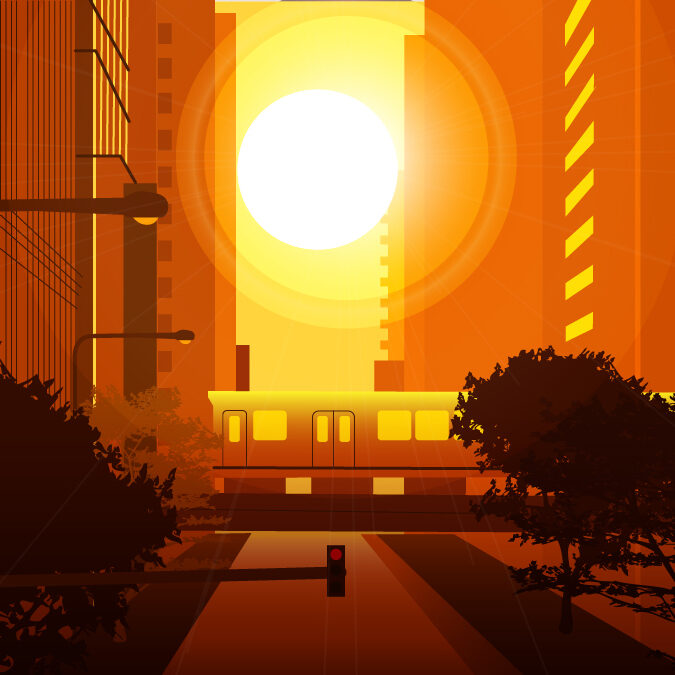
For those who don’t know, Chicagohenge occurs twice a year and happens when the Sun directly lines up with Chicago’s east-west facing streets.
Not only is this event a beautiful sight to behold, but the science behind it is quite interesting—let’s dive in!
About Chicago’s Grid
To fully understand Chicagohenge, you have to be aware of the two main factors that cause it: Chicago’s grid plan and equinoxes.
Let’s first touch on the grid plan that Chicago was built on. A grid plan is when the streets of a city run at right angles to each other forming a (you guessed it) grid!

The present-day Chicago grid system can be attributed to the Public Land Survey System—a surveying method created in 1785 that was used to divide land for selling and settling. But this style of city design has been around since the dawn of civilization and can be found in the ruins of ancient Rome, Greece, and others.
The benefits of a grid plan are numerous. They help make cities more walkable, navigable, and adaptable. Plus they end up resulting in cool astronomical and architectural events (like Chicagohenge)!
Fun fact: Chicago’s streets line up almost perfectly with the cardinal east and west directions on a compass. This in turn, sets up the perfect stage for Chicagohenge to take place.
Chicagohenge is named after the famous prehistoric monument, Stonehenge. A sculpture similar to this familiar giant stone monument, America’s Courtyard, can be found on the right side of the Adler Planetarium when approaching the building. The installation can be used to mark the Sun’s passage through the seasonal equinoxes and solstices.

However, did you know that Stonehenge isn’t actually a henge after all?
Now that we’ve got the basics of Chicago’s grid mapped out—let’s dive into the role that equinoxes play in the makings of Chicagohenge.
Equinoxes 101
As the Earth orbits around the Sun, it is also spinning along its tilted axis.
Since the Earth’s axis is tilted, sunlight is not always distributed equally. At any given point, one-half of the Earth is tilted towards the Sun more than the other. As the Earth orbits around the Sun, the part that was tilting away from the Sun begins to be the part that is facing towards the Sun. This is why we have seasons!
There are two times during the year when the Earth’s equator receives most of the sunlight. When this happens, our planet’s Northern and Southern Hemispheres experience equal amounts of day and night—hence the term equinox.
There are two equinoxes each year, one that marks the start of spring (Spring Equinox) and one that marks the end of summer (Autumn Equinox).
During an equinox, the Sun rises and sets directly to the east and west.
Thanks to Chicago’s perfectly lined grid system, the bi-annual equinoxes mark a time when the Sun rises and sets directly in line with Chicago’s east and west streets, causing Chicagohenge!
When is Chicagohenge 2026?
In 2025, Chicagohenge dates fall around March 20–23, 2026 and September 19–22, 2026. The best time to view Chicagohenge is when looking due east or due west around sunset or sunrise on these day(s) leading up to or after the equinoxes.
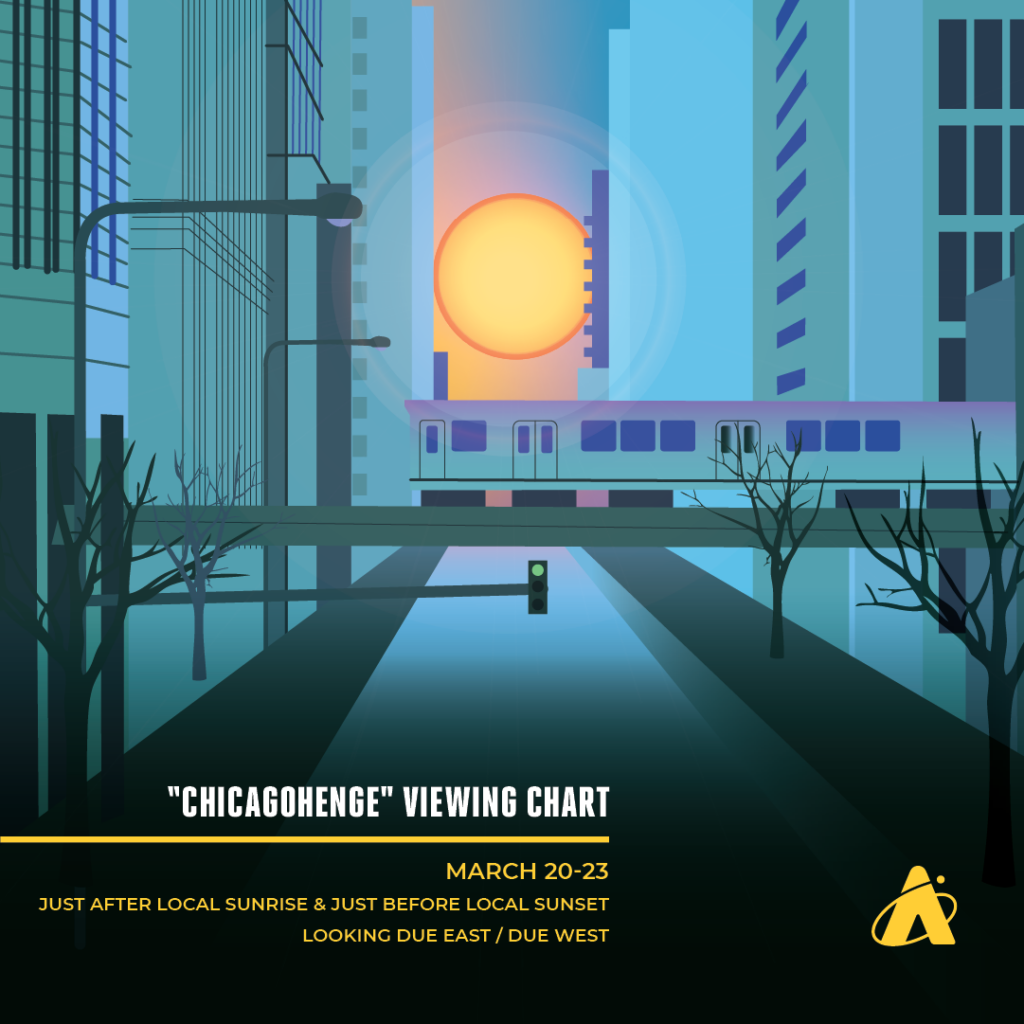
Friday, March 20, 2026: Sunrise at 6:53 am and sunset at 7:02 pm
Saturday, March 21, 2026: Sunrise at 6:51 am and sunset at 7:03 pm
Sunday, March 22, 2026: Sunrise at 6:50 am and sunset at 7:05 pm
Monday, March 23, 2026: Sunrise at 6:48 am and sunset at 7:06 pm
Sunday, September 19, 2026: Sunrise at 6:34 am and sunset at 6:52 pm
Sunday, September 20, 2026: Sunrise at 6:35 am and sunset at 6:51 pm
Monday, September 21, 2026: Sunrise at 6:37 am and sunset at 6:49 pm
Tuesday, September 22, 2026: Sunrise at 6:38 am and sunset at 6:47 pm
Best Spots to View Chicagohenge
Finding a place to spot Chicagohenge is a no-brainer! Simply find one of Chicago’s east–west facing streets, pick a spot 5-10 minutes before sunrise or sunset, and enjoy the view.
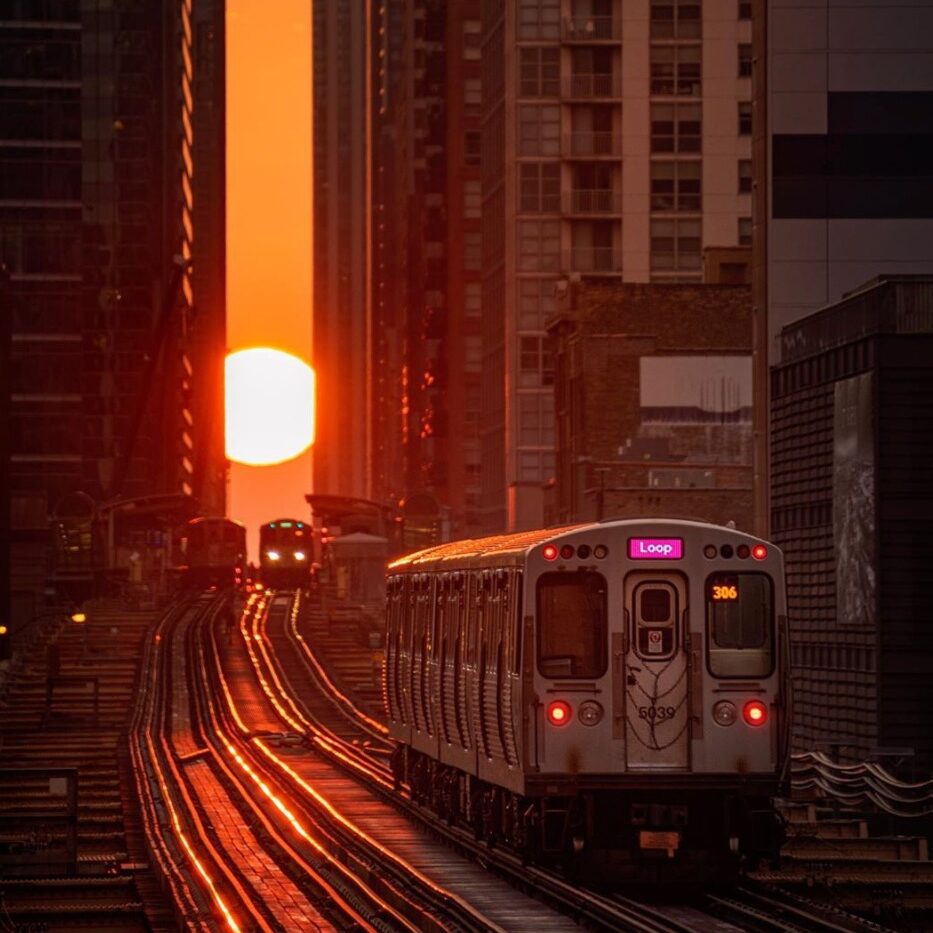
If you do decide to check it out, snap a pic and tag @adlerplanet and #Chicagohenge on your favorite social media channels! It’s sure to be a sight to behold.
Learn From Our Astronomy Educators
In a previous Sky Observers Hangout episode, our astronomy educators show you how to observe equinox sunrise and sunset alignments in your area and how to photograph Chicagohenge!
Watch the full Chicagohenge episode and subscribe to our YouTube channel to stay up to date on upcoming cosmic happenings and even see celestial objects through a telescope virtually.
Adler Skywatch: March 2026
Image Caption: The March 13-14, 2025 lunar eclipse at totality. The full Moon appears to be a dark brick red as the Earth’s shadow covers it. Image credit: Adler Planetarium
The Moon temporarily disappears early this month, and the Sun is in the sky longer each day in March. What else can you see in the sky this month?
Here’s your guide on what to see in the sky in March 2026!
Total Lunar Eclipse
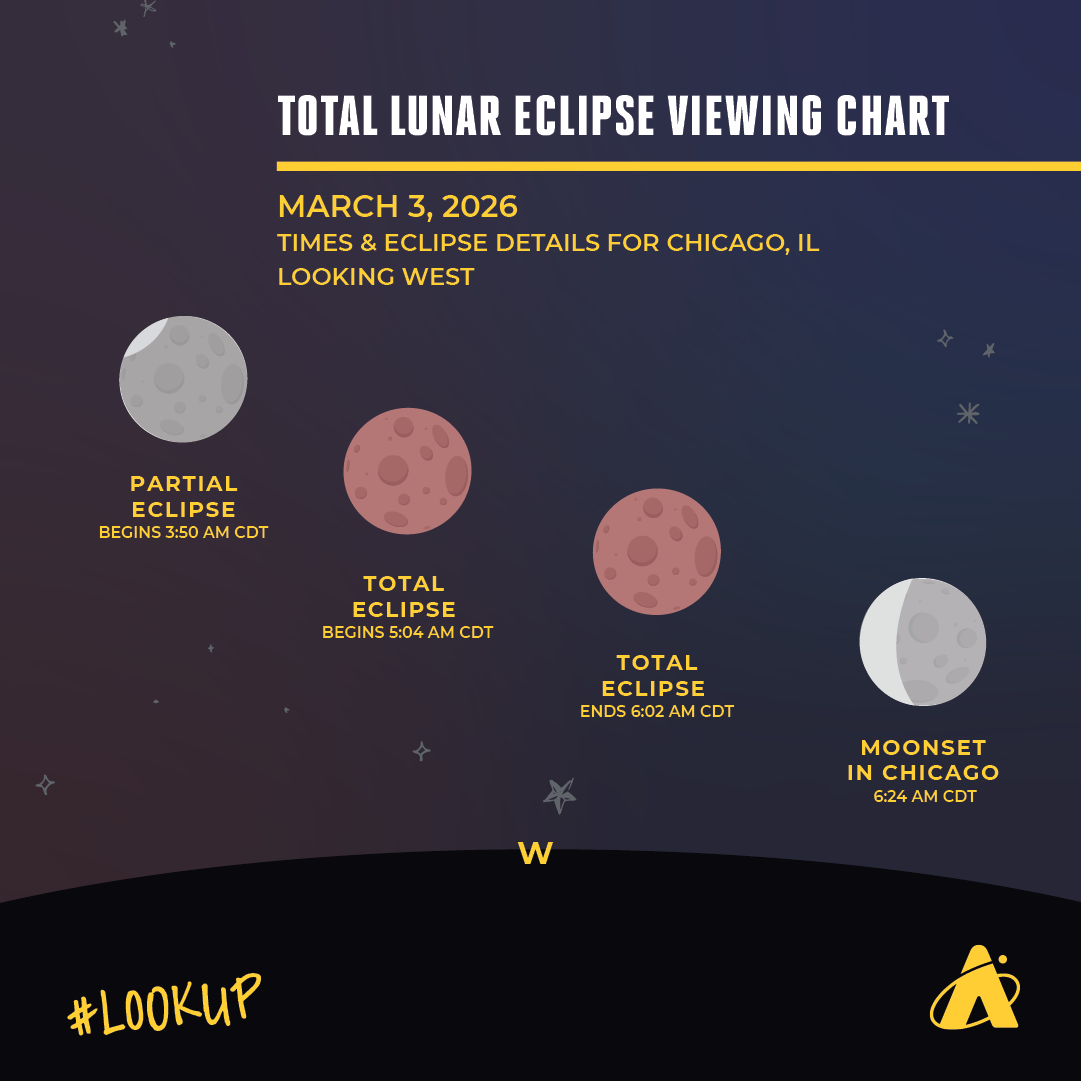
A few hours before sunrise on March 3, the Chicago area gets to experience a total eclipse of the Moon, as the Moon’s orbit takes it into and through the Earth’s shadow cast into space.
How To See The March Lunar Eclipse
In Chicagoland, this lunar eclipse officially starts at 2:44 am CST, when the Moon is not quite 40 degrees high in the west-southwest sky.
As the Moon moves into the Earth’s lighter outer penumbra shadow, we’ll see a barely noticeable darkening of the Moon.
At around 3:50 am, when the Moon is just under 30 degrees high in the southwestern sky, the partial phase of the lunar eclipse starts as the Moon begins to move into the Earth’s darker inner umbral shadow. A larger portion of the Moon gradually becomes visibly darker.
When Does the Total Lunar Eclipse Start?
The total phase of the eclipse starts at 5:04 am in the Chicago area. During totality, the Moon is only about 15 degrees above the western horizon, and the Full Moon may take on a deep reddish tint, commonly called a “blood moon.” A totally eclipsed Moon can appear to be brown, orange, or gray—we’ll have to wait and see what color we get.
The midpoint of totality in the Chicago area is at 5:33 am. By this time, the Moon is less than ten degrees above the western horizon. The total eclipse ends at 6:02 am in the Chicago area, the Moon will be just three degrees above the western horizon then, so you will need a perfectly clear view to the west to see it.
When Does the Lunar Eclipse End?
The Moon will set for Chicagoland just before 6:30 am, as the Moon starts to exit the Earth’s shadow. So scope out your eclipse viewing spot ahead of time for an open westerly view—or visit the west coast, where the eclipse is higher in the sky.
To dive more into the explanation of both solar and lunar eclipses, check out our blog Solar Eclipses and Lunar Eclipses Explained.
All the eclipse times here are in Central Standard Time.
Central Daylight Time Begins
Don’t forget to reset your clocks! On March 8 at 2:00 am, Central Daylight Time begins. On this date, clocks spring forward one hour. We’ll get that lost hour back later this year, on November 1, 2026.
Spring Equinox
The winter months are known for long nights and short days. But since the start of the winter season, the amount of daylight has been increasing a bit each day.
On March 20, at 9:46 am CDT, we reach the vernal equinox, also called the spring equinox, the first day of astronomical spring in the northern hemisphere. On the equinox, daytime and nighttime hours are of roughly equal length.
Chicagohenge
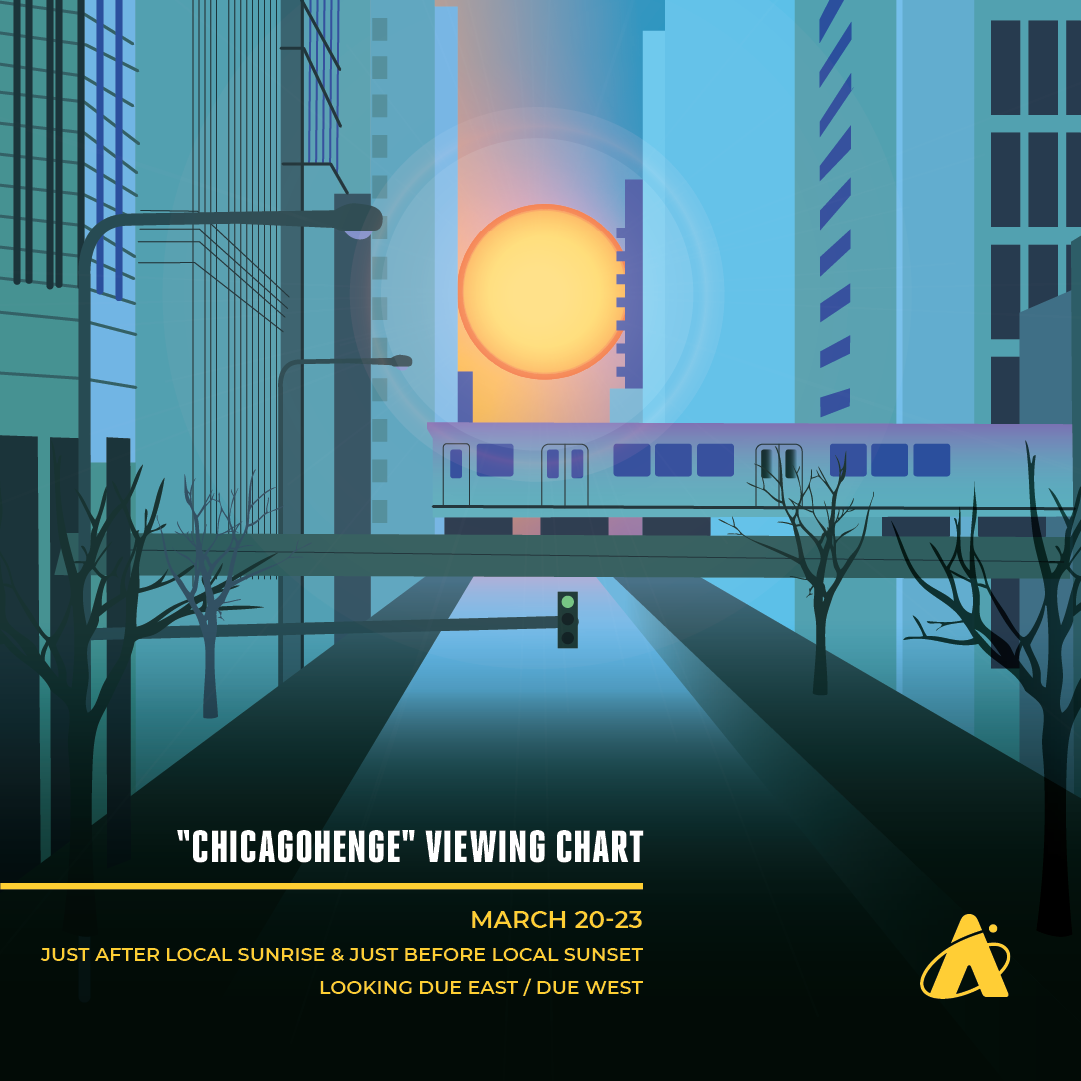
In Chicago, try spotting the Chicagohenge phenomenon around the equinox, when the rising and setting Sun aligns with Chicago’s east-west running streets. It’s especially visible in the Loop area due to skyscrapers creating a canyon effect.
Just remember to never look directly at the Sun, or you risk permanent eye damage.
March Moon Phases

Full Moon: March 3
Last Quarter Moon: March 11
New Moon: March 18
First Quarter Moon: March 25
Please note: these descriptions are for the Chicago area, using Central time.
Visible Planets In March 2026
How To See Venus
This month, the brightest planet, Venus, starts to move further away from the glare of the Sun and higher into the early-evening sky. It shines brighter than -3.9 magnitude all month long.
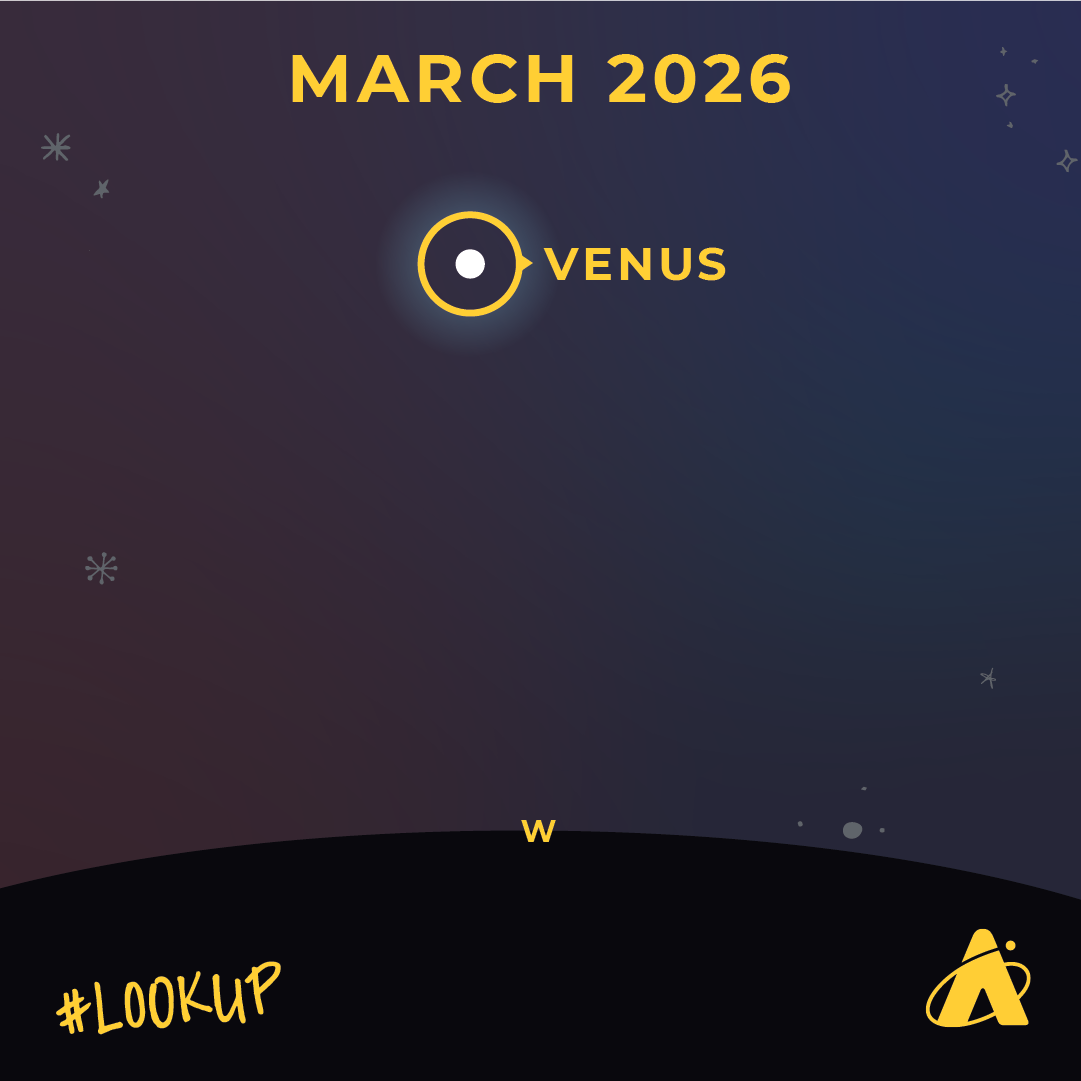
You’ll need to wait until the Sun has fully set in the west to look for it—but once the Sun is below the horizon, Venus may be visible extremely low in the west. By month’s end, it’s far enough away from the Sun in the sky to be visible about a half-hour after sunset.
How To See Jupiter
The second-brightest planet, Jupiter, rises each day this month while the Sun is still in the sky. Once evening twilight sets in, start looking for it high in the south-southeast sky early in the month, and high in the southern sky later in the month.
It’s not as bright as Venus, but brighter than minus-two magnitude, easily outshining all the stars. It sets in the west-northwest around 3:30 am. Central Standard time at the start of the month, around 4:00 am CDT on March 8, and around 3:00 am CDT by month’s end.
When Jupiter is due south in the sky, look about 40 degrees below it to see Sirius, the brightest star in the sky, which is not quite minus-1.5 magnitude in brightness.
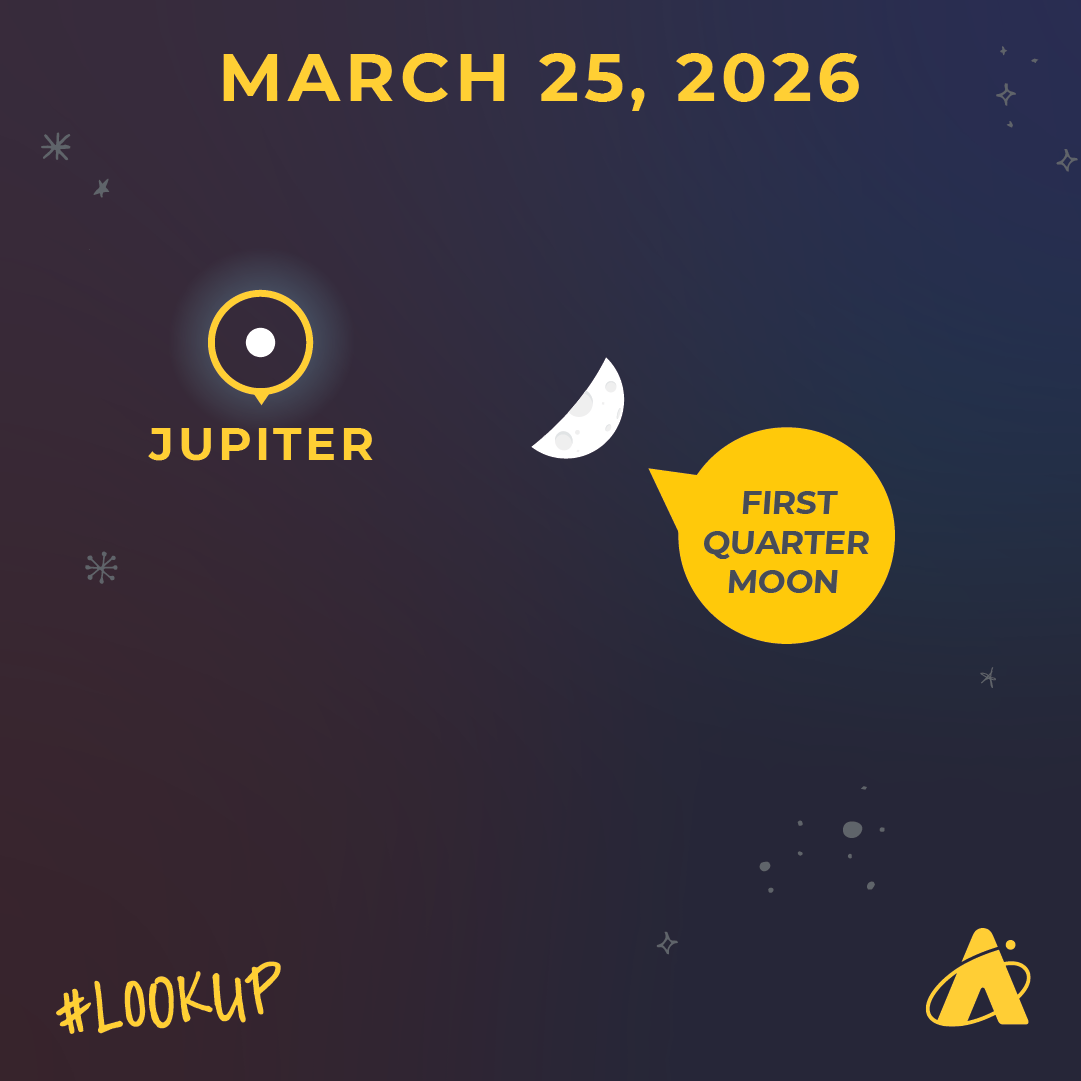
The planets Mars, Mercury, and Saturn appear so close to the Sun this month that they will be difficult, if not impossible, to see.
Our Astronomy Educators Explain Lunar Eclipses
Learn about what happens during a lunar eclipse and watch as the Moon passes through the Earth’s shadow during a previous total lunar eclipse in a prior episode of Sky Observers Hangout.
This episode was streamed live from the campus of Southern Illinois University Carbondale on March 14, 2025.
10 Things At The Adler Planetarium You Don’t Want To Miss
Header Image: Outside shot of the Adler Planetarium at sunset.
Editor’s Note: Updated to reflect more current and updated exhibit information for Spring Break programs and activities beginning Monday, March 23, through Sunday, April 5, 2026.
As humanity prepares to return to the Moon, join the Adler Planetarium this Spring Break as we explore it as both icon and enigma and why it still captivates us.
Through interactive Moon experiences, an Artemis-focused discussion on the future of lunar exploration, and a classic The Dark Side Of The Moon planetarium show, discover how science, culture, and curiosity collide then and now.
As the first planetarium in the Western Hemisphere (and one of the historic Chicago attractions located on the city’s Museum Campus), we’ve got some pretty stellar exhibits and activities you don’t want to miss during your visit to learn more about new missions, the science behind why the Moon matters, and why humans are poised to return.
For a list of fun things to do in Chicago this spring break, read on, and you’ll even learn some behind-the-scenes tidbits along the way.
#1: Dome Theater Sky Shows
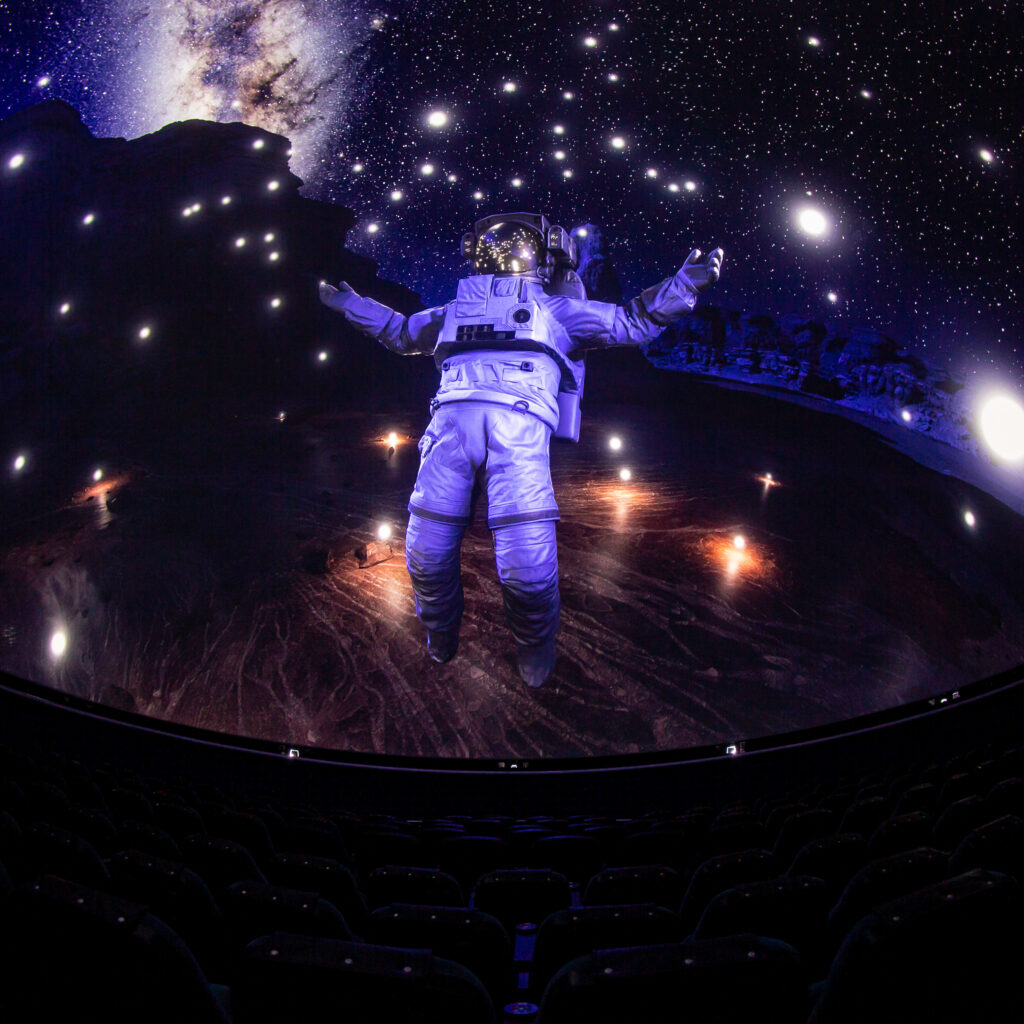
One of the coolest things about the Adler Planetarium is that we have not one, but two dome theaters!
Fun fact: We were also the first planetarium in Chicago to open a dome theater back in the day.
When you step inside a planetarium dome theater and take a seat, you become immersed in spectacular space visualizations that transport you across time and space.
What’s Currently Playing at the Adler:
- The Dark Side Of The Moon: Go on a cosmic visual journey choreographed to one of the best-selling albums of all time: Pink Floyd’s The Dark Side Of The Moon!
- Imagine The Moon: Explore how the Moon—our partner in space and companion in our sky—has inspired human creativity, learning, and exploration ever since looking up.
- Skywatch Live: See Chicago’s magnificent night sky simulated without light pollution. Our live presenters will show you constellations, stars, the Moon, and more as seen above the city on the day of your visit—perfect for stargazing enthusiasts!
- Big Astronomy: Discover Chile’s grand observatories and meet the people who push the limits of technology and what we know about the universe using world-class telescopes.
- Niyah And The Multiverse: Join young Niyah, her grown-up self, and her friends on an Afrofuturist journey through multiverse theory! Learn about shadow matter, bubble universes, many worlds, and the connections between science and culture.
- Cosmic Rhythms: Featuring Adler astronomer’s expertise, breathtaking imagery, and bold choreography by Joffrey Ballet dancer Xavier Nuñez, Cosmic Rhythms takes audiences on a mesmerizing journey through the cosmos.
- Destination Solar System: It’s 2096, and you’ve just signed up for a trip around the solar system with Space Express Tours! Get ready to tour the hottest hot spots, and most spectacular sights in deep space—fun for space explorers of all ages.
- One World, One Sky: Blast off in an imaginary rocket with Big Bird and Elmo on an unforgettable journey to the Sun, Moon, and the Big Dipper!
Buy Tickets For Your Next Space Adventure
#2: Our Newest Exhibit, Stars Aligned

Here in the 21st century, the words astrologer and astronomer mean very different things. But in the early modern period (1500–1800), you could get accurate information about the next lunar eclipse from an astrologer or have your horoscope cast by Galileo himself.
What do astrology and astronomy have in common? What did the world look like when observing the sky and interpreting its meaning were one and the same? Step back in time in our newest exhibition, Stars Aligned: Tracing the Story of Astronomy and Astrology, to discover how these two practices were once intertwined.
#3: Say Cheese and Take A Selfie

There are eight different Selfie Spots around the museum—can you find them all?
Throughout the museum you can find stickers labeled “Selfie Spots.” Take a selfie with our inflatable Moon near the Cosmic Cafe, on a light pollution map of Chicago in Chicago’s Night Sky or with the JWST mirrors in Stargazers Hub. When exploring Other Worlds, there are a couple of awesome selfie spots where you can take pictures with large models of Saturn, Jupiter, Neptune, or Uranus hanging from the ceiling, a climbable gas giant ringed exoplanet, and a real meteorite from the Arizona desert.
#4 Astronomical Objects Everywhere

The Adler has the best and most comprehensive sundial collection in all of North America, but we also have a ton of other collections objects too! You can learn about different cultures through these objects like astrolabes and celestial globes on display.
For a limited time, experience Stargazers Hub unlocked, from November 28—December 31 from Tuesday—Sunday between 10:00 am–2:00 pm and 4:00 pm–8:00 pm on Wednesday night. Take a step into the gallery to see the tools used to look at the skies for centuries for special hands-on experiences that relate to our newest exhibition: Stars Aligned: Tracing the Story of Astrology and Astronomy.
This hands-on experience gives you a close look at our seven-foot armillary sphere and the tools people have used to map the stars throughout history in our Cabinet of Curiosity.
Spring Break Object Encounters
When: Every Tuesday between Monday, March 23–Sunday, April 5, 2026
Get up close and personal with Adler historical artifacts! Every Tuesday of spring break, our curator and other members of the Collections department will bring out some of our coolest, rarest, and strongest artifacts about the Moon from Renaissance maps to Apollo mission materials in the Stargazers Hub on the Lower Level.
#5: The Doane Observatory

Did you know the Doane Observatory is home to the largest publicly accessible telescope in Chicago? Since opening in 1977, the observatory in Chicago has had several telescopes within its walls, and these telescopes have given Chicagoans the opportunity to look up at the Sun, the Moon, stars, nebulae and planets despite light pollution’s interference in the city.
The Doane is open (weather permitting) on Wednesdays throughout the year. To know when the Doane will be open, join our Facebook Group or check our Doane Observatory page the week of your visit. You can also check in at the box office on the evening of your visit to inquire about the availability of the Observatory.
The observatory building is east of the Adler’s main building, right next to the shores of Lake Michigan. Follow the sidewalk around the back of the Adler to the observatory’s front doors. If the doors are open, you are welcome to come in, head up the stairs, and check out the sights!
Spring Break Night Sky Observing:
- Wednesday, March 25 between 7:00 pm–10:00 pm*
- Wednesday, April 1 between 7:45 pm–10:00 pm*
*Depending on crowd size and/or weather, the line entry may close prior to the time listed. Telescope targets will depend on weather/cloud conditions and may change without notice.
#6: Cutting Edge Astrophysics From Chicagoland Researchers
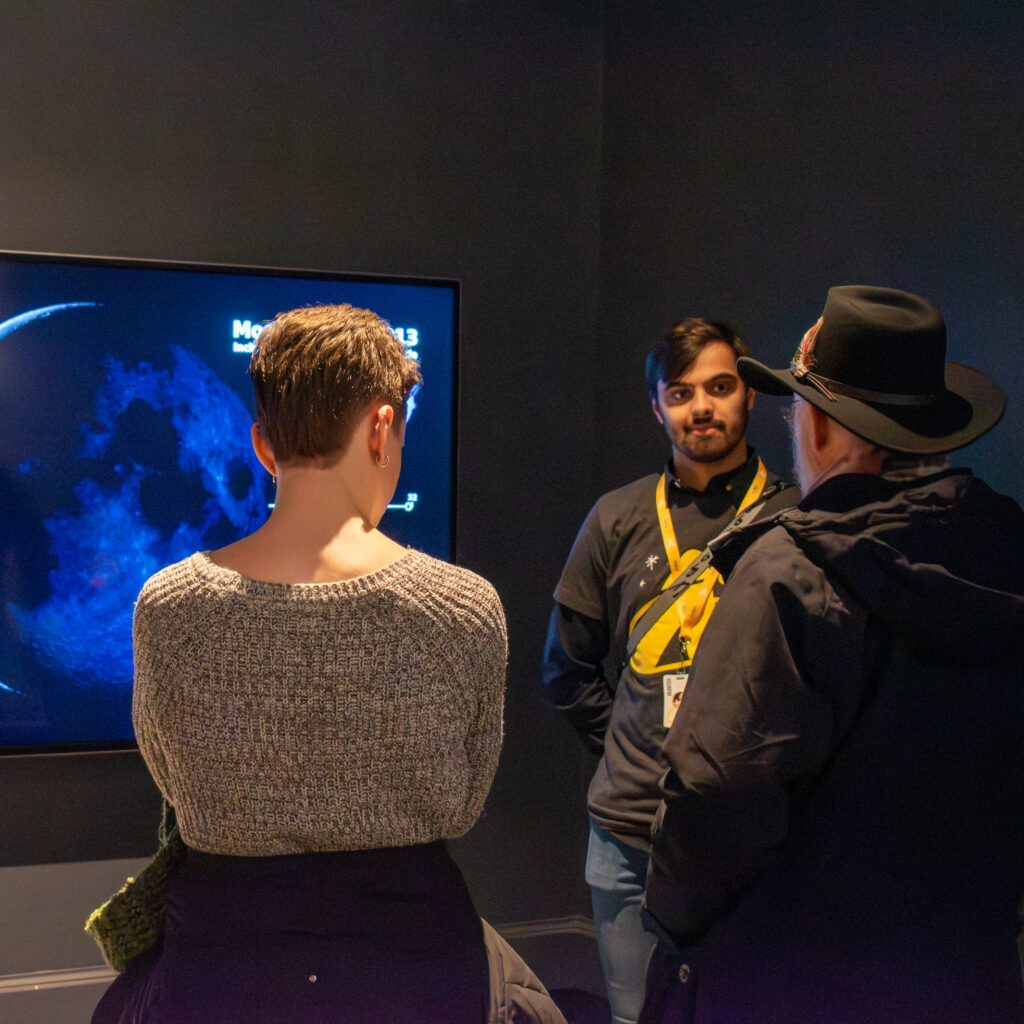
Come hear about cutting-edge astrophysics from Chicagoland researchers, accompanied by engaging images, visualizations, and simulations of space science topics.
Museum guests are encouraged to steer the conversations to learn about astronomy and space science topics they find most fascinating.
The Space Visualization Lab hosts scientists all year round on Wednesdays from 6:00 pm–8:00 pm and Saturday–Sunday 11:00 am–1:00 pm.
Spring Break Offerings:
Special Astronomy Conversation: Megan Eaves, Adler’s Youth Organization for Lights Out Participants Featured in Her Book, “Nightfaring: In Search of Disappearing Darkness.”
- When: April 1, 5:00 pm–6:00 pm
- Where: Space Visualization Lab
Pop-Up Talks with Astrophysicists: Adler astrophysicists will be giving 10-minute talks multiple times a day on topics related to the Moon and lunar exploration, followed by a Q&A.
- When:
- Monday, Tuesday, Thursday, Friday: 10:00 am, 11:00 am, 12:00 am
- Wednesday: 6:00 pm, 7:00 pm, 8:00 pm
- Where: Other Worlds exhibit on the Upper Level
#7: An Out-Of-This-World Stomp Rocket

Located in our Mission Moon exhibit, there is an interactive stomp rocket where you can build your own foam rocket and try to send it up as high as you possibly can through the atmosphere (aka a very large tube)!
Test out the brand new Moon Wall prototype (available for spring break beginning Monday, March 23, 2026 through Sunday, April 5, 2026.) and discover new details about Moon exploration that led us to the Artemis missions and what’s on the horizon.
Spring Break Mission Moon Tours:
- When: Monday, Tuesday, Thursday, Friday 10:45 am and 12:45 pm and Wednesdays 4:45PM (Starting March 23 through Sunday, April 5, 2026)
- Where: Main Lobby Mission Moon Entrance, Upper Level
Told through the life and career of astronaut Jim Lovell, Mission Moon reflects the human side of space exploration and experimentation.
On this special spring break tour, Adler experts offer insights and perspectives on one of the museum’s most popular exhibitions, highlighting a real space capsule, a Moon rock, and other authentic artifacts. As new initiatives aim to return humans to the Moon, this tour grounds today’s ambitions in the people and problem-solving that shaped the first era of lunar exploration.
#8: Architectural Secrets

In 1930—the year the Adler Planetarium opened—Italian-American sculptor Alfonso Iannelli built and installed a dedication plaque in what is known as our Rainbow Lobby. To get into the museum, you walk up the front steps and pass through this lobby! Why is it called the Rainbow Lobby you ask? Around sunset every single day, the Sun’s rays pass through our glass angled prism-like front doors causing the light to bend and the colors in the Sun’s light to spread out, creating lots of tiny rainbows!
Fun fact: The Rainbow Lobby’s dedication plaque is not the only sculpture around the building created by Alfonso Iannelli. Outside and inside the Planetarium are 12 zodiac constellation plaques that match the Rainbow Lobby’s plaques that depict the planets.
#9: Spaces For Collaboration, Curiosity, and Hands-On Activities
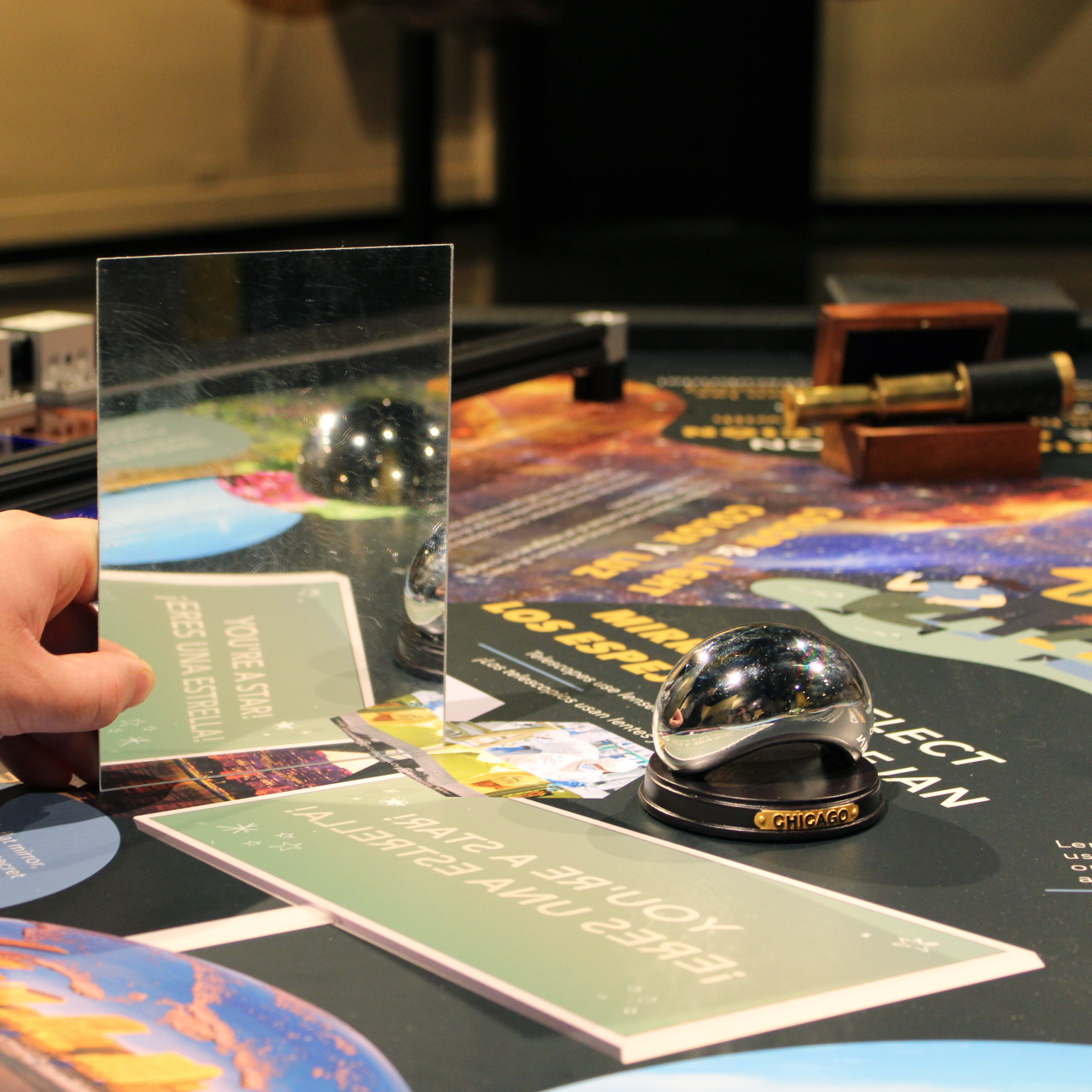
Around the planetarium are several Community Design Labs that are flexible spaces for guests to learn through play, test ideas, create art, and reflect.
- Located in the Telescopes: Through The Looking Glass exhibit, the brand new Community Stargazers Hub offers a multiversity journey through time with a focus on historic objects and is great for all ages.
- The Community PlayLab is located in the Planet Explorers exhibit and is great for children six and under and their families.
- The Community Star Studio is located in the Chicago’s Night Sky exhibit and is great for all ages!
Spring Break Activities:
Between Saturday, March 21 and Sunday, April 5, special facilitated experiences are included with museum entry. Activities run between 10:00 am–3:00 pm between Tuesday–Sunday and 4:00 pm-8:00 pm on Wednesday nights.
- The Vacuum of Space: What would happen to a marshmallow on the Moon? Find out with an Adler educator at this demonstration station. Observe vacuum chamber experiments to see how a lack of air changes everyday objects, and consider what those conditions mean for exploring and working on the Moon!
- Spacecraft Design Challenge: Design, build, and test your own spacecraft using simple materials. Can your cotton-ball astronaut survive the trip through our wind tunnel? Inspired by NASA’s Artemis missions to the Moon, explore how engineering design choices affect your mission’s success!
- Lunar Surface Collages in the Star Studio: Stop by Star Studio this spring break to explore the surface of the Moon! Learn more about lunar geography and observing – past and present! Use rubbings taken from 3-D printed lunar terrain and historic Moon imagery, including Galilelo’s early sketches to create your own mixed-media observational collage.
- Moon Modeling in the PlayLab: What would it be like to play and work on the Moon? Families can find out by building a Moon landscape, exploring craters, and trying fun astronaut challenges together. Put on “astronaut” gloves and see how even simple tasks can feel tricky in space! Designed for families with children 6 and under.
- The Moon Rocks in Stargazers Hub: This gallery highlights the methods and tools used to look to the skies for centuries. During spring break, special hands-on experiences shine a light on our Moon and its rocky surface.
#10: City Views

There’s lots to look at on the inside at the Adler, but what about the outside? We’ve been located on Chicago’s lakeshore for almost 93 years, and the views of the city are unbelievable!
Fun fact: There is a huge sundial out in front of the Adler. Have you seen it before?
Join Us This Spring Break—Get Tickets
This spring break, between Saturday, March 21 and Sunday, April 5, special facilitated experiences are included with museum entry.
Meet Apollo 11 Spacesuit Designer Bob Davidson
Image Caption: Bob Davidson, shown on the left of the image holding a microphone, is seen conducting a spacesuit fit check with Astronaut Rusty Schweikart on December 17, 1966.
Editor’s Note: This blog was originally published in 2019, and has been updated.
Imagine you are called into a meeting about a job. The job is completely different from any job you’ve ever had. It’s not an anxiety dream—this is really happening!—so you do what any responsible person would do: You tell the other people in the meeting you have no idea how to do this job.
To your surprise, they don’t seem concerned.
That’s okay, they say. Neither do we.
That’s more or less exactly what happened to Bob Davidson in 1962, not long after President John F. Kennedy, Jr., had announced that the United States would send people to the Moon before the end of that decade. Well, “announced” is a strong word. President Kennedy had said, “We choose to go to the Moon” into a microphone, but he couldn’t have been certain it would happen—let alone by the end of the decade—because it might have been impossible.
Nobody had ever done it before.
Who is Bob Davidson?
Bob Davidson was a fresh-faced college graduate, a newly minted electrical engineer. He had been working on a satellite project for NASA, but the project got cancelled and Bob got a new offer: Join a team of contractors from Playtex (The bra company? Yes, the bra company) to design and build a wearable device that could keep a person alive, comfortable, and mobile in the vacuum of space. A spacesuit. Or, as Bob prefers to think of it, a personal spacecraft.
Designing the Apollo 11 Astronaut Spacesuit
“We started with nothing,” he said, “and we had eight years.”
When Bob said “nothing,” he really meant it. At the beginning of the project, the team had no technical specifications to work with. They had only the most basic information about the environment on the Moon (less gravity, more extreme temperatures), and no real sense of direction. All they knew was that their work had to be done—and done perfectly—in time for the Apollo 11 launch. They were under an incredible amount of pressure to succeed, but Bob said the team didn’t really feel it.
”It was not pressure,” he said. “It was motivation. We’re gonna do it. We’re a team.”

A few colleagues and I had the privilege of talking with Bob about his work on the Apollo 11 spacesuit design team. Even now, he has an encyclopedic knowledge of every inch of the suit.
The ventilation system that kept astronauts from breathing in their own hair and skin cells. The way the zipper had to be designed to seal under pressure—two zippers, actually. The first one took the stress off the second. The connector tubes to the backpack, the urine port on the right knee, the urine bag, the buffer tubes, the draining bag. (“We had to test this stuff, by the way,” he said.) There was even a cargo pocket in case the astronauts only had time to grab a handful of rocks and run.
Lessons From Designing a Spacesuit
As Bob shared his story with us, there were many striking things about him. But aside from his deep knowledge, sharp memory, and memorable mustache, the thing that stuck with me was his optimistic (but also pragmatic) outlook on the human capacity to solve big, difficult problems—when we work together.
“If we as a nation have an issue, we have a problem, just look how John Kennedy did it. Use him as an example,” he said. “Get everybody to buy in.”
As a nation and as a species, we have different problems now than we had in the 1960s, like all the looming disasters that climate change may bring. But Bob is convinced that if everyone buys in, we can succeed in ways that will surprise us.
“The benefits that come out of it will be tenfold than just improving the environment. The benefits that spill out of it and come back to the commercial sectors—things we never thought we could develop, industries that become major industries,” he said.
“Everybody is gonna benefit from this.”

Speaking as a person who has a LOT of anxiety dreams, this is the part of Bob’s story that inspired me most: the way the team didn’t fritter away its time worrying about the immensity of the project, what might go wrong, all the ways they might have failed. It gave me a new appreciation for what people could accomplish together if our starting assumption was less “It’s impossible. We’re doomed” and more “We’re gonna do it. We’re a team.”
Learn More About Apollo 11
Inspired by Bob Davidson? Explore Apollo 11’s mission to the Moon by taking a look at “A Giant Leap for Mankind,” a digital collection made in partnership with NASA, the U.S. National Archives, Smithsonian’s Air and Space Museum, and more.
A Total Lunar Eclipse
Image Caption: The March 15, 2022, lunar eclipse at totality. The full Moon appears to be brick red in color as the Earth’s shadow covers it. Image credit: Adler Planetarium
Editor’s Note: This blog was originally published in 2018 and has been updated to include relevant information about the next upcoming total lunar eclipse in 2026.
Are you getting ready for the next total lunar eclipse? If the weather is clear, lunar eclipses can be a magnificent show in the sky from start to finish. And the best part: you don’t need any special equipment to see one – just your eyes and a clear sky!
Here’s everything you need to know about lunar eclipses, and tips to see the next one.
Lunar Eclipses Explained
When the Sun’s light falls on our planet, the Earth blocks this light and casts a shadow into space. This is just like when you’re standing in the Sun—a shadow is cast behind you because YOU are blocking some of the Sun’s light! When the Moon’s orbit intersects with the Earth’s shadow, the Moon passes through the shadow, and the Moon appears to darken for a short while. We call this phenomenon a lunar eclipse.
When Do Lunar Eclipses Happen?
A lunar eclipse can only happen when the Moon is at the full Moon lunar phase. Why don’t we get a lunar eclipse at every full Moon? The Moon’s orbit doesn’t always intersect Earth’s shadow. The Moon’s orbit is tilted a bit with respect to the Earth, so as the Moon orbits Earth, usually the Moon misses the shadow, passing a bit above or below it in space. When everything lines up just right, we get a lunar eclipse.
On average, lunar eclipses only happen once or twice a year, so they are somewhat rare. Additionally, depending on your location, you may not see a lunar eclipse occur. If your spot on the Earth is not facing the Moon while the eclipse is happening, you will not see the eclipse at all. This makes spotting a lunar eclipse even more special!
Fun fact: If you were standing on the surface of the Moon during a lunar eclipse, you would see the Earth eclipse the Sun as a solar eclipse. Firefly Aerospace’s Blue Ghost Mission 1 robotic lander photographed this amazing phenomenon during the March 13-14, 2025 lunar eclipse! The Moon’s surface appeared reddish around the lander, and the craft photographed a beautiful solar eclipse.
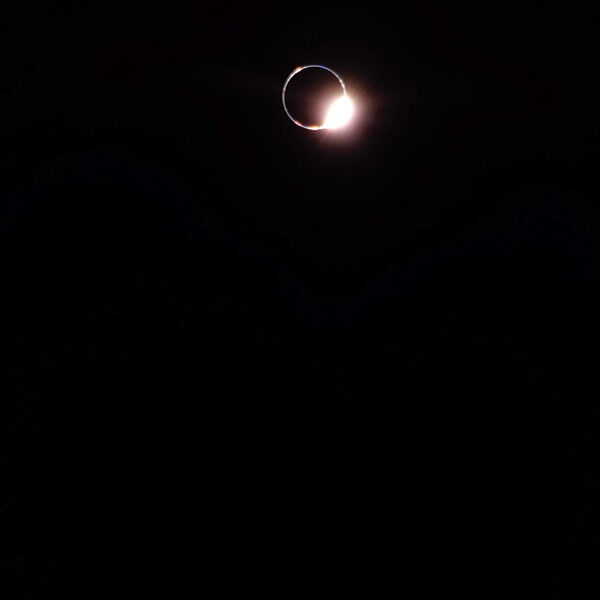
Image Caption: Captured at our landing site in the Moon’s Mare Crisium around 3:30 am CDT, the photo shows the sun about to emerge from totality behind Earth. Image credits/copyright: Firefly Aerospace
Different Types Of Lunar Eclipses
A penumbral lunar eclipse occurs when the Moon passes through the lighter, outer part of Earth’s shadow, called the penumbra. When the Moon is in this part of the shadow, it may appear a bit more tan in color, but the color change can sometimes be hard to notice at all.
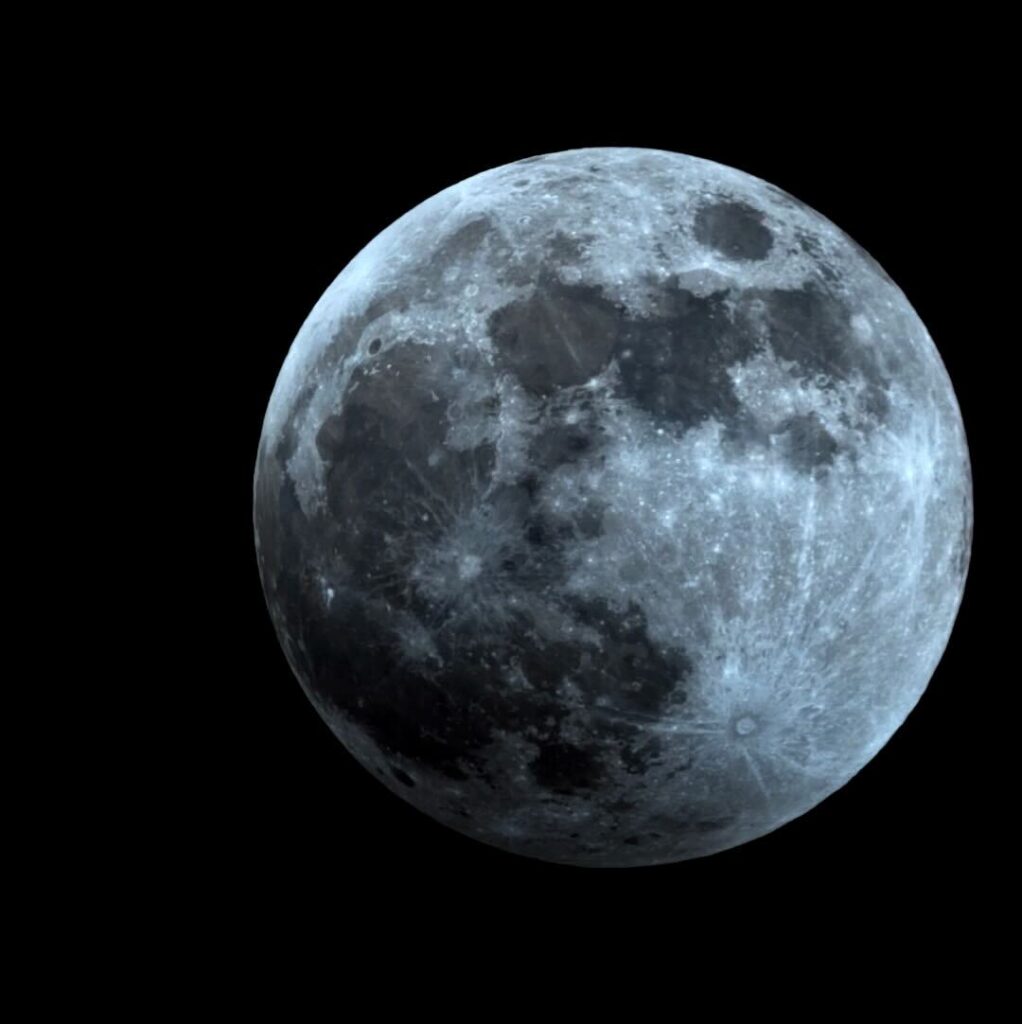
Image caption: The Moon in the Earth’s penumbral shadow during the March 13-14, 2025 lunar eclipse. The Moon shows a slight darkening on its lower-left side. Image credit: Adler Planetarium
A partial lunar eclipse occurs when some of the Moon passes into the darker, inner area of Earth’s shadow, called the umbra. At this point, the Moon looks like it has a bite taken out of it, and that bite grows progressively larger as the Moon passes further and further into the dark shadow.
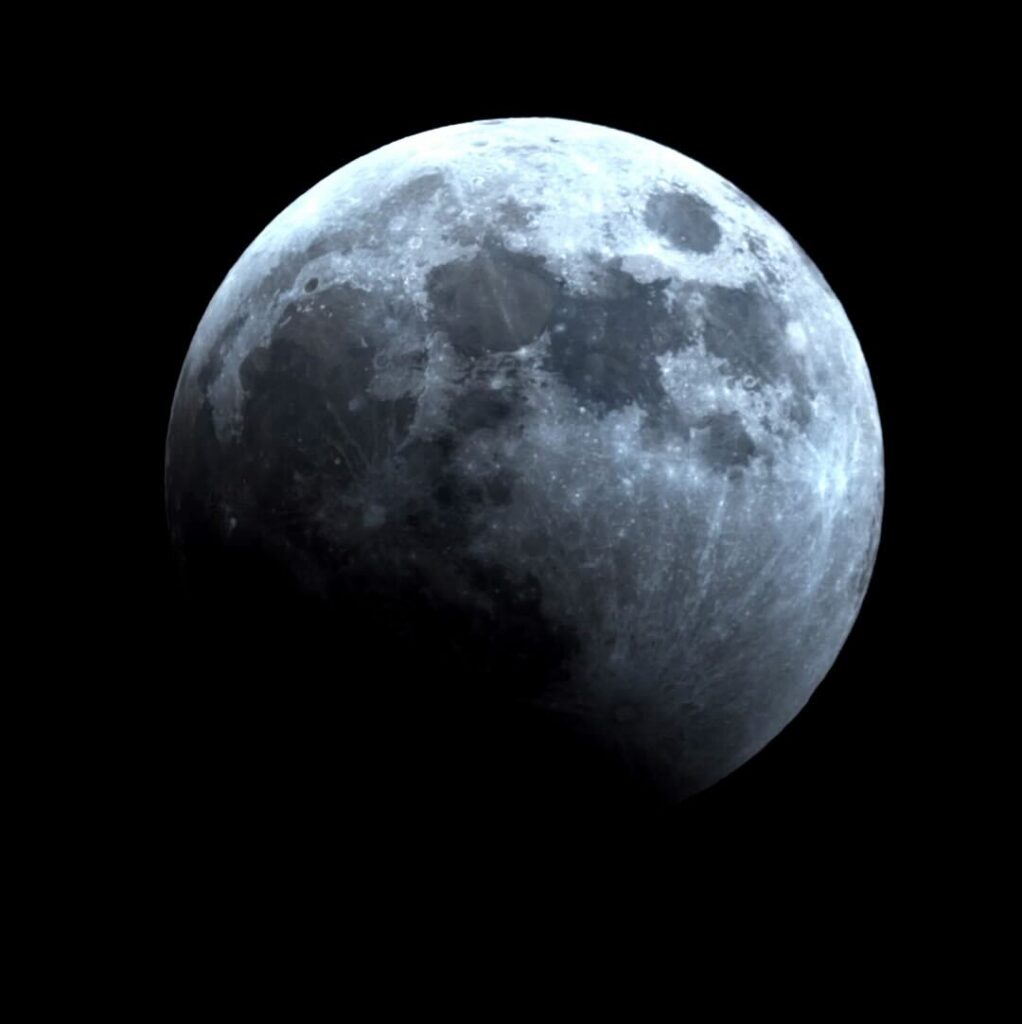
Image Caption: The partially eclipsed Moon during the March 13-14, 2025 lunar eclipse. A dark shadow covers the lower-left section of the Moon. Image credit: Adler Planetarium
A total lunar eclipse occurs when the Moon fully passes into the Earth’s umbra, the darkest central part of its shadow. Once totality begins, the Moon can appear reddish, gray, or even orange.
Not all lunar eclipses are total eclipses. The Moon’s orbit may only take it through part of the Earth’s shadow, never passing completely into the Earth’s umbra shadow. Some lunar eclipses are just penumbral eclipses, and some are just partial lunar eclipses.
Why Does The Moon Change Color During A Total Lunar Eclipse?
The color of the Moon during totality is due to sunlight passing through the atmosphere all around the edge of the Earth. Our atmosphere scatters away the bluer rays of the Sun’s light, and the redder wavelengths of light pass through and into the Earth’s shadow. You can also see this effect right before sunset: at that moment, sunlight is passing through a lot of air near the horizon, scattering the blue wavelengths and leaving the Sun’s redder wavelengths which makes the Sun appear orange or red.
Think of a lunar eclipse as showing you the color of the collective sunrises and sunsets happening around the entire edge of the Earth at that exact moment. Pretty cool, right?
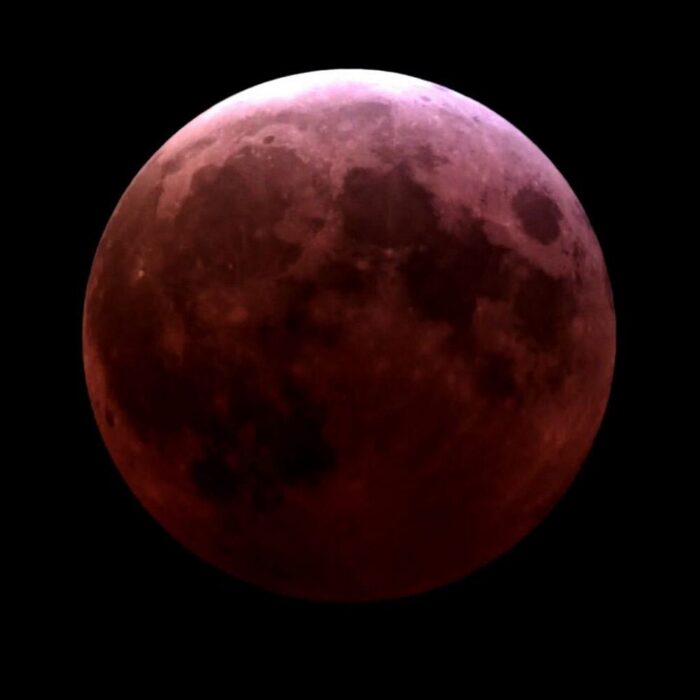
Image Caption: The March 13-14, 2025 lunar eclipse at totality. The full Moon appears to be a dark brick red as the Earth’s shadow covers it. Image credit: Adler Planetarium
The color of the Moon during totality is often different from one lunar eclipse to the next. This depends on whether the air the sunlight is passing through at that moment is dusty, clear, or cloudy, if there has been a sandstorm, or if there has been a recent volcanic eruption. The quality and clarity of Earth’s atmosphere affects the color of a total lunar eclipse. Sometimes during a total lunar eclipse, the Moon might appear light or dark red, orange, or even light or dark gray. That’s part of the fun of total lunar eclipses—we don’t know what the color of the Moon will be until the eclipse happens! The lunar eclipses in November 2021 and November 2022 were both dark brick-red in color. One Adler Planetarium staff member described the color of the March 13-14, 2025 total lunar eclipse as “a cinnamon-dusted cranberry.”
What Is A Blood Moon?
Blood Moon is an informal term used to refer to a total lunar eclipse, but it is not technically an astronomical or scientific term.
The phrase’s usage has grown in popularity, and these days, blood Moon and lunar eclipse are often used interchangeably. People use the phrase blood Moon because the Moon might appear the color of blood during the totality phase of a lunar eclipse.
Blood Moons aren’t your thing? Learn about Supermoons.
Solar And Lunar Eclipses Come In Pairs
Solar eclipses and lunar eclipses are extremely intertwined. If the Moon’s orbit is lined up with Earth to cause a lunar eclipse, it is also lined up with Earth for a partial or total solar eclipse, either about two weeks before or two weeks after the lunar eclipse.
The type of lunar eclipse will depend on which part of the Earth’s shadow the Moon encounters, and the type of solar eclipse will depend on how much of the Sun is covered as seen from the Earth. However, both eclipses may not be visible to the same parts of Earth, and both eclipses may not be total. For example, the lunar eclipse in early March 2026 has a corresponding solar eclipse in late February 2026, but that solar eclipse is only visible to viewers in Antarctica, the far southern tip of South America, and far southeast Africa and Madagascar.
To dive more into the explanation of both solar and lunar eclipses, check out our blog Solar Eclipses And Lunar Eclipses Explained.
When Is The Next Lunar Eclipse?
The next lunar eclipse visible from the Chicago area is early in the morning on March 3, 2026.
The Moon will be in the southwestern sky when the eclipse starts at 2:44 a.m. CST. As it appears lower and lower in our sky, the Moon begins to pass into the lighter outer part of the Earth’s shadow. The color of the Moon will start to change from bright light gray to a progressively deeper tan.
At 3:50 a.m. CST, the Moon will start to darken considerably as it begins to enter the Earth’s inner darker shadow. More and more of the Earth’s shadow will darken the Moon, making it look like an ever-increasing bite is taken out of it.
Totality, when the Moon is fully within the Earth’s umbra shadow, lasts from 5:04 a.m. CST until 6:02 a.m. CST. The Moon will be very low in the western sky at this point, so make sure you have a clear view to the western horizon. After totality is over, the Moon sets for viewers in the Chicagoland area just before 6:30 a.m. CST, so we’ll miss most of the end of the eclipse.
Can I See The Total Lunar Eclipse From My Location?
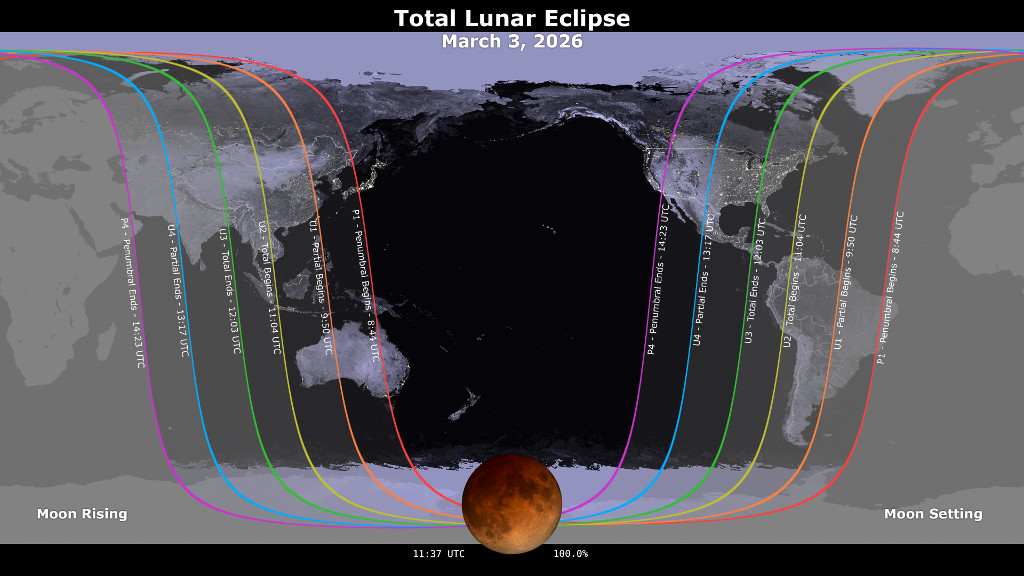
Each eclipse has different visibility and timing depending on your location. To see the lunar eclipse visibility map and the eclipse timing for the March 2026 lunar eclipse, check out Time and Date’s total lunar eclipse interactive map.
Please note that for some areas, the eclipse starts when it is still the late evening on March 2, so be sure to check your exact local timing for your location.
Tips For Viewing A Lunar Eclipse
If it is clear out and you are away from tall buildings and trees, you should have no trouble spotting the eclipse, at least at the beginning of it, for viewers in the Chicago area. As the Moon moves lower toward the western horizon, it will be harder to see due to local obstructions. Near the end of totality, the Moon will be extremely low in the sky and more difficult to see.
Here are a few more tips to make your viewing spectacular:
- Check the weather beforehand and dress appropriately. Lunar eclipses usually take several hours from start to finish.
- Double-check the time of each lunar eclipse phase in your time zone leading up to totality. The timing to view a lunar eclipse depends on your time zone at the moment when the Moon passes through the Earth’s shadow.
- Don’t stress about needing a telescope or binoculars—you don’t need any special equipment to see a lunar eclipse. If you can see the Moon with just your eyes at any other time, you can see a darker version of the Moon with just your eyes.
If it isn’t clear out in your location, you can watch a live broadcast of the lunar eclipse on the Time and Date website.
Our Astronomy Educators Explain Lunar Eclipses
Learn about what happens during a lunar eclipse and watch as the Moon passes through the Earth’s shadow during a previous total lunar eclipse in a prior episode of Sky Observers Hangout.
This episode was streamed live from the campus of Southern Illinois University Carbondale on March 14, 2025.
Adler Skywatch: February 2026
Header image: Silhouette of a person looking through a small telescope at dusk
Two planets that have been hidden in the glare of the Sun for some time begin to emerge into darker skies this month. Here’s your guide on what to see in the sky in February 2026!
Visible Planets In February 2026
How To See Mercury
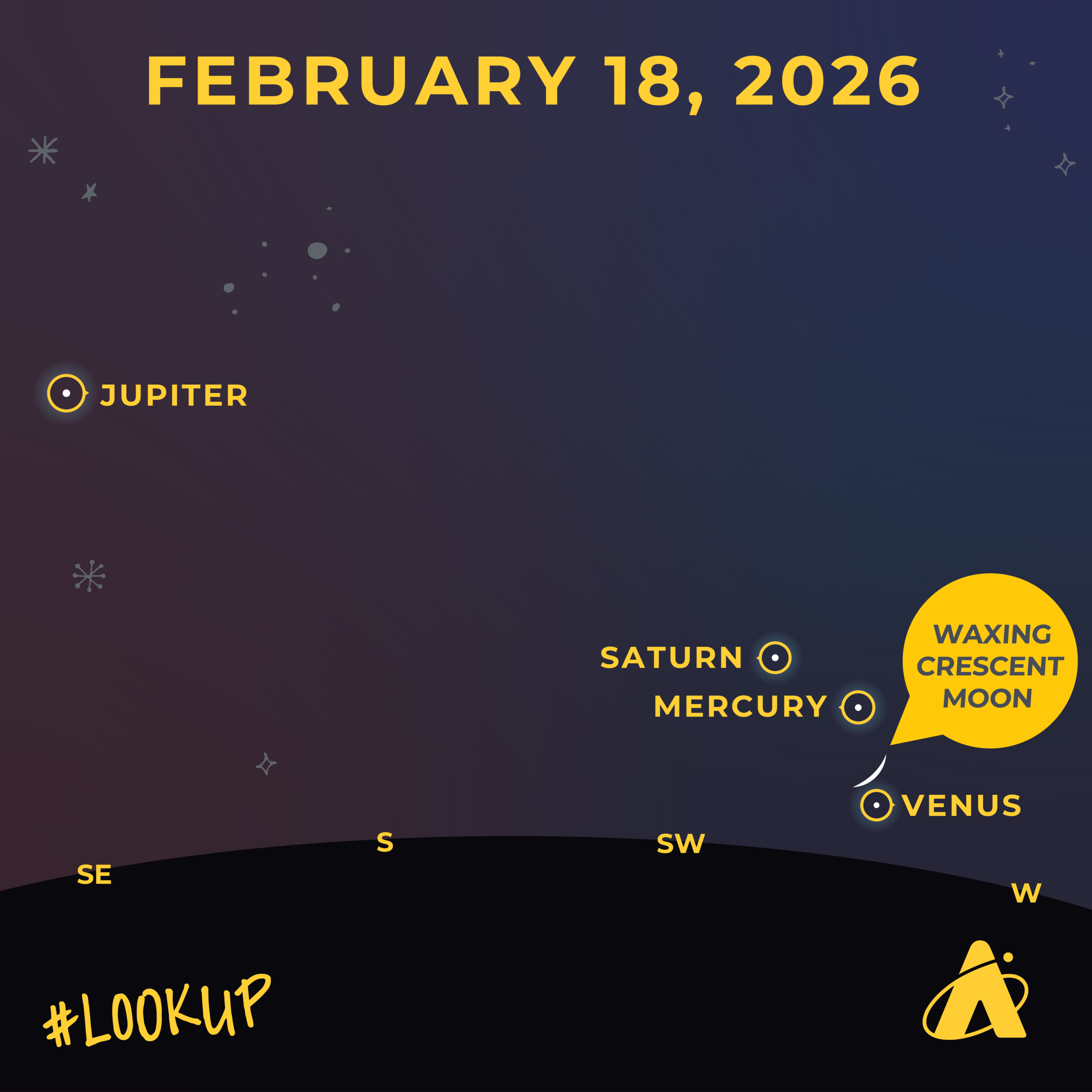
The planet Mercury appears to move away slightly from the Sun this month, having been too close to it last month for visibility. Mercury still appears somewhat close to the Sun in the sky, so you’ll need a clear view to the west-southwest horizon to spot it. To protect your eyesight, don’t attempt to look for Mercury until at least 40 minutes after the Sun is entirely below the horizon. This means any viewing must be done when the planet is very close to the horizon. The evening of February 18, the planet looms above the dark edge of the setting Moon, only one day after the new Moon. In the Chicago area, this conjunction is visible only a few degrees above the horizon, if at all.
Where Is Venus In The Sky?
During the last few days of February, if you can spot Mercury—and if your horizon sight-lines are clear—you may be able to also spot the brightest planet, Venus, slightly below and to the left of Mercury. But remember, don’t start looking until at least 30–40 minutes after the Sun is fully below the horizon. Next month, Venus will become much easier to see in the early evening.
How To See Saturn
For the past few months, Saturn has been the main evening planet visible to the naked eye. In February, Saturn sets earlier each evening, while the Sun sets later. By the end of the month, Saturn is setting less than two hours after the Sun. Look for Saturn now, while you can, since for most of March it will appear too close to the Sun for safe viewing.
Additionally, Saturn’s brightness is around magnitude 1 in February. At the start of the month, it appears in evening twilight about 30 degrees above the southwest horizon. By mid-February, it’s about 25 degrees in the west-southwest sky. By month’s end, it appears only about 15 degrees above the west-southwest horizon. The evening of February 19, Saturn appears less than three degrees to the left of a very slim waxing crescent Moon, creating a lovely planetary conjunction.
Jupiter In The February Night Sky
On the opposite side of the evening sky, Jupiter becomes the main sight. At brighter than -2 magnitude, it’s easier to spot than Saturn. In fact, it’s the brightest natural object, besides the Moon, in the evening sky for most of the month! However, when Venus comes back into view later in the month and into March, it will outshine Jupiter.
At the start of the month, Jupiter pops into view about 25–30 degrees high in the eastern sky during evening twilight. By the end of the month, it appears about 50–60 degrees high in the east-southeast. Around 9:30 pm, the planet reaches its highest point in the sky, about 70 degrees up in the south. It will set in the west-northwest around 6:30 am early in the month, and around 4:30 am late in the month. Plus, keep an eye out on the evening of February 26, when a waxing gibbous Moon appears roughly five degrees away from Jupiter.
The planet Mars is too faint and appears too close to the Sun this month to be readily visible.
How To See The Moon And Pleiades Conjunction
In January 2026, there was a conjunction—a close encounter—between the Moon and the Pleiades star cluster. This month, the pair meet again in the sky, and they appear even closer than they did in January! The night of February 23, the dark edge of the first quarter Moon grazes the Pleiades. Because the conjunction starts along the Moon’s dark edge, the star cluster should be easier to see than it was during last month’s conjunction.
Begin looking for the Moon and the Pleiades in the southwestern sky in evening twilight. The two are together for the rest of the night, setting within ten minutes of each other shortly after 1:00 am.
February’s Annular Solar Eclipse
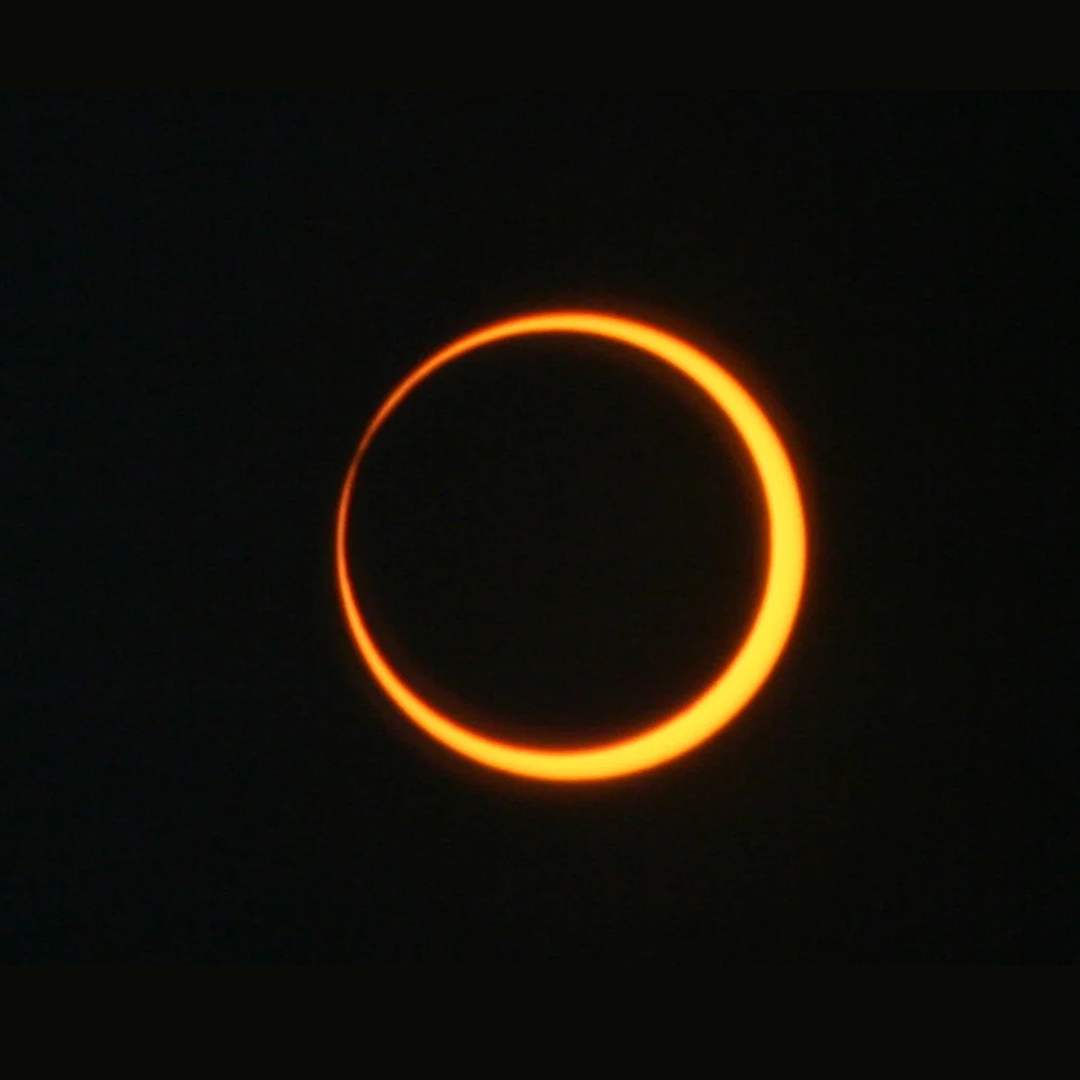
In case you’ve heard that a solar eclipse is occurring this month, it’s true, and it occurs on February 17. It’s an annular solar eclipse, meaning the Moon will not entirely block out the Sun’s disk, and will appear as a ring of light around the Moon as it eclipses the Sun.
Before you get too excited, the February 17 solar eclipse will not be visible in Chicago, or anywhere in North America. The full annular eclipse is visible only in Antarctica and the southern Indian Ocean. A partial solar eclipse is visible in limited locations in southern Africa and South America. If you’re located outside of the U.S., see if you can view the solar eclipse here.
February Moon Phases

Full Moon: February 1
Last Quarter Moon: February 9
New Moon: February 17—Lunar New Year
First Quarter Moon: February 24
Please note: these descriptions are for the Chicago area, using Central time.
Get More Stargazing Tips
Get more tips on what you can see in the February sky! Hunter explains how to see the planetary parade of six planets at the end of February, 2026. Don’t miss a chance to see Saturn, Mercury, Venus, Jupiter, Neptune, and Uranus.

Subscribe To Skywatch Wednesday This February
Tour the sky with the Adler Planetarium’s Theaters Manager, Nick, in Skywatch Wednesday. Nick uses cutting-edge visualizations, NASA images, and astrophotography to show you what you can see in the night sky throughout the year.
Check out Nick’s latest episode to guide you through the winter night sky. Learn what stars, planets, and constellations you can see in the winter of 2025–2026. Discover how to find famous winter constellations like Orion, Taurus, Auriga, Canis Major and Minor, and the planets Jupiter, Venus, Mercury, and even Saturn without its rings. Plus, see the lunar occultation of Regulus in February!
Happy Valentine’s Day “With Love, from the Man on the Moon”
Editor’s Note: This blog was originally published in 2019 and written by Carlyn Hill, Former Content Strategist. It has been updated with more current information.
The greatest love story on Earth didn’t take place on Earth at all—it happened 238,900 away from Earth on our celestial neighbor! In honor of Valentine’s Day, hear the grand romantic gesture Captain James A. Lovell Jr. made while orbiting the Moon on Apollo 8.
“You want the Moon? Say the word, and I’ll throw a lasso around it and pull it down.” Anyone who’s seen the 1946 film It’s a Wonderful Life knows this infamous line. But did you know that 50 years ago, an astronaut we all know and love actually made good on this larger-than-life promise in his own way?
If you want to be truly romantic this Valentine’s Day, take a note out of Captain James A. Lovell Jr.’s flight plans (and not just because “love” is in his name). Over fifty years ago, on Apollo 8, he became one of three astronauts to make history by becoming the first crew to orbit the Moon. But on that day, he also made history by making the greatest romantic gesture in the history of humankind.
While many families were with their families on Christmas Eve in 1968, Marilyn Lovell—along with millions of others—was listening to her husband and his crewmates read from the book of Genesis (a broadcast you can hear & watch in our Mission Moon exhibit!) while orbiting the Moon. In terms of long-distance relationships, the several days Lovell was in space is guaranteed to take the cake.
One of Lovell’s jobs on Apollo 8 was to look for distinctive lunar features in order to find suitable landing sites for the future crew that would eventually make the first Moon landing. He noticed a small, triangular mountain that had yet to be named, right on the Sea of Tranquility. Its location was perfect, right on the flight line of the proposed landing course for the future Apollo 11 mission and would make for the perfect descent point. In Lovell’s words,
“I named it ‘Mt. Marilyn’ after my wife and briefed the astronauts when I returned.”
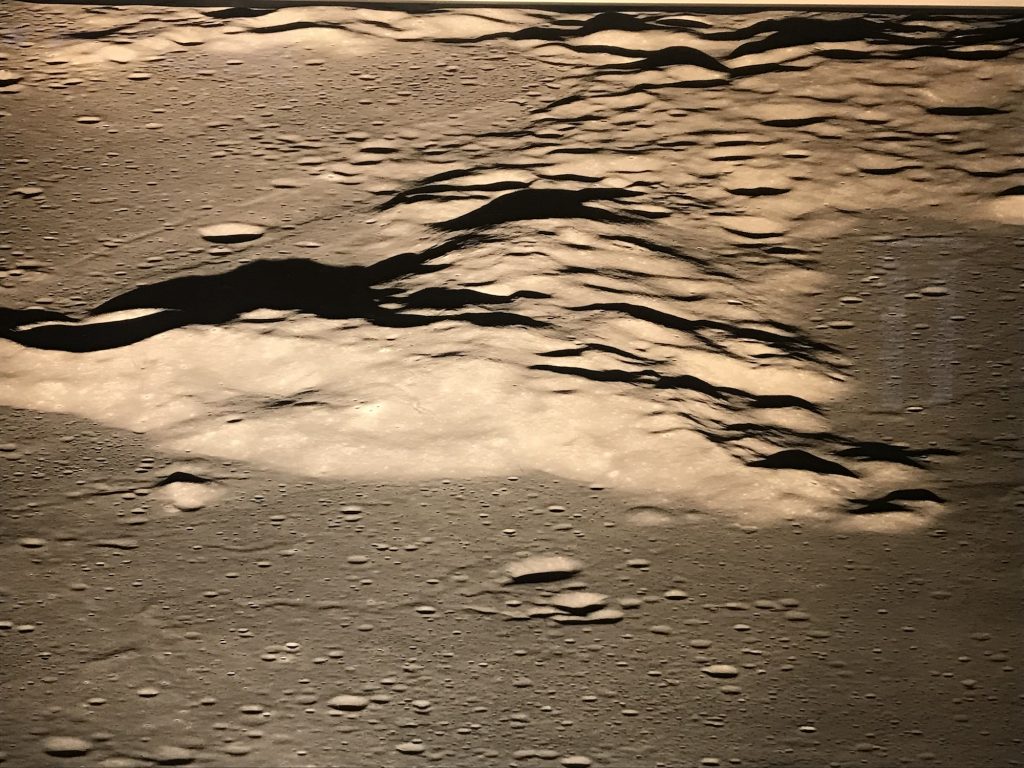
This is probably the closest you can get to actually throwing a lasso around the Moon for your loved one. This officially-named Moon feature will be referred to as Mt. Marilyn for generations. And sure enough, the Apollo 11 crew used Mt. Marilyn as their initial landing descent point for the Moon landing the next year!

We can’t all journey to the Moon and name craters, mountains, and ridges after our loved ones. But here’s another part of this Love(ll) story that we can try to apply to our gift-giving!
Before leaving on the Apollo 8 mission, Capt. Lovell arranged to have a fur coat delivered to his wife, Marilyn, on Christmas Day. So that on Christmas Eve—while he was seemingly worlds away—the gift was delivered to Marilyn with a note signed, “With love, from the Man on the Moon.”
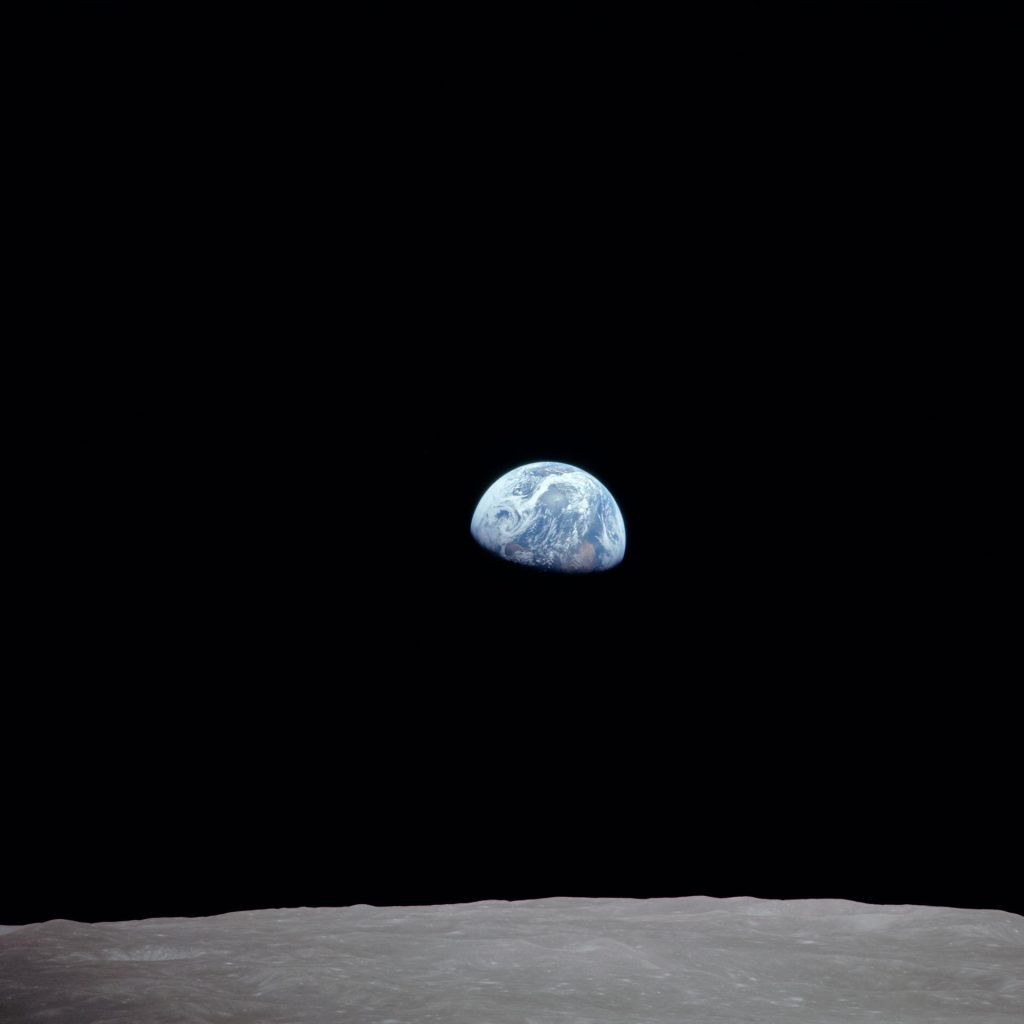
Space exploration may seem like the most out-of-this-world thing we can do. Space exploration is about testing the limits of our knowledge and abilities, expanding our perspective, bringing us all a little closer together, and better understanding the human place in the Universe.
At the end of one of the most turbulent decades in American history, it was a crew of three men in space who drew millions of people together. Perhaps that’s why a grand gesture of love taking place so far outside of our atmosphere is so striking—it shows that love truly has no limits.
Honoring The Life And Legacy Of Astronaut Jim Lovell
It is with incredibly heavy hearts that we share that Captain James A. Lovell Jr. passed away. NASA astronaut and lifelong friend of the Adler, Captain Lovell was one of our heroes. His work on the Apollo missions, his extraordinary leadership, and his grace under pressure inspired the whole world. His passion for space exploration—and the work he did to share it with generations of kids and adults—continues to inspire us every day. The Adler has had the great privilege of working closely with Capt. Lovell for more than a decade, caring for many of his personal artifacts, and sharing his story with all of you.
Give to the James A. Lovell Legacy Fund
Unique Chicago Date Ideas At The Adler Planetarium
Header image: a couple holds hands while looking at the Atwood Sphere in the Adler Planetarium’s exhibit, Chicago’s Night Sky.
Chicago is a city full of possibilities, opportunities, and adventures. But with so many options for places to go and things to do in Chicago, how do you find the perfect date spot amidst the lists of Chicago date ideas?
The Adler Planetarium is the perfect place for a unique date where you’ll get closer to your loved one—and the universe! While all of our exhibits and shows are worth seeing, we think these five are particularly well-suited for a memorable date under the stars. Here’s your guide to must-see spots at the Adler for a truly unique Chicago date—whether you’re testing your astrological compatibility or enjoying skyline views.
A Unique Chicago Date Idea At The Adler Planetarium
Stroll Through Space And Time At The Adler
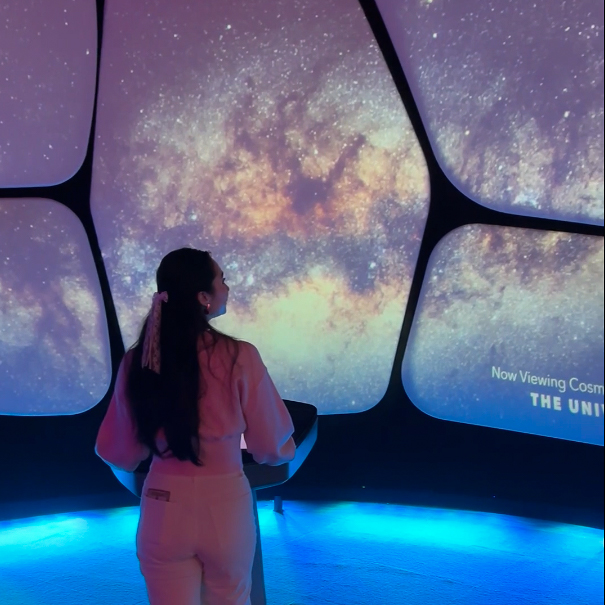
Image caption: A woman gazes at imagery of the universe on the giant visualization wall in the Adler Planetarium’s exhibit, The Universe: A Walk through Time and Space.
Where else in Chicago can you take a romantic walk through space and time?
In our exhibit, The Universe: A Walk through Time and Space, you’ll walk through the timeline of the universe, guided by immersive lights, sounds, and space visualizations. Then, you’ll look at things with a new perspective, zooming in on the smallest atoms and zooming out to the massive expanse of a galaxy on our giant visualization wall.
By the end of the exhibit, you’ll realize just how special it is that you two found each other in this massive, ever-expanding universe.
The Perfect Indoor Stargazing Experience In Chicago
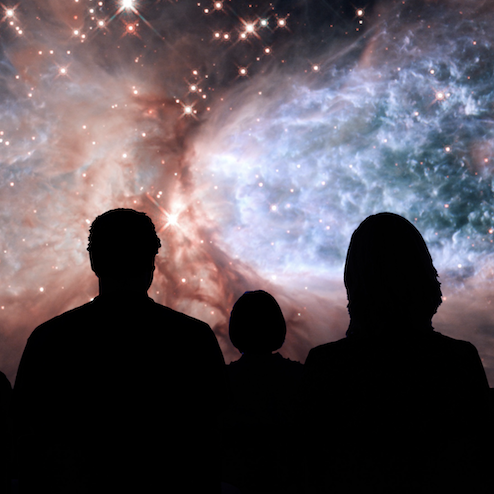
Image caption: Three silhouettes in front of a blue and pink image of a nebula in one of the dome theaters at the Adler Planetarium.
There’s nothing more romantic than stargazing, but in Chicago, the light pollution outshines the stars. Luckily, at the Adler you can take your date stargazing without having to leave the city!
Skywatch Live is an immersive dome theater show that turns down the city lights and cranks up the stars so you and your date can appreciate the night sky like never before. This guided show takes you from the Chicago skyline, straight into outer space. You’ll learn what you can see in the night sky and even travel to see some distant planets.
Step inside the dome theater, get comfy, and immerse yourself in breathtaking space visualizations.
Feel The Thrill Of A Spacewalk Together
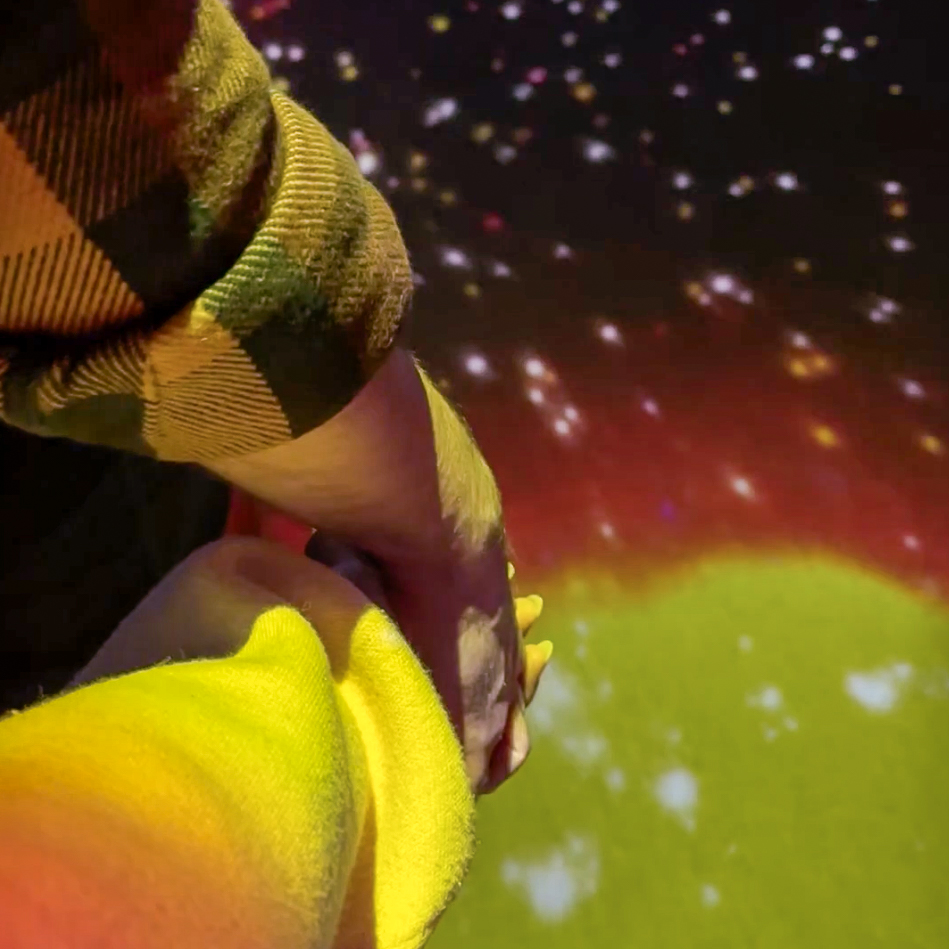
Image caption: A couple holding hands at the Adler Planetarium beneath colorful lights and stars.
Planet Explorers—our interactive exhibit for kids ages 3–8—might not sound like an obvious stop on a Chicago date. But tucked inside the spaceship is one of the Adler Planetarium’s hidden gems for adults: the Spacewalk Experience.
Hold your date’s hand tight as you step into this immersive space simulator. Whether you’re facing your greatest fears, chasing a thrill, or exploring your desire for space travel, this will get your adrenaline pumping!
Fun fact: Did you know that adrenaline is one of the hormones involved in creating feelings of attraction and emotional bonding? So if you’re looking for a Chicago date idea that will truly bring you closer, this might be your moment.
Explore Astrological Compatibility Together

Image caption: Inside the Adler Planetarium’s exhibit, Stars Aligned.
At the start of relationships, things can feel so wonderful that it’s as if your love was written in the stars. In Stars Aligned, our newest exhibit exploring the history of astronomy and astrology, you can see if it actually was!
Astrology has played an important role in our understanding of space. Explore the stars’ role in early modern people’s decision-making—including romantic compatibility and choosing wedding dates. You and your date will be able to decide for yourself if your relationship’s horoscope is worth listening to.
Enjoy Chicago’s Museum Campus And Skyline Views

Image caption: A couple sitting on the sidewalk outside the Adler Planetarium, enjoying the view of Lake Michigan and the Chicago skyline.
It wouldn’t be a true Chicago date if you can’t enjoy the beauty of the city. The Adler Planetarium’s location on the Museum Campus gives you everything you’re looking for on a date in the city: Lake Michigan and one of the most iconic Chicago skyline views.
Whether you’re visiting during the day or our evening hours on Wednesday nights, at the Adler you’ll get to enjoy both the beauty of space and Chicago. After your visit, take a stroll hand-in-hand along the lake, dip your toes in Lake Michigan, and don’t forget to commemorate the day with a picture in front of the best view in Chicago.
Plan your next Chicago date at the Adler Planetarium—get tickets today!
- Follow Us!


VISIT
1300 S. DuSable Lake Shore Dr.
Chicago, IL 60605
Open Today From 4pm – 10pm
*Last admission one hour before close.*
SUPPORT
We all have the potential to discover something great. Help the Adler unlock the potential in every mind with a tax-deductible gift.