Adler Skywatch: March 2026
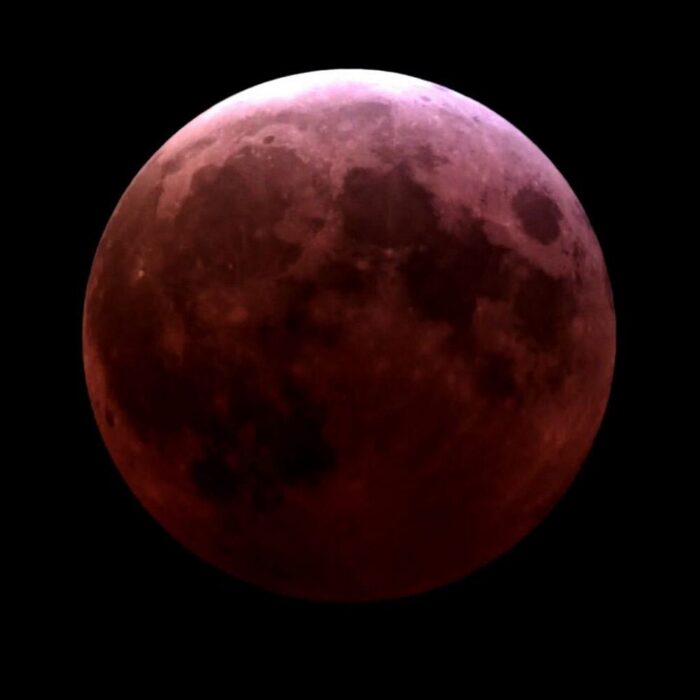
Image Caption: The March 13-14, 2025 lunar eclipse at totality. The full Moon appears to be a dark brick red as the Earth’s shadow covers it. Image credit: Adler Planetarium
The Moon temporarily disappears early this month, and the Sun is in the sky longer each day in March. What else can you see in the sky this month?
Here’s your guide on what to see in the sky in March 2026!
Total Lunar Eclipse
A few hours before sunrise on March 3, the Chicago area gets to experience a total eclipse of the Moon, as the Moon’s orbit takes it into and through the Earth’s shadow cast into space.
How To See The March Lunar Eclipse
In Chicagoland, this lunar eclipse officially starts at 2:44 am CST, when the Moon is not quite 40 degrees high in the west-southwest sky.
As the Moon moves into the Earth’s lighter outer penumbra shadow, we’ll see a barely noticeable darkening of the Moon.
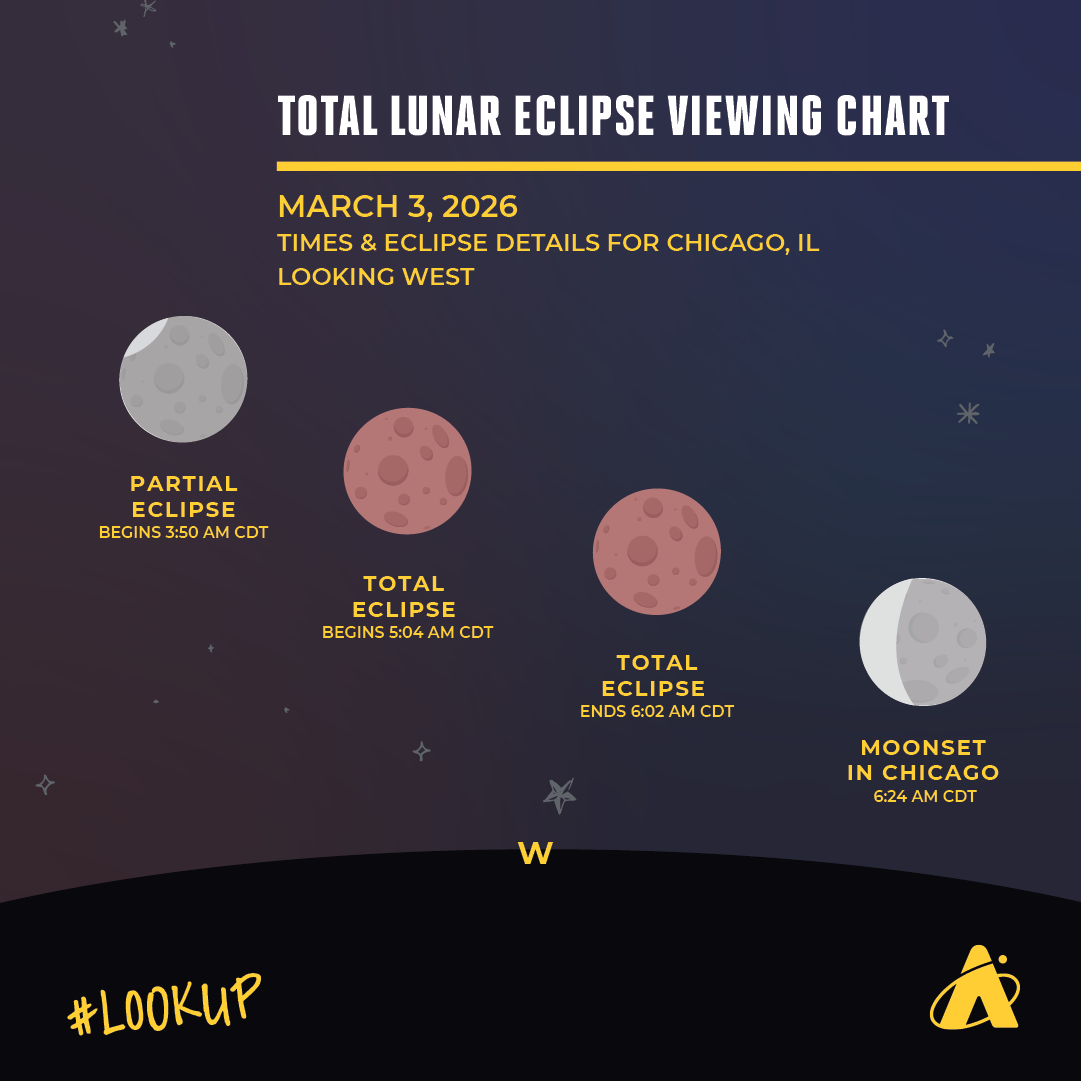
At around 3:50 am, when the Moon is just under 30 degrees high in the southwestern sky, the partial phase of the lunar eclipse starts as the Moon begins to move into the Earth’s darker inner umbral shadow. A larger portion of the Moon gradually becomes visibly darker.
When Does the Total Lunar Eclipse Start?
The total phase of the eclipse starts at 5:04 am in the Chicago area. During totality, the Moon is only about 15 degrees above the western horizon, and the Full Moon may take on a deep reddish tint, commonly called a “blood moon.” A totally eclipsed Moon can appear to be brown, orange, or gray—we’ll have to wait and see what color we get.
The midpoint of totality in the Chicago area is at 5:33 am. By this time, the Moon is less than ten degrees above the western horizon. The total eclipse ends at 6:02 am in the Chicago area, the Moon will be just three degrees above the western horizon then, so you will need a perfectly clear view to the west to see it.
When Does the Lunar Eclipse End?
The Moon will set for Chicagoland just before 6:30 am, as the Moon starts to exit the Earth’s shadow. So scope out your eclipse viewing spot ahead of time for an open westerly view—or visit the west coast, where the eclipse is higher in the sky.
To dive more into the explanation of both solar and lunar eclipses, check out our blog Solar Eclipses and Lunar Eclipses Explained.
All the eclipse times here are in Central Standard Time.
Central Daylight Time Begins
Don’t forget to reset your clocks! On March 8 at 2:00 am, Central Daylight Time begins. On this date, clocks spring forward one hour. We’ll get that lost hour back later this year, on November 1, 2026.
Spring Equinox
The winter months are known for long nights and short days. But since the start of the winter season, the amount of daylight has been increasing a bit each day.
On March 20, at 9:46 am CDT, we reach the vernal equinox, also called the spring equinox, the first day of astronomical spring in the northern hemisphere. On the equinox, daytime and nighttime hours are of roughly equal length.
Chicagohenge
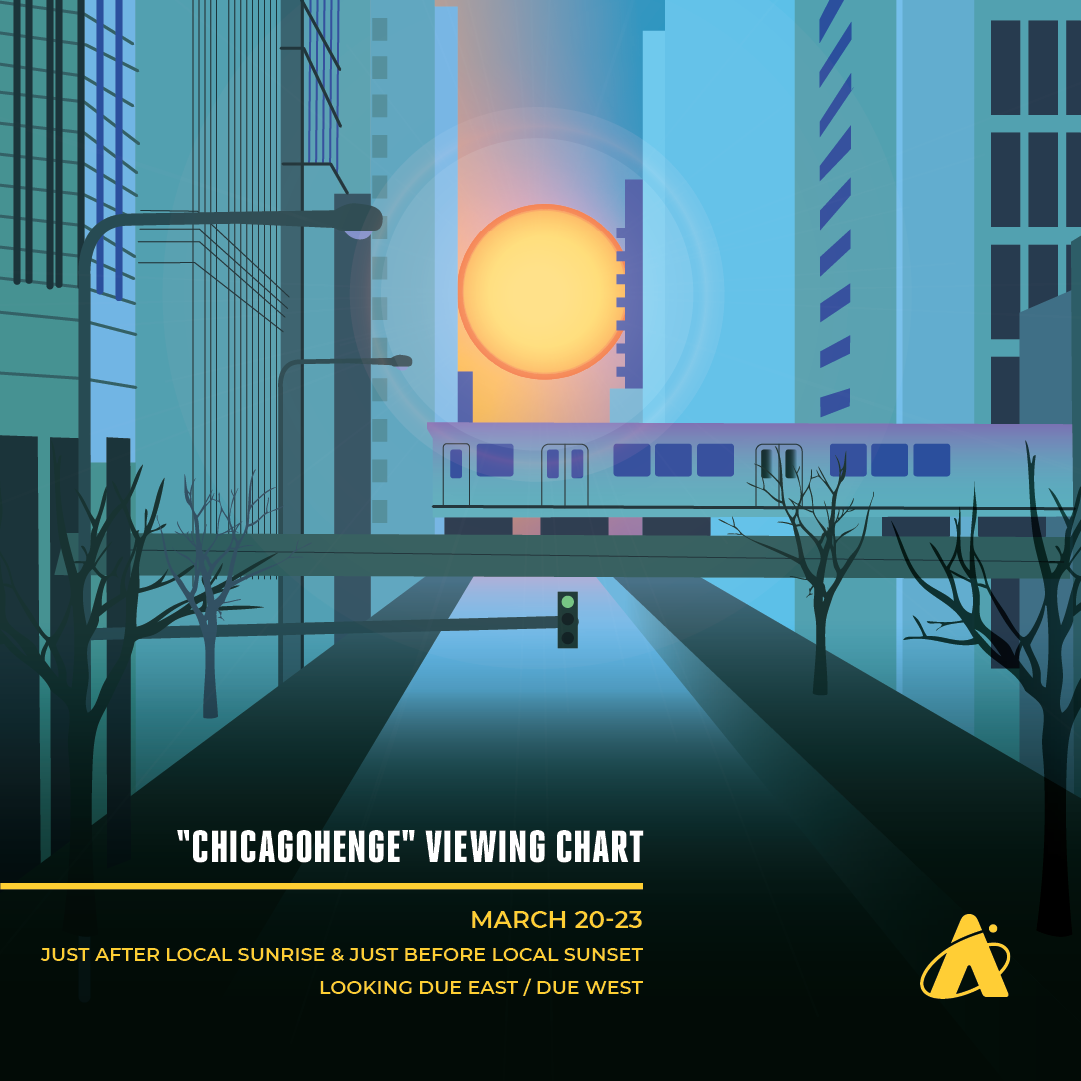
In Chicago, try spotting the Chicagohenge phenomenon around the equinox, when the rising and setting Sun aligns with Chicago’s east-west running streets. It’s especially visible in the Loop area due to skyscrapers creating a canyon effect.
Just remember to never look directly at the Sun, or you risk permanent eye damage.
March Moon Phases
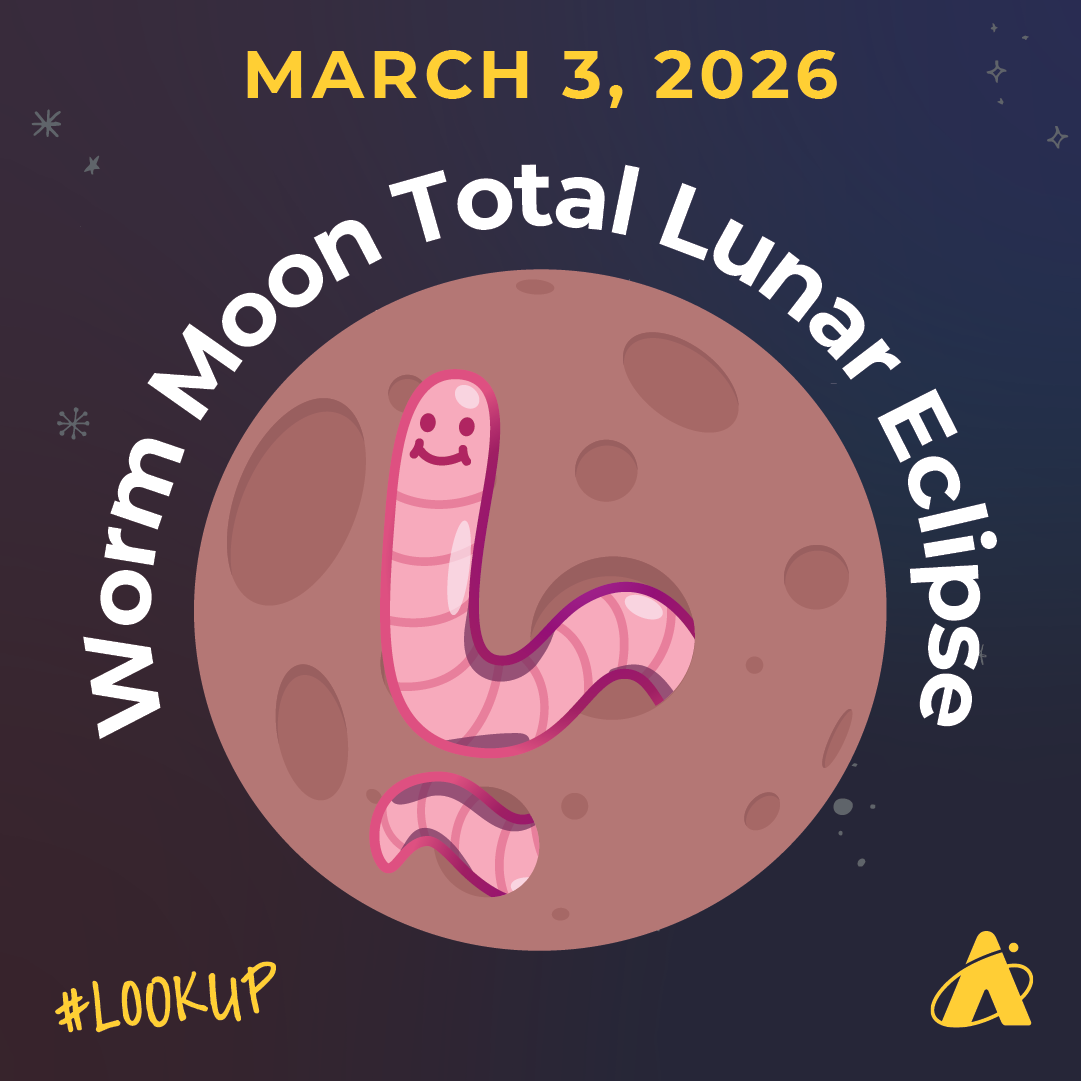
Full Moon: March 3
Last Quarter Moon: March 11
New Moon: March 18
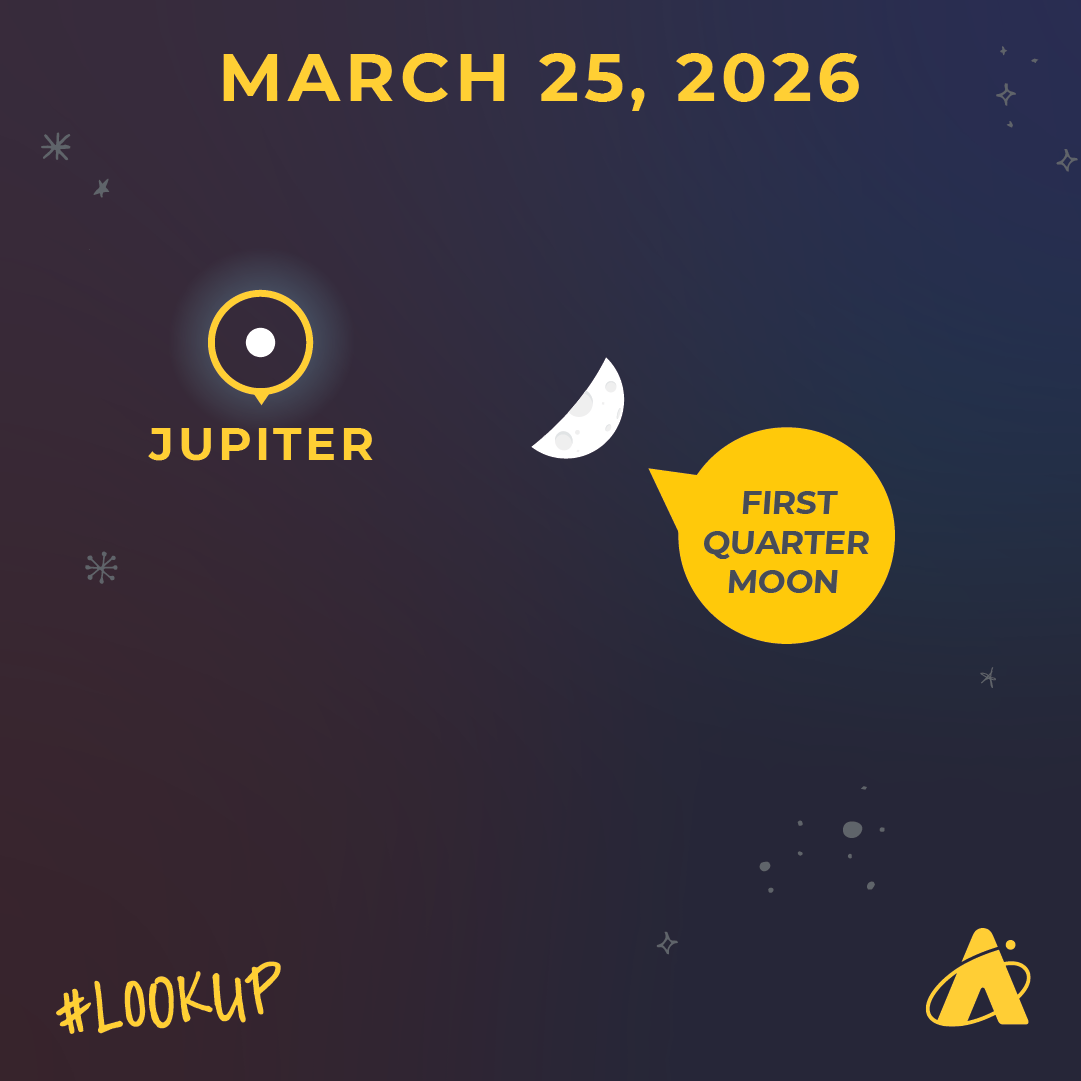
First Quarter Moon: March 25
Please note: these descriptions are for the Chicago area, using Central time.
Visible Planets In March 2026
How To See Venus
This month, the brightest planet, Venus, starts to move further away from the glare of the Sun and higher into the early-evening sky. It shines brighter than -3.9 magnitude all month long.
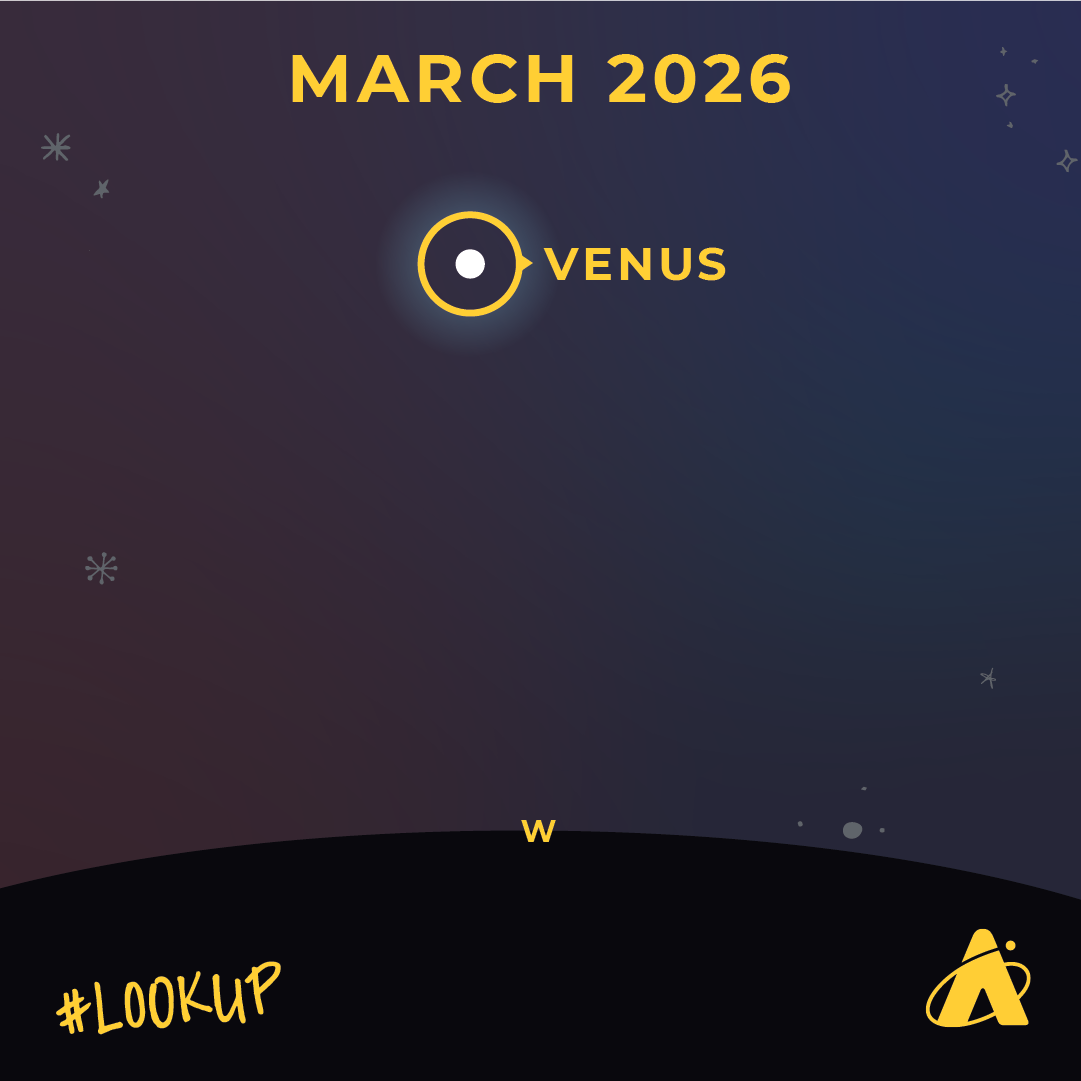
You’ll need to wait until the Sun has fully set in the west to look for it—but once the Sun is below the horizon, Venus may be visible extremely low in the west. By month’s end, it’s far enough away from the Sun in the sky to be visible about a half-hour after sunset.
How To See Jupiter
The second-brightest planet, Jupiter, rises each day this month while the Sun is still in the sky. Once evening twilight sets in, start looking for it high in the south-southeast sky early in the month, and high in the southern sky later in the month.
It’s not as bright as Venus, but brighter than minus-two magnitude, easily outshining all the stars. It sets in the west-northwest around 3:30 am. Central Standard time at the start of the month, around 4:00 am CDT on March 8, and around 3:00 am CDT by month’s end.
When Jupiter is due south in the sky, look about 40 degrees below it to see Sirius, the brightest star in the sky, which is not quite minus-1.5 magnitude in brightness.
The planets Mars, Mercury, and Saturn appear so close to the Sun this month that they will be difficult, if not impossible, to see.
Our Astronomy Educators Explain Lunar Eclipses
Learn about what happens during a lunar eclipse and watch as the Moon passes through the Earth’s shadow during a previous total lunar eclipse in a prior episode of Sky Observers Hangout.
This episode was streamed live from the campus of Southern Illinois University Carbondale on March 14, 2025.