Space Visualization Lab
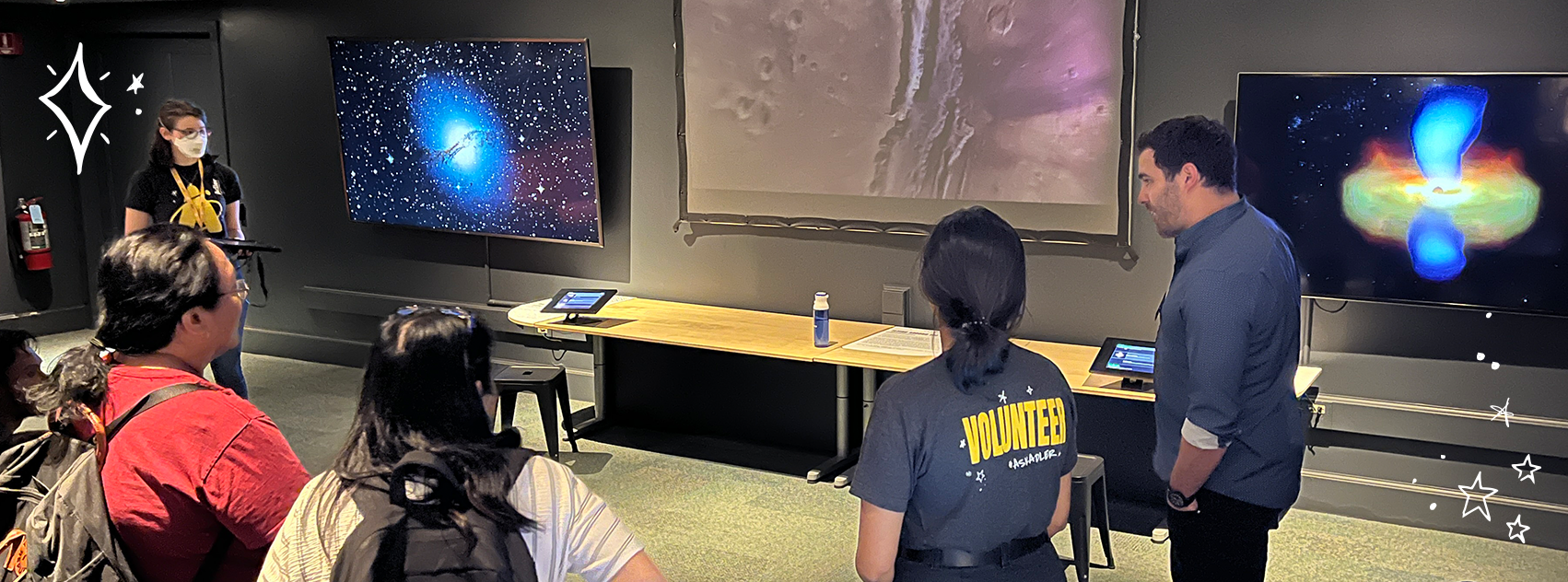
Talk to astronomers about cutting-edge research and experience awe-inspiring visualizations!
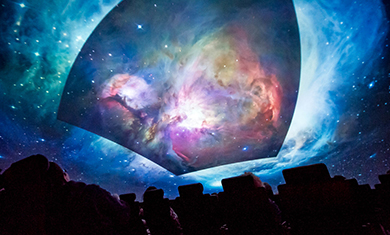
In this working laboratory, scientists, technology experts, artists, and educators work together to create new ways for people to virtually explore the universe. Since its inauguration in 2007, the Space Visualization Lab has brought cutting-edge research from scientists in the most prominent institutions around the country, as well as immersive and interactive technologies to the museum floor. In the Space Visualization Lab, visitors can experience new interactive and immersive visualizations and attend presentations by astronomers and related researchers featuring these visualizations.
Astronomy Conversations
Location: Located on the Lower Level in between the entrances to the Community Stargazers Hub, and Telescopes: Through The Looking Glass exhibitions
As the featured program inside the Space Visualization Lab (SVL), Astronomy Conversations hosts Adler researchers and visiting scientists to engage museum guests about their research, complemented by SVL visuals, but lets the museum guests steer the conversation towards any astronomical topic they are interested in.
Having practicing scientists interact with museum guests in this space helps to disseminate cutting-edge astronomical research while adding a crucial human element to scientific research and making space science more accessible. Perfect for museum guests of all ages
Upcoming Adler Researchers & Visiting Scientists
Thursday, April 30, 2026 (11:00 am–12:00 pm)
Dr. Michael Zevin (Adler Planetarium): Gravitational Waves, Compact Objects, Stellar Evolution, General Astronomy
Saturday, May 2, 2026 (11:00 am–1:00 pm)
Beryl Hovis-Afflerbach (Northwestern University): Massive Stars, High-redshift Galaxies
Nathalie Korhonen Cuestas (Northwestern University): Galaxy Evolution
Wednesday, May 6, 2026 (6:00 pm–8:00 pm)
Dr. Tim Miller (Northwestern University): Observational Galaxy Evolution
Dr. Lily Zhao (University of Chicago): Exoplanets
Thursday, May 7, 2026 (11:00 am–12:00 pm)
Dr. Nycole McGreevy (Adler Planetarium): Radio Astronomy, Galactic Center
Saturday, May 9, 2026 (special time – 1:00 pm–4:00 pm)
Achintya Krishnan (University of Illinois Urbana-Champaign): Cosmic Microwave Background
Yashasvi Moon (University of Illinois Urbana-Champaign): Black Holes
Tanner Murphey (University of Illinois Urbana-Champaign): Supernova Observations
Liam Nolan (University of Illinois Urbana-Champaign): Binary Active Galactic Nuclei
Wednesday, May 13, 2026 (6:00 pm–8:00 pm)
Dr. John Hood (University of Chicago): Active Galactic Nuclei, Experimental Cosmology, Transients
Emily Simon (University of Chicago): Supernovae, Particle Physics
Thursday, May 14, 2026 (11:00 am–12:00 pm)
Dr. Shanika Galaudage (Adler Planetarium / Northwestern University): Gravitational Waves, Compact Objects
Saturday, May 16, 2026 (11:00 am–1:00 pm)
Dr. Amy Bender (Argonne National Lab): Cosmic Microwave Background, Cosmology
Dr. John Hood (University of Chicago): Active Galactic Nuclei, Experimental Cosmology, Transients
Wednesday, May 20, 2026 (6:00 pm–8:00 pm)
Ryn Grutkoski (University of Chicago): Theoretical Cosmology
Elizabeth Mone (Northwestern University): Cosmology, Black Holes, Galaxy Evolution
Thursday, May 21, 2026 (11:00 am–12:00 pm)
Dr. Cliff Johnson (Adler Planetarium): Citizen Science, Star Formation
Saturday, May 23, 2026 (11:00 am–1:00 pm)
To be announced
Wednesday, May 27, 2026 (6:00 pm–8:00 pm)
To be announced
Saturday, May 30, 2026 (11:00 am–1:00 pm)
Dr. Lindsay Kwok (Northwestern University): Supernovae
Worldwide Telescope
Worldwide Telescope (WWT) is an open-source visualization software package that enables your computer to function as a virtual telescope. Adler SVL staff have contributed to the content and development of WWT. Worldwide Telescope was used to create the Adler’s former sky show, Cosmic Wonder, and it powers several exhibits throughout the museum.